You're all caught up—no notifications available.
Explore All Exams at KGS


All Exams
Explore All Exams at KGS

Khan Sir Courses
Geography I Polity I History | World Map I Indian Map I Economics I Biology

UPSC & State PSC
UPSC I BPSC I UP-PSC I MP-PSC

State Exams
UP I Bihar I MP | Rajasthan

NEET | JEE | CUET
NEET | JEE | CUET

Defence Exams
NDA I CDS I CAPF I AFCAT I SSB I Agniveer

Police Exams
UP SI | Bihar SI | Delhi Police | UP Constable

SSC Exams
CGL I CPO I CHSL I MTS I SSC GD I Delhi Police

Foundation Courses
Physics I Chemistry I Biology I History I Geography I Polity I NCERT I Math I English | Map I Reasoning

Railway Exams
RRB | RPF

Teaching Exams
TET | Teaching | UGC

Banking Exams
SBI | RBI | IBPS

Engineering Exams
Civil | Electrical | Mechanical
UGC NET
UGC NET/JRF
Current Affairs provides you with the best compilation of the Daily Current Affairs taking place across the globe: National, International, Sports, Science and Technology, Banking, Economy, Agreement, Appointments, Ranks, and Report and General Studies

SYLLABUS
GS-2: Important International institutions, agencies and fora - their structure, mandate.
Context: The Stockholm International Peace Research Institute (SIPRI) released its latest report on trends in global military expenditure in April 2026, highlighting the evolving nature of global security dynamics.
More on the News
• The report underscores the continued rise in military spending amid persistent geopolitical tensions such as the Russia–Ukraine conflict, intensifying Indo-Pacific competition, and renewed focus on NATO rearmament and European security concerns.
• It reflects a broader global trend of increasing militarisation driven by uncertainty in the international order and rising strategic rivalries among major powers.
Key Findings
(A) Global Trends
• The global military expenditure rose by 2.9% in real terms to reach $2887 billion in 2025, which was the 11th consecutive year of growth.
• The global spending reflects a 41% increase over the decade (2016–25), marking the continuation of a sustained upward trajectory in global defence spending.
• Military spending as a share of global GDP increased from 2.4% in 2024 to 2.5% in 2025, the highest level recorded since 2009, indicating rising prioritisation of defence in national economies.
• Defence expenditure constituted approximately 6.9% of total global government spending, while per capita military spending reached $352, highlighting the growing burden of militarisation on public finances.
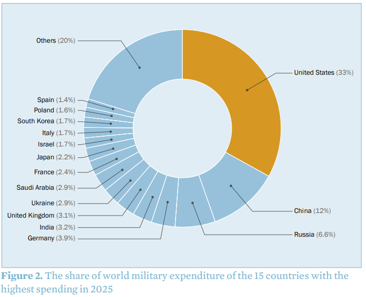
• The five biggest spenders in 2025 were the United States, China, Russia, Germany and India, which together accounted for 58% of world military spending.
• The United States remained the largest military spender at $954 billion, accounting for a third of all military spending in 2025.
• The US registered a decline of around 7.5% in 2025, while China ($336 billion, +7.4%) and Russia ($190 billion, +5.9%) continued to expand their defence budgets steadily.
(B) Regional Trends
• Europe: Europe recorded the highest regional increase in military expenditure, with spending rising by 14% to $864 billion, driven primarily by the Russia–Ukraine conflict and enhanced NATO defence commitments.
• Asia and Oceania: Military spending in Asia and Oceania grew by 8.1% to $681 billion, marking the fastest growth since 2009, largely due to China’s military modernisation and rising defence investments by countries such as India, Japan, and Taiwan.
• Middle East: Military expenditure in the Middle East remained relatively stable at $218 billion, reflecting a phase of consolidation amid evolving regional security dynamics.
• Africa: Africa witnessed an increase of 8.5% in military spending to $58.2 billion, driven by internal security challenges, counter-terrorism operations, and regional instability.
India-Specific Findings
(A) Global Ranking and Expenditure Levels
• India ranked as the 5th largest military spender globally in 2025, with total expenditure estimated at around $92.1 billion.
• The country recorded an increase of approximately 8.9% in military spending compared to the previous year.
(B) Key Drivers of Defence Spending
• India’s military expenditure is primarily driven by border tensions with China along the Line of Actual Control and ongoing security concerns with Pakistan.
• The need to maintain preparedness on both western and northern fronts has significantly influenced defence allocations.
• The government’s push for ‘Atmanirbhar Bharat’ in defence has led to increased investments in domestic manufacturing and defence research.
Implications of Rising Military Expenditure
• Global Security Paradox: The continuous rise in military expenditure reflects a paradox wherein increased spending does not necessarily ensure peace but instead often intensifies mistrust and strategic competition among nations.
• Economic Trade-offs and Developmental Impact: Rising defence budgets divert resources away from critical sectors such as health, education, and infrastructure, potentially hindering progress toward Sustainable Development Goals.
• Risk of Regional Arms Race: The growing trend of militarisation increases the likelihood of arms races, particularly in Europe and the Indo-Pacific, thereby escalating regional tensions and instability.
• Emergence of a Competitive Multipolar Order: Increasing military expenditure signifies a shift toward a multipolar world order characterised by competitive power dynamics rather than cooperative global governance.
About the Stockholm International Peace Research Institute (SIPRI)
• It is an independent international institute dedicated to research on issues related to conflict, armaments, arms control, and disarmament.
• SIPRI was established in 1966, and it provides data, analysis, and recommendations based on open sources.
• It is widely regarded as a credible source of global security data and publishes authoritative resources such as the SIPRI Yearbook and Military Expenditure Database.
• Headquarters: Stockholm, Sweden.
SOURCES
SIPRI
SIPRI
Times Of India
The most trusted learning platform on your phone
With our training programs, learning online can be a very exciting experience! Take the next step toward achieving your professional and personal objectives



Course Related Query:
Ask Your DoubtsStore Related Query:[email protected]NCERT Books
Resources
We love learning. Through our innovative solutions, we encourage ourselves, our teams, and our Students to grow. We welcome and look for diverse perspectives and opinions because they enhance our decisions. We strive to understand the big picture and how we contribute to the company’s objectives. We approach challenges with optimism and harness the power of teamwork to accomplish our goals. These aren’t just pretty words to post on the office wall. This is who we are. It’s how we work. And it’s how we approach every interaction with each other and our Students.
Come with an open mind, hungry to learn, and you’ll experience unmatched personal and professional growth, a world of different backgrounds and perspectives, and the freedom to be you—every day. We strive to build and sustain diverse teams and foster a culture of belonging. Creating an inclusive environment where every students feels welcome, appreciated, and heard gives us something to feel (really) good about.
Get Free academic Counseling & Course Details