logo

All Exams

Notifications

All Exams

Explore All Exams at KGS

All Exams
Home>Current Affairs>WHO Prequalifies First-Ever Malaria Treatment for Newborns and Infants
Current Affairs made simple.

Current Affairs provides you with the best compilation of the Daily Current Affairs taking place across the globe: National, International, Sports, Science and Technology, Banking, Economy, Agreement, Appointments, Ranks, and Report and General Studies

banner-image

WHO Prequalifies First-Ever Malaria Treatment for Newborns and Infants

SYLLABUS

GS-2: Important International institutions, agencies and fora - their structure, mandate.

GS-3: Science and Technology- Developments and their Applications and Effects in Everyday Life.

Context: The World Health Organization has prequalified the first-ever malaria treatment specifically designed for newborns and young infants, marking a major milestone in global health.

More on the News
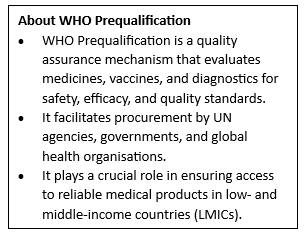
  • Malaria continues to be a major cause of illness and death globally, particularly among children in sub-Saharan Africa, with 249 million cases and 608,000 deaths reported in 2022, nearly 80% of which occurred in children under five.
  • A critical gap existed in malaria treatment, as no age-appropriate formulations were available for infants below 5 kg, leading to reliance on adjusted doses of drugs meant for older children, raising concerns of safety and efficacy.
  • The WHO has now prequalified a new infant-specific formulation of artemether-lumefantrine, enabling safe, effective treatment and facilitating its global procurement and deployment.
  • In addition, WHO has prequalified three new rapid diagnostic tests (RDTs) designed to overcome challenges such as HRP2/HRP3 gene deletions, which previously led to false-negative malaria diagnoses.
  • This combined advancement in targeted treatment and improved diagnostics significantly strengthens global malaria control efforts by enabling more accurate detection and safer management of the disease in vulnerable populations.

About the New Treatment

  • The newly prequalified drug is a baby-friendly formulation of artemether-lumefantrine (Coartem® Baby), developed by Novartis in collaboration with Medicines for Malaria Venture.
  • It is the first antimalarial treatment specifically designed for newborns and infants weighing between 2–5 kg.
  • The formulation allows for accurate dosing and improved safety, addressing risks associated with off-label use of adult or paediatric drugs.
  • It is designed to be easily administered (e.g., dispersible in liquids such as breast milk), ensuring better compliance and ease of use.
  • The drug meets WHO standards and is expected to be supplied on a largely not-for-profit basis, enhancing affordability in endemic regions.

Significance

  • Addressing a Critical Treatment Gap: The availability of an infant-specific antimalarial formulation eliminates the need for dose adjustments of adult medicines, thereby reducing risks of toxicity and ineffective treatment.
  • Reducing Infant Mortality: By targeting one of the most vulnerable groups, the intervention has the potential to significantly reduce malaria-related deaths among infants, especially in high-burden regions.
  • Strengthening Global Malaria Control: The combined advancement in treatment and diagnostics enhances early detection and effective case management, supporting global malaria elimination efforts.
  • Promoting Equity in Healthcare: The availability of safe, affordable, and appropriate treatment improves equitable access to healthcare, particularly in low-resource settings.
  • Encouraging Innovation in Neglected Diseases: The development reflects the success of public-private partnerships in addressing neglected tropical diseases through targeted research and innovation.

About Malaria

  • Malaria is a life-threatening disease caused by Plasmodium parasites, transmitted through the bites of infected female Anopheles mosquitoes.
  • There are 5 Plasmodium parasite species that cause malaria in humans, and 2 of these species – P. falciparum and P. vivax – pose the greatest threat.
  • Symptoms include fever, chills, headache, and fatigue, which can progress to severe complications if untreated.
  • The disease is most prevalent in tropical and subtropical regions, particularly in Africa, South-East Asia, and parts of South America.
  • Prevention strategies include vector control (insecticide-treated nets, indoor spraying), chemoprevention, and vaccination efforts (e.g., RTS,S vaccine).

Malaria Prevalence in India

  • India has made significant progress in malaria control, with cases declining from about 11.7 lakh in 2015 to about 2.27 lakh in 2023, and further to around 2 lakh cases in 2025.
  • Malaria-related deaths have also reduced sharply from 384 (2015) to 83 (2023) and around 50–80 annually in recent years, indicating improved case management.
  • India contributes approximately 1–3% of the global malaria burden, but remains the largest contributor in the WHO South-East Asia Region.
  • Over 90% of districts now report low transmission levels (API < 1), placing India in the pre-elimination phase, though hotspots persist in tribal, forested, and northeastern regions.
  • In 2024, India exited the WHO’s High Burden to High Impact (HBHI) group, reflecting a significant decline in malaria cases and deaths.

Initiatives Taken for Control and Elimination
  • National Malaria Control Programme (NMCP), 1953: Launched in 1953 with strategies of indoor residual spraying (DDT), surveillance, and treatment, and later transformed into the National Malaria Eradication Programme (NMEP) in 1958.
  • National Centre for Vector Borne Disease Control (NCVBDC): Serves as the nodal body (earlier NVBDCP) for prevention and control of vector-borne diseases, including malaria, with a focus on integrated vector management and surveillance.
  • National Framework for Malaria Elimination (2016–2030): Provides the national roadmap targeting zero indigenous malaria cases by 2027 and complete elimination by 2030.
  • National Strategic Plan for Malaria Elimination (2023–2027): Focuses on universal access to diagnosis and treatment, strengthened surveillance, and targeted interventions in high-burden districts to accelerate malaria elimination.
footer image

The most trusted learning platform on your phone

With our training programs, learning online can be a very exciting experience! Take the next step toward achieving your professional and personal objectives


app-storeplay-store
logo
Khan Global Studies Pvt. Ltd. 5th Floor,
A13A, Graphix 1 Tower B, Sector 62,
Noida, Uttar Pradesh 201309

Course Related Query:

Ask Your DoubtsStore Related Query:[email protected]

Get Free Academic Counseling & Course Details

KGS best learning platform

About Khan Global Studies

We love learning. Through our innovative solutions, we encourage ourselves, our teams, and our Students to grow. We welcome and look for diverse perspectives and opinions because they enhance our decisions. We strive to understand the big picture and how we contribute to the company’s objectives. We approach challenges with optimism and harness the power of teamwork to accomplish our goals. These aren’t just pretty words to post on the office wall. This is who we are. It’s how we work. And it’s how we approach every interaction with each other and our Students.


What Makes Us Different

Come with an open mind, hungry to learn, and you’ll experience unmatched personal and professional growth, a world of different backgrounds and perspectives, and the freedom to be you—every day. We strive to build and sustain diverse teams and foster a culture of belonging. Creating an inclusive environment where every students feels welcome, appreciated, and heard gives us something to feel (really) good about.

Copyright 2026 KhanGlobalStudies

Have a question?

Get Free academic Counseling & Course Details

floatButton