logo

All Exams

Notifications

All Exams

Explore All Exams at KGS

All Exams
Home>Current Affairs>Solid Fuel Ducted Ramjet (SFDR) Technology
Current Affairs made simple.

Current Affairs provides you with the best compilation of the Daily Current Affairs taking place across the globe: National, International, Sports, Science and Technology, Banking, Economy, Agreement, Appointments, Ranks, and Report and General Studies

banner-image

Solid Fuel Ducted Ramjet (SFDR) Technology
SYLLABUS

GS-3: Achievements of Indians in science & technology; indigenisation of technology and developing new technology.

Context: Recently, the Defence Research & Development Organisation (DRDO) has successfully conducted a trial of its indigenously developed Solid Fuel Ducted Ramjet (SFDR) propulsion technology.

More on the News

  • This marks a major milestone in India’s effort to develop long-range air-to-air missiles with superior performance.
  • The demonstration was conducted at the Integrated Test Range (ITR), Chandipur, nearly four years after the previous test, with earlier trials beginning in 2018.
  • The SFDR has been developed by Defence Research and Development Laboratory (DRDL),Hyderabad, in collaboration with other DRDO laboratories.

About Solid Fuel Ducted Ramjet (SFDR) Technology

  • It is a next-generation propulsion technology developed for long-range air-to-air missiles.
  • It enables fighter aircraft to engage enemy targets beyond visual range (BVR), significantly increasing air combat reach.
  • Unlike conventional rocket motors that carry both fuel and oxidiser, SFDR uses solid fuel while drawing oxygen from the atmosphere for combustion.
  • This fundamental difference allows the missile to sustain supersonic speeds for a much longer duration during its flight.
  • It can also be adapted for surface-to-air missile systems, thereby strengthening India’s overall air defence architecture.
  • SFDR-powered missiles offer exceptional operational parameters:
  • Engagement range: between 50 km to 340 km
  • Speed: Mach 2 to Mach 3.8
  • Operational altitude: Sea level up to 20 km
  • Vertical manoeuvre capability: Up to 10 km
  • This combination of range, speed, and agility makes enemy aircraft significantly harder to evade, providing Indian fighter jets with a decisive aerial combat advantage.

Working of the SFDR Propulsion System

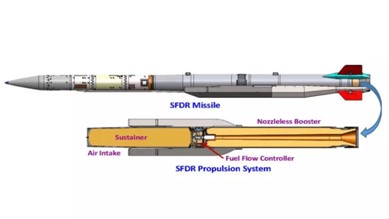
  • Nozzle-less booster: The missile is rapidly accelerated to supersonic speeds within about three seconds using a nozzle-less booster, ensuring safe and efficient air-launched ignition.
  • Solid fuel ducted ramjet sustainer: After boost, a boron-based solid fuel ramjet ignites, burning onboard fuel with atmospheric oxygen to enable sustained powered flight for 50–200 seconds depending on altitude.
  • Hot gas valve: An indigenously developed hot gas valve precisely regulates combustion gases according to speed and altitude using advanced high-temperature materials.
  • Air intakes: Cheek-mounted air intakes compress incoming air efficiently to maintain continuous combustion throughout the flight envelope.
  • Advanced onboard systems: Integrated guidance, navigation, seekers, secure data links, and high-torque actuators ensure accurate targeting, complemented by a proximity-fused fragmentation warhead for enhanced lethality.

Significance for India

  • Indigenous Technological Capability: The successful SFDR demonstration marks a major milestone in India’s indigenous missile development by demonstrating mastery over complex long-range propulsion technologies previously possessed by only a few countries, such as the US, Russia, and France.
  • Expansion of the No-Escape Zone (NEZ): By providing sustained thrust instead of losing speed after burnout like conventional missiles, SFDR significantly enlarges the No-Escape Zone, making it nearly impossible for enemy aircraft to evade through speed or manoeuvrability.
  • Higher Average Speed: Using atmospheric oxygen for continuous combustion, SFDR-powered missiles maintain high average speeds of Mach 2 to 3.8 throughout flight, ensuring maximum kinetic energy during the terminal phase even at extreme ranges.
  • Strategic Autonomy: Indigenous development of SFDR reduces India’s dependence on foreign propulsion systems such as those used in the Meteor missile, reinforcing strategic autonomy under the Aatmanirbhar Bharat initiative in critical air-defence technologies.
  • Force Enhancement: As the propulsion core of the Astra Mk-III (Gandiva), SFDR is expected to deliver a range of 190–340 km, providing the Indian Air Force with a decisive “First Look, First Kill” advantage against regional adversaries.

About the Ramjet

  • A ramjet is an air-breathing jet engine that produces thrust through subsonic combustion of fuel in air that is compressed naturally by the vehicle’s high forward speed, without using compressors or turbines.
  • Since a ramjet cannot generate thrust at low speeds, a ramjet-powered vehicle requires assisted take-off, usually through rocket boost or another propulsion system, to reach the minimum speed needed for operation.
  • The engine functions solely on the principle of ram pressure, where incoming air is compressed due to the vehicle’s rapid forward motion.
  • Ramjets become effective only at very high velocities, typically in the range of Mach 2.5 to Mach 3.0 and above.

Source:
PIB
Indian Express
Deccanherald

footer image

The most trusted learning platform on your phone

With our training programs, learning online can be a very exciting experience! Take the next step toward achieving your professional and personal objectives


app-storeplay-store
logo
Khan Global Studies Pvt. Ltd. 5th Floor,
A13A, Graphix 1 Tower B, Sector 62,
Noida, Uttar Pradesh 201309

Course Related Query: [email protected] Store Related Query: [email protected]

Get Free Academic Counseling & Course Details

KGS best learning platform

About Khan Global Studies

We love learning. Through our innovative solutions, we encourage ourselves, our teams, and our Students to grow. We welcome and look for diverse perspectives and opinions because they enhance our decisions. We strive to understand the big picture and how we contribute to the company’s objectives. We approach challenges with optimism and harness the power of teamwork to accomplish our goals. These aren’t just pretty words to post on the office wall. This is who we are. It’s how we work. And it’s how we approach every interaction with each other and our Students.


What Makes Us Different

Come with an open mind, hungry to learn, and you’ll experience unmatched personal and professional growth, a world of different backgrounds and perspectives, and the freedom to be you—every day. We strive to build and sustain diverse teams and foster a culture of belonging. Creating an inclusive environment where every students feels welcome, appreciated, and heard gives us something to feel (really) good about.

Copyright 2026 KhanGlobalStudies

Have a question?

Get Free academic Counseling & Course Details

floatButton
Solid Fuel Ducted Ramjet (SFDR) Technology | Current Affairs