You're all caught up—no notifications available.
Explore All Exams at KGS


All Exams
Explore All Exams at KGS

Khan Sir Courses
Geography I Polity I History | World Map I Indian Map I Economics I Biology

UPSC & State PSC
UPSC I BPSC I UP-PSC I MP-PSC

State Exams
UP I Bihar I MP | Rajasthan

NEET | JEE | CUET
NEET | JEE | CUET

Defence Exams
NDA I CDS I CAPF I AFCAT I SSB I Agniveer

Police Exams
UP SI | Bihar SI | Delhi Police | UP Constable

SSC Exams
CGL I CPO I CHSL I MTS I SSC GD I Delhi Police

Foundation Courses
Physics I Chemistry I Biology I History I Geography I Polity I NCERT I Math I English | Map I Reasoning

Railway Exams
RRB | RPF

Teaching Exams
TET | Teaching | UGC

Banking Exams
SBI | RBI | IBPS

Engineering Exams
Civil | Electrical | Mechanical
UGC NET
UGC NET/JRF
Current Affairs provides you with the best compilation of the Daily Current Affairs taking place across the globe: National, International, Sports, Science and Technology, Banking, Economy, Agreement, Appointments, Ranks, and Report and General Studies

SYLLABUS
GS-2: Bilateral, regional and global groupings and agreements involving India and/or affecting India’s interests.
Context: At the invitation of Indian Prime Minister Narendra Modi, Federal Chancellor of Austria, Christian Stocker, paid his first official visit to India, marking the first visit by an Austrian Chancellor in over four decades.
More on the News
• The visit took place in the backdrop of strengthening India–EU relations, including the conclusion of the India–EU Free Trade Agreement (2026), which is expected to boost bilateral trade and investment.
• It builds upon the “Enhanced India–Austria Partnership” launched during Prime Minister Modi’s 2024 Vienna visit, which expanded cooperation into areas such as innovation, renewable energy, and artificial intelligence.
• Both leaders reviewed the growing trajectory of bilateral relations across sectors such as trade, technology, infrastructure, and education, and agreed to further deepen cooperation through institutional mechanisms.
• The visit also assumes significance amid a rapidly evolving global geopolitical environment marked by tensions in Ukraine and West Asia, with both sides emphasizing dialogue, diplomacy, and a rules-based international order.
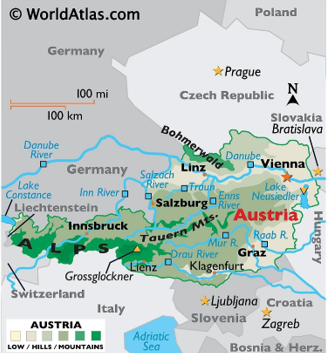
Key Outcomes of the Visit
• Institutional Agreements and Frameworks:
• Security and Strategic Cooperation:
• Economic and Trade Engagement:
• Infrastructure and Energy Cooperation
• Technology, Innovation and Space:
• Education, Skills and Mobility:
• Multilateral and Global Cooperation
India–Austria Bilateral Relations
|
Historical Relations: |
·
Diplomatic
relations were formally established in 1949, soon after
India’s independence. ·
Austria
developed a strong tradition of Indology (study of Indian culture,
Sanskrit, religion), and Sanskrit teaching began at the University of
Vienna in 1845. ·
Rabindranath
Tagore visited Vienna (1921
& 1926), strengthening intellectual ties. ·
The
relationship is rooted in shared democratic values, with
Austria’s neutrality (since 1955) aligning with India’s strategic autonomy
approach in foreign policy. |
|
Political Relations: |
·
High-level
visits have played a key role: o
Prime
Minister’s visit (July 2024) marked 75 years of relations and
resulted in an Enhanced Partnership. o Regular meetings at global platforms like UNGA,
COP summits, Munich Security Conference. ·
Austria, as a neutral
EU country, is an important partner for India in strengthening India–EU
relations. |
|
Economic & Trade Relations: |
·
Total trade
reached USD 3.47 billion in 2025, showing continuous
growth from 2021. ·
India’s
exports: electronics, textiles,
footwear, auto components, machinery. ·
Imports
from Austria: high-value
machinery, steel, and railway technology. |
|
Science & Technology
Cooperation: |
·
Cooperation
between India’s DST and the Austrian Science Fund promotes joint
research projects. ·
TU Austria
initiative (2025) enhances academic exchange and attracts Indian
students. ·
Launch of India–Austria
Startup Bridge (2024) marks a shift toward innovation-led
partnership. |
|
Migration & Skill Mobility: |
·
The Comprehensive
Migration and Mobility Partnership Agreement (2023) provides legal
pathways for migration, especially for students and skilled workers |
|
Diaspora: |
·
Around 13,500
Indians live in Austria. ·
Over 730
Indian students are pursuing higher education, and the number is
rising. ·
The diaspora
acts as a bridge for cultural exchange, business, and academic
cooperation. |

The most trusted learning platform on your phone
With our training programs, learning online can be a very exciting experience! Take the next step toward achieving your professional and personal objectives


Course Related Query:
Ask Your DoubtsStore Related Query:[email protected]NCERT Books
Resources
We love learning. Through our innovative solutions, we encourage ourselves, our teams, and our Students to grow. We welcome and look for diverse perspectives and opinions because they enhance our decisions. We strive to understand the big picture and how we contribute to the company’s objectives. We approach challenges with optimism and harness the power of teamwork to accomplish our goals. These aren’t just pretty words to post on the office wall. This is who we are. It’s how we work. And it’s how we approach every interaction with each other and our Students.
Come with an open mind, hungry to learn, and you’ll experience unmatched personal and professional growth, a world of different backgrounds and perspectives, and the freedom to be you—every day. We strive to build and sustain diverse teams and foster a culture of belonging. Creating an inclusive environment where every students feels welcome, appreciated, and heard gives us something to feel (really) good about.
Get Free academic Counseling & Course Details