Explore All Exams at KGS


All Exams
Explore All Exams at KGS

Khan Sir Courses
Geography I Polity I History | World Map I Indian Map I Economics I Biology

UPSC & State PSC
UPSC I BPSC I UP-PSC I MP-PSC

State Exams
UP I Bihar I MP | Rajasthan

NEET | JEE | CUET
NEET | JEE | CUET

Defence Exams
NDA I CDS I CAPF I AFCAT I SSB I Agniveer

Police Exams
UP SI | Bihar SI | Delhi Police | UP Constable

SSC Exams
CGL I CPO I CHSL I MTS I SSC GD I Delhi Police

Foundation Courses
Physics I Chemistry I Biology I History I Geography I Polity I NCERT I Math I English | Map I Reasoning

Railway Exams
RRB | RPF

Teaching Exams
TET | Teaching | UGC

Banking Exams
SBI | RBI | IBPS

Engineering Exams
Civil | Electrical | Mechanical
UGC NET
UGC NET/JRF
Current Affairs provides you with the best compilation of the Daily Current Affairs taking place across the globe: National, International, Sports, Science and Technology, Banking, Economy, Agreement, Appointments, Ranks, and Report and General Studies
Current Affairs
SYLLABUS
GS-2: Structure, organization and functioning of the Executive and the Judiciary Ministries and Departments of the Government.
Context: The Supreme Court, with 5.18 crore cases pending in district courts across the country, has sent a distress call to States to enhance the retirement age of experienced judicial officers from 60 to 62 years.
Supreme Court’s Directions
• A three-judge Bench headed by Chief Justice of India Surya Kant, in its September 1, 2026 order, directed States to take steps towards enhancing the retirement age of judicial officers to 62 years.
• SC directed Chhattisgarh, Karnataka, Madhya Pradesh, Maharashtra, Sikkim, Tamil Nadu and West Bengal to enhance the age of superannuation in the judicial service to 62 years.
• These States have been directed to amend their service rules within two months.
• The concerned High Courts would enhance the age of superannuation to 62 years, subject to a suitability assessment at the age of 60 years.
Other States and Union Territories
• The Supreme Court directed Andhra Pradesh, Arunachal Pradesh, Assam, Bihar, Goa, Gujarat, Haryana, Himachal Pradesh, Jharkhand, Kerala, Manipur, Meghalaya, Mizoram, Nagaland, Odisha, Punjab, Rajasthan, Telangana, Tripura, Uttarakhand, Uttar Pradesh, NCT of Delhi, Jammu and Kashmir and Puducherry to reconsider their decisions regarding enhancement of the retirement age.
• These States and Union Territories have been asked to take a decision within two weeks and submit a compliance report.
Constitutional and Institutional Context
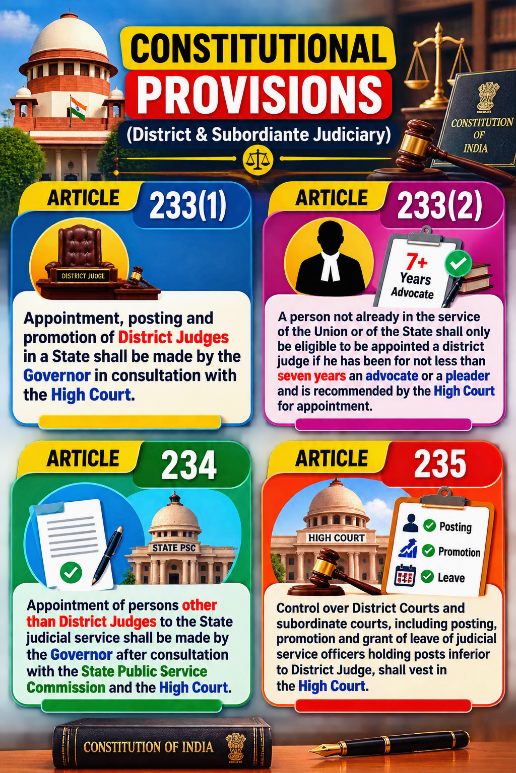
• The issue concerns the conditions of service of the district judiciary, which are governed by rules framed by the States on the recommendation of the High Courts.
• The retirement age currently stands at 65 years for Supreme Court judges and 62 years for High Court judges, while district judiciary judges in several States retire at 60 years.
• The demand for a uniform enhancement of the retirement age of district judiciary judges has a longer judicial history.
• In its 2002 judgment, the Supreme Court had declined to accept the recommendation of the Justice K. Jagannatha Shetty Commission, which had proposed raising the retirement age of district judges to 62 years.
Judicial Vacancies and Case Pendency
• The Supreme Court highlighted the persistent gap between the sanctioned cadre strength and working strength of judicial officers across States.
• Several recruitment drives have not resulted in optimum recruitment or filling of the sanctioned cadre strength.
• The difficulty of recruiting independent and competent judicial officers makes the retention of experienced judicial officers particularly important.
• With 5.18 crore cases pending in district courts, the shortage of judicial manpower has direct implications for the administration of justice and access to justice.
Financial Burden on States
• Financial Concerns: Several States expressed apprehension over the financial burden on the State exchequer and possible demands for parity from other State employees; the Supreme Court termed these concerns entirely misconceived.
• 1992 Judicial Precedent: The Court held that additional expenditure on salaries and retiral benefits would be negligible compared with the enormous advantage to the administration of justice and society at large.
• Post-Retirement Expenditure: Retaining judicial officers up to 62 years could postpone post-retiral expenditure, while retirement at 60 may require States to bear both post-retiral dues and salaries of newly appointed judicial officers.
Safeguards for Judicial Efficiency
• The enhancement of retirement age is not intended to provide automatic continuation to every judicial officer.
• Several High Courts have recommended a thorough assessment of judicial work before permitting officers to continue beyond 60 years.
• The Madras High Court, among others, has introduced relevant riders to ensure that the deadwood does not take advantage of the enhanced retirement age.
• Continuation should therefore be based on competence, proven integrity and suitability, thereby balancing the preservation of experienced judicial talent with the efficiency and quality of the judiciary.
Significance
• Addressing Judicial Manpower Shortage: Raising the retirement age to 62 years can help address the immediate shortage of judicial manpower and reduce the impact of persistent unfilled posts.
• Retention of Judicial Talent: It would allow the judiciary to retain experienced judicial talent, particularly when recruitment of independent and competent judicial officers remains an arduous task.
• Strengthening District Judiciary: The measure can strengthen the district judiciary, which carries the major burden of case disposal and forms the primary level of the justice delivery system.
• Improves Access to Justice: The Supreme Court linked the issue directly with access to justice, observing that unfilled judicial posts can make access to justice a mere “chimera”.
Challenges
• Raising the retirement age alone cannot resolve the structural problem of judicial vacancies and case pendency.
• There remains a need for timely recruitment to ensure that the sanctioned cadre strength is adequately filled.
• Any extension beyond 60 years requires an effective suitability assessment to prevent the continuation of officers whose performance or integrity does not meet the required standards.
• States also need to balance financial considerations with the constitutional objective of ensuring timely and effective access to justice.
Way Forward
• The enhancement of retirement age should be accompanied by regular recruitment and timely filling of sanctioned judicial posts.
• High Courts should adopt transparent and objective mechanisms for suitability assessment at the age of 60 years.
• Judicial manpower planning should take into account case pendency, workload, sanctioned strength and working strength.
• Strengthening the district judiciary should remain central to improving the administration of justice and access to justice.
Conclusion
• The Supreme Court’s intervention highlights the link between judicial vacancies, experienced judicial talent and case pendency, with raising the retirement age from 60 to 62 years, subject to suitability assessment, offering an immediate response, while sustainable improvement requires recruitment, sanctioned strength, judicial infrastructure and efficient case disposal.
Khan Global Studies App
With our training programs, learning online can be a very exciting experience. Take the next step toward achieving your professional and personal objectives.



Course Related Query:
Ask Your DoubtsStore Related Query:[email protected]NEET | JEE | CUET
NCERT Books
Resources
We love learning. Through our innovative solutions, we encourage ourselves, our teams, and our Students to grow. We welcome and look for diverse perspectives and opinions because they enhance our decisions. We strive to understand the big picture and how we contribute to the company’s objectives. We approach challenges with optimism and harness the power of teamwork to accomplish our goals. These aren’t just pretty words to post on the office wall. This is who we are. It’s how we work. And it’s how we approach every interaction with each other and our Students.
Come with an open mind, hungry to learn, and you’ll experience unmatched personal and professional growth, a world of different backgrounds and perspectives, and the freedom to be you—every day. We strive to build and sustain diverse teams and foster a culture of belonging. Creating an inclusive environment where every students feels welcome, appreciated, and heard gives us something to feel (really) good about.