You're all caught up—no notifications available.
Explore All Exams at KGS


All Exams
Explore All Exams at KGS

Khan Sir Courses
Geography I Polity I History | World Map I Indian Map I Economics I Biology

UPSC & State PSC
UPSC I BPSC I UP-PSC I MP-PSC

State Exams
UP I Bihar I MP | Rajasthan

NEET | JEE | CUET | Boards
NEET | JEE | CUET | Boards

Defence Exams
NDA I CDS I CAPF I AFCAT I SSB I Agniveer

Police Exams
UP SI | Bihar SI | Delhi Police | UP Constable

SSC Exams
CGL I CPO I CHSL I MTS I SSC GD I Delhi Police

Foundation Courses
Physics I Chemistry I Biology I History I Geography I Polity I NCERT I Math I English | Map I Reasoning

Railway Exams
RRB | RPF

Teaching Exams
TET | Teaching | UGC

Banking Exams
SBI | RBI | IBPS

Engineering Exams
Civil | Electrical | Mechanical
UGC NET
UGC NET/JRF
Current Affairs provides you with the best compilation of the Daily Current Affairs taking place across the globe: National, International, Sports, Science and Technology, Banking, Economy, Agreement, Appointments, Ranks, and Report and General Studies

SYLLABUS
GS-2: Government policies and interventions for development in various sectors and issues arising out of their design and implementation.
Context: Recently, Jharkhand implemented rules under the Panchayat (Extension to Scheduled Areas) Act (PESA), 25 years after attaining statehood.
PESA Rules in Jharkhand
• Extent of Coverage: The new rules apply fully in 13 of Jharkhand’s 24 districts, including Ranchi, Khunti, Lohardaga, Gumla, Simdega, Latehar, East and West Singhbhum, Saraikela, Dumka, Jamtara, Sahibganj and Pakur.
o Partial implementation has begun in Palamu, Godda and Garhwa.
• Alignment with Panchayati Raj Institution: Officials held PESA rules will not directly affect Panchayati Raj elections, even in Scheduled Areas.
o The Jharkhand Panchayati Raj Act, 2001, is already aligned with PESA, leaving the three-tier panchayat system unchanged.
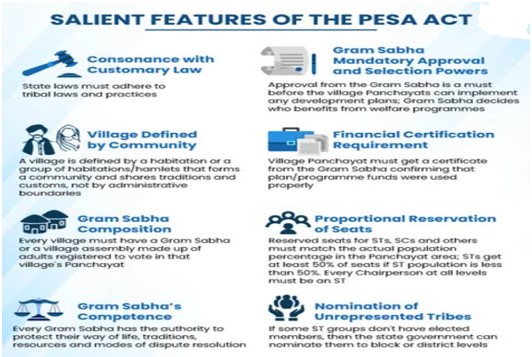
• Empowerment of Gram Sabha: The Gram Sabha is designated as the supreme authority in Scheduled Areas.
o The president of the Gram Sabha shall be chosen as per the village’s established traditional practices.
o Jurisdiction of Gram Sabha: Gram Sabhas will manage natural and community resources, including minor minerals and small water bodies, within their traditional boundaries.
• Role of the District Administration: The district deputy commissioner will recognise and notify Gram Sabhas and their boundaries.
• Annual development plans: A multidisciplinary team at the district level will prepare annual development plans in consultation with Gram Sabhas.
Significance of PESA Rules in Jharkhand
• Tribal self-governance: With tribals making up 26.3% of Jharkhand’s population, comprising 32 tribal communities, including eight Particularly Vulnerable Tribal Groups (2011 Census data), the new rules aim to enhance tribal control over land, forests, and water, restoring their autonomy.
• Inclusive Development Planning: The provision for annual development plans by district authorities in consultation with Gram Sabhas promotes participatory governance and addresses local needs.
• Recognition of Tribal Rights: The implementation of this law will grant constitutional recognition to the traditional rights and duties of tribal village assemblies operating under customary laws.
Concern regarding PESA Rules in Jharkhand
• Diluting the spirit of the original PESA Act: Critics argue that Sections 4(a) and 4(d) of the PESA Act, which protect customary law, religious practices and cultural identity, have been ignored.
o The term ‘community ownership’ has also been omitted.
• Excessive power to district Authorities: Assigning the responsibility of recognising Gram Sabhas to district authorities reflects administrative control rather than customary governance, thereby undermining the authority of the Gram Sabha.
• Limited power of Gram Sabha: The rules do not mention Gram Sabha authority over District Mineral Foundation Trust funds or the Tribal Sub Plan, thus limiting their control over key local resources.
• Exclusion of key Development Sectors: According to the state’s Economic Survey, only 6.08% of tribal households have salaried employment, and literacy among Scheduled Tribes was 57.2% in 2011.
o Restricting Gram Sabha rights to minor minerals and forest produce, while excluding areas like health, education, and employment, perpetuates tribal vulnerability.
About the PESA Act, 1996
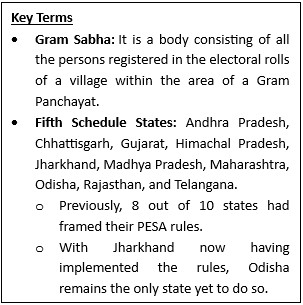
• The PESA was enacted on 24th December 1996, to extend the framework of Part IX of the Constitution (73rd Amendment Act, 1992) to the Fifth Schedule Areas, which are predominantly inhabited by tribal populations.
o The Ministry of Panchayati Raj celebrates December 24 as PESA Day.
• Under Article 243M, the 5th and 6th Schedule areas, along with some other areas/states, are exempted from the provisions of Part IX (Panchayats) of the Constitution. However, the Parliament, by law, can extend the provisions of Part IX to the Scheduled Areas (5th Schedule) and the tribal areas (6th Schedule) with certain modifications and exemptions.
• Under this, the Parliament, on the recommendations of the Bhuria Committee, enacted the Panchayats (Extension to the Scheduled Areas) Act (PESA), 1996, to extend Part IX of the Constitution (73rd Amendment Act, 1992) to the Scheduled areas of 10 States under the 5th Schedule.
Source :
DowntoEarth
Indian Express
PIB

NEWS IN SHORT
Jharkhand Implements the PESA Act, 1996
India opposes Chinese infrastructure activity in the Shaksgam Valley, reasserts sovereignty
India opposes Chinese infrastructure activity in the Shaksgam Valley, reasserts sovereignty
German Chancellor Friedrich Merz visits India
Trump greenlights Bill proposing 500% tariff over Russia oil trade; withdraws from India-led ISA
PSLV-C62/EOS-N1 Mission Encounters Anomaly During PS3 Stage
Kashmir Markhor faces extinction risk in India

The most trusted learning platform on your phone
With our training programs, learning online can be a very exciting experience! Take the next step toward achieving your professional and personal objectives



NCERT Books
Resources
We love learning. Through our innovative solutions, we encourage ourselves, our teams, and our Students to grow. We welcome and look for diverse perspectives and opinions because they enhance our decisions. We strive to understand the big picture and how we contribute to the company’s objectives. We approach challenges with optimism and harness the power of teamwork to accomplish our goals. These aren’t just pretty words to post on the office wall. This is who we are. It’s how we work. And it’s how we approach every interaction with each other and our Students.
Come with an open mind, hungry to learn, and you’ll experience unmatched personal and professional growth, a world of different backgrounds and perspectives, and the freedom to be you—every day. We strive to build and sustain diverse teams and foster a culture of belonging. Creating an inclusive environment where every students feels welcome, appreciated, and heard gives us something to feel (really) good about.
Get Free academic Counseling & Course Details