You're all caught up—no notifications available.
Explore All Exams at KGS


All Exams
Explore All Exams at KGS

Khan Sir Courses
Geography I Polity I History | World Map I Indian Map I Economics I Biology

UPSC & State PSC
UPSC I BPSC I UP-PSC I MP-PSC

State Exams
UP I Bihar I MP | Rajasthan

NEET | JEE | CUET
NEET | JEE | CUET

Defence Exams
NDA I CDS I CAPF I AFCAT I SSB I Agniveer

Police Exams
UP SI | Bihar SI | Delhi Police | UP Constable

SSC Exams
CGL I CPO I CHSL I MTS I SSC GD I Delhi Police

Foundation Courses
Physics I Chemistry I Biology I History I Geography I Polity I NCERT I Math I English | Map I Reasoning

Railway Exams
RRB | RPF

Teaching Exams
TET | Teaching | UGC

Banking Exams
SBI | RBI | IBPS

Engineering Exams
Civil | Electrical | Mechanical
UGC NET
UGC NET/JRF
Current Affairs provides you with the best compilation of the Daily Current Affairs taking place across the globe: National, International, Sports, Science and Technology, Banking, Economy, Agreement, Appointments, Ranks, and Report and General Studies

SYLLABUS
GS-2: Issues relating to Poverty and Hunger; Important International Institutions, agencies and fora - their Structure, Mandate.
Context: A joint Hunger Hotspots report by the Food and Agriculture Organization (FAO) and the World Food Programme (WFP) has warned that millions of people are likely to face worsening acute hunger across 13 global hotspots between June and November 2026.
Key Highlights of the Report
• The latest FAO-WFP Hunger Hotspots Outlook (June–November 2026) identifies 13 countries and territories where acute food insecurity is expected to worsen significantly in the coming months.
• Sudan, South Sudan, Yemen, Palestine, Northeast Nigeria, and Somalia have been identified as hotspots of highest concern, owing to the risk of famine, catastrophic hunger and rising mortality.
• Afghanistan, the Democratic Republic of the Congo (DRC), and Haiti are categorised as hotspots of very high concern, requiring urgent humanitarian intervention.
• The remaining hotspots include Myanmar, Mali, Lebanon, and Madagascar, where conflict, economic shocks and climate-related stresses continue to undermine food security.
• The report notes that nearly 266 million people experienced acute food insecurity in 2025, underscoring the growing scale of the global hunger crisis.
• Several hotspot regions contain populations facing IPC Phase 5 (Catastrophe/Famine) conditions, the most severe level of food insecurity under the Integrated Food Security Phase Classification framework.
• The report highlights that armed conflict and violence are the main drivers of hunger in 12 of the 13 hotspots.
Factors Behind Worsening Global Hunger
• Armed Conflict and Insecurity: Conflict remains the primary driver of acute hunger, disrupting agricultural production, markets, livelihoods and humanitarian operations in countries such as Sudan, Gaza, Yemen, Myanmar and parts of the Sahel.
• Climate Extremes: Recurring droughts, floods, cyclones and erratic weather patterns are undermining food production, damaging livelihoods and increasing vulnerability in already fragile regions.
• Economic Shocks: Persistent inflation, high food prices, currency depreciation and weak economic conditions are reducing households' purchasing power and access to nutritious food.
• Displacement and Humanitarian Constraints: Large-scale displacement, restricted humanitarian access, and declining international funding are limiting the delivery of life-saving food assistance and nutrition support.
Global Efforts to Address Hunger
• Sustainable Development Goal (SDG) 2: Zero Hunger: SDG 2 seeks to end hunger, achieve food security, improve nutrition and promote sustainable agriculture by 2030.
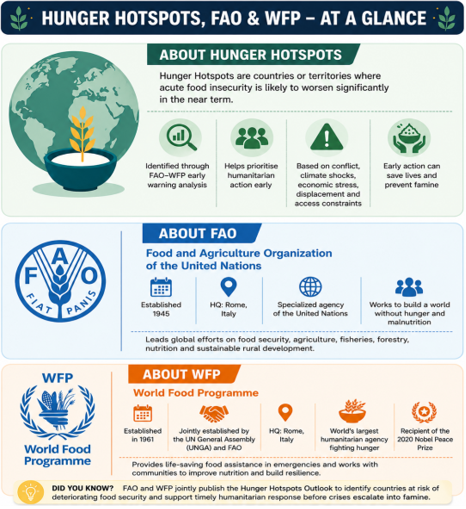
• Food and Agriculture Organization (FAO): FAO leads global efforts to improve food security, agricultural productivity and nutrition, while also supporting food-security monitoring and early-warning systems.
• World Food Programme (WFP): WFP is the world's largest humanitarian organisation addressing hunger and food emergencies and was awarded the 2020 Nobel Peace Prize for its efforts to combat hunger and prevent its use as a weapon of war.
• Integrated Food Security Phase Classification (IPC): The IPC is an internationally recognised framework used to assess and classify the severity of food insecurity, with Phase 5 (Catastrophe/Famine) representing the most critical situation.
• Early Warning and Humanitarian Response: FAO and WFP jointly publish the Hunger Hotspots Outlook to identify countries at risk of deteriorating food security and facilitate timely humanitarian interventions before crises escalate into famine.

The most trusted learning platform on your phone
With our training programs, learning online can be a very exciting experience! Take the next step toward achieving your professional and personal objectives



Course Related Query:
Ask Your DoubtsStore Related Query:[email protected]NEET | JEE | CUET
NCERT Books
Resources
We love learning. Through our innovative solutions, we encourage ourselves, our teams, and our Students to grow. We welcome and look for diverse perspectives and opinions because they enhance our decisions. We strive to understand the big picture and how we contribute to the company’s objectives. We approach challenges with optimism and harness the power of teamwork to accomplish our goals. These aren’t just pretty words to post on the office wall. This is who we are. It’s how we work. And it’s how we approach every interaction with each other and our Students.
Come with an open mind, hungry to learn, and you’ll experience unmatched personal and professional growth, a world of different backgrounds and perspectives, and the freedom to be you—every day. We strive to build and sustain diverse teams and foster a culture of belonging. Creating an inclusive environment where every students feels welcome, appreciated, and heard gives us something to feel (really) good about.
Get Free academic Counseling & Course Details