You're all caught up—no notifications available.
Explore All Exams at KGS


All Exams
Explore All Exams at KGS

Khan Sir Courses
Geography I Polity I History | World Map I Indian Map I Economics I Biology

UPSC & State PSC
UPSC I BPSC I UP-PSC I MP-PSC

State Exams
UP I Bihar I MP | Rajasthan

NEET | JEE | CUET
NEET | JEE | CUET

Defence Exams
NDA I CDS I CAPF I AFCAT I SSB I Agniveer

Police Exams
UP SI | Bihar SI | Delhi Police | UP Constable

SSC Exams
CGL I CPO I CHSL I MTS I SSC GD I Delhi Police

Foundation Courses
Physics I Chemistry I Biology I History I Geography I Polity I NCERT I Math I English | Map I Reasoning

Railway Exams
RRB | RPF

Teaching Exams
TET | Teaching | UGC

Banking Exams
SBI | RBI | IBPS

Engineering Exams
Civil | Electrical | Mechanical
UGC NET
UGC NET/JRF
Current Affairs provides you with the best compilation of the Daily Current Affairs taking place across the globe: National, International, Sports, Science and Technology, Banking, Economy, Agreement, Appointments, Ranks, and Report and General Studies

SYLLABUS
GS-2: Functions and responsibilities of the Union and the States, issues and challenges pertaining to the federal structure; Separation of powers between various organs dispute redressal mechanisms and institutions.
Context: Haryana and Rajasthan signed a Memorandum of Agreement (MoA) to operationalise the long-pending 1994 Upper Yamuna Water Sharing Agreement, enabling Rajasthan to receive its allocated share of Yamuna water through dedicated infrastructure after nearly 32 years.
Key Highlights of the Agreement
• Under the agreement, approximately 580 million Cubic Metres (MCM) of surplus Yamuna water available during the monsoon season (July–October) will be supplied annually to Rajasthan.
• Water will be released from the Hathnikund Barrage (Haryana) and conveyed through three underground pipelines (over 3.6 m in diameter) routed along the Western Yamuna Canal System.
• Around 300 km of underground pipeline infrastructure will be constructed between Hathnikund Barrage and Rajasthan at an estimated cost of ₹3,900 crore.
• The project will ensure a reliable drinking water supply to the water-stressed districts of Churu, Sikar and Jhunjhunu (Shekhawati region) in Rajasthan, besides benefiting Bhiwani and Fatehabad districts of Haryana.
• The agreement is also expected to accelerate the implementation of the Renuka, Kishau and Lakhwar Multipurpose Dam Projects envisaged under the 1994 Upper Yamuna Water Sharing Agreement.
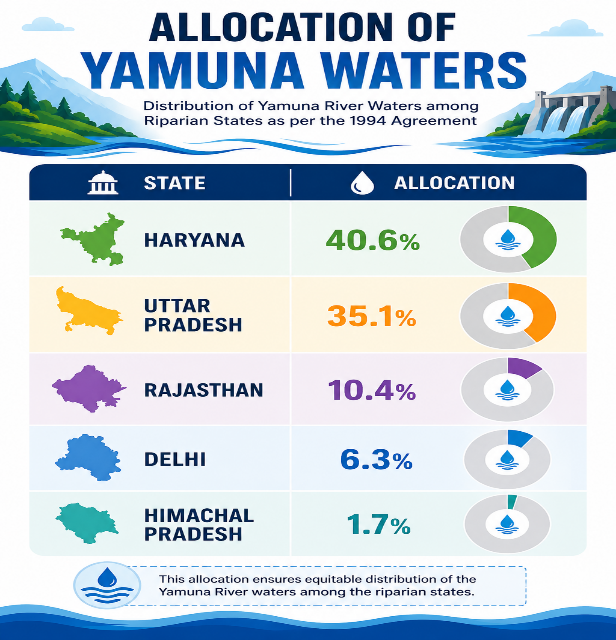
About the 1994 Upper Yamuna Water Sharing Agreement
• The Upper Yamuna Water Sharing Agreement was signed on 12 May 1994 for the allocation of the utilisable surface waters of the Upper Yamuna Basin among the basin States.
• The agreement was signed by the Governments of Haryana, Uttar Pradesh, Rajasthan, Himachal Pradesh, and National Capital Territory (NCT) of Delhi.
• Following the creation of Uttarakhand in 2000, it also became a party to the agreement.
• Objectives of the Agreement:
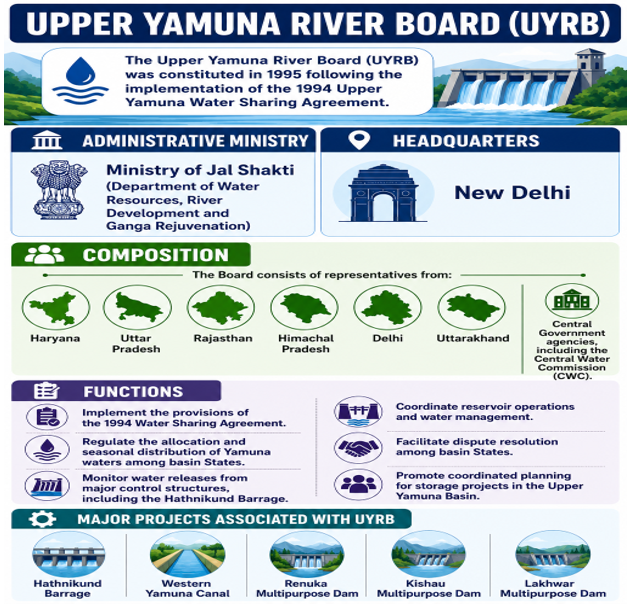
Reasons Behind the 32-Year Delay
• Lack of Water Conveyance Infrastructure: No dedicated canal or underground pipeline existed to transport Rajasthan's allocated Yamuna water from the Hathnikund Barrage.
• Delay in Project Planning: Preparation of the Detailed Project Report (DPR) and finalisation of the underground pipeline design were significantly delayed.
• Inter-State Administrative Differences: Haryana and Rajasthan took years to reach consensus on cost sharing, financial responsibilities, land acquisition, water release protocols, operation and maintenance, and monitoring arrangements.
• Delay in Upstream Dam Projects: The slow implementation of the Renuka, Kishau, and Lakhwar Dam projects delayed augmentation of water availability in the Upper Yamuna Basin.
• Prolonged Administrative Processes: Extended inter-governmental consultations and administrative delays postponed the implementation of the 1994 agreement.
Significance of the Agreement
• Long-Pending Implementation of the 1994 Agreement: Operationalises a water-sharing arrangement that remained pending for nearly 32 years, enabling Rajasthan to utilise its allocated share of Yamuna waters.
• Strengthening Water Security: Provides a long-term solution to the drinking water needs of the water-stressed Shekhawati region (Churu, Sikar and Jhunjhunu) while also benefiting parts of Haryana.
• Efficient Utilisation of Monsoon Surplus: Enables productive use of surplus monsoon flows that previously went downstream unused, while also supporting groundwater recharge through storage in ponds.
• Boost to Cooperative Federalism: Demonstrates successful resolution of a long-pending inter-State water issue through dialogue and consensus, strengthening cooperative federalism and institutional coordination.
• Catalysing Basin Infrastructure Development: Accelerates the implementation of the Renuka, Kishau and Lakhwar Multipurpose Dam Projects, enhancing water storage, improving basin management, and ensuring long-term water availability.

Report on 'Unlocking Growth in Tourism and Hospitality Sector'
SPECIES IN NEWS
Haryana–Rajasthan Yamuna Water Agreement
Viksit Bharat – Guarantee for Rozgar and Aajeevika Mission (Gramin) [VB-G RAM G] Act, 2025
Report on 'Unlocking Growth in Tourism and Hospitality Sector'
SPECIES IN NEWS
Haryana–Rajasthan Yamuna Water Agreement
Viksit Bharat – Guarantee for Rozgar and Aajeevika Mission (Gramin) [VB-G RAM G] Act, 2025
National Study Report on Low Participation in Gram Sabha Across States/UTs
The most trusted learning platform on your phone
With our training programs, learning online can be a very exciting experience! Take the next step toward achieving your professional and personal objectives



Course Related Query:
Ask Your DoubtsStore Related Query:[email protected]NEET | JEE | CUET
NCERT Books
Resources
We love learning. Through our innovative solutions, we encourage ourselves, our teams, and our Students to grow. We welcome and look for diverse perspectives and opinions because they enhance our decisions. We strive to understand the big picture and how we contribute to the company’s objectives. We approach challenges with optimism and harness the power of teamwork to accomplish our goals. These aren’t just pretty words to post on the office wall. This is who we are. It’s how we work. And it’s how we approach every interaction with each other and our Students.
Come with an open mind, hungry to learn, and you’ll experience unmatched personal and professional growth, a world of different backgrounds and perspectives, and the freedom to be you—every day. We strive to build and sustain diverse teams and foster a culture of belonging. Creating an inclusive environment where every students feels welcome, appreciated, and heard gives us something to feel (really) good about.
Get Free academic Counseling & Course Details