logo

All Exams

Notifications

All Exams

Explore All Exams at KGS

All Exams
Home>Current Affairs>e-NAM Completes 10 Years: Digital Revolution in India’s Agricultural Marketing
Current Affairs made simple.

Current Affairs provides you with the best compilation of the Daily Current Affairs taking place across the globe: National, International, Sports, Science and Technology, Banking, Economy, Agreement, Appointments, Ranks, and Report and General Studies

banner-image

e-NAM Completes 10 Years: Digital Revolution in India’s Agricultural Marketing

SYLLABUS

GS 3: ECONOMIC DEVELOPMENT- Storage, Transport and Marketing of Agricultural Produce and Issues and Related Constraints; E-technology in the aid of farmers

Context: National Agriculture Market (e-NAM),  launched in April 2016 is a pan-India electronic trading platform integrating agricultural mandis into a unified digital market enabling seamless online trading transparent price discovery and wider market access for farmers and traders representing a major step toward achieving the vision of “One Nation One Market” in agricultural marketing.

Key Achievements of e-NAM
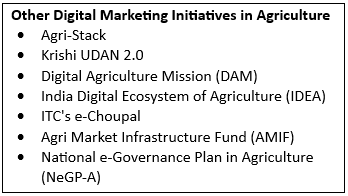
  • e-NAM has emerged as a major digital reform in agricultural marketing, strengthening market integration and improving transparency in trade across India.
    • Its achievements reflect both scale expansion and deeper structural transformation of agricultural markets.
  • A total of 1,656 mandis across 23 States and 4 Union Territories have been successfully integrated into the platform, indicating wide geographical coverage and increasing adoption of digital trading systems.
  • The platform has built a strong stakeholder ecosystem with more than 80 crore farmers, 2.73 lakh traders, and 4,724 Farmer Producer Organizations (FPOs) registered, showing large-scale participation of key actors in agricultural markets.
  • In terms of trade performance, e-NAM has enabled cumulative transactions of around 25 crore metric tonnes of agricultural produce valued at approximately ₹4.84 lakh crore (2016–2026), reflecting its growing role in national agricultural commerce.
  • The platform has also demonstrated strong growth momentum, with trade value rising significantly from ₹3.19 lakh crore in 2024 to ₹4.84 lakh crore in 2026, highlighting increasing trust and deeper market engagement among stakeholders.
  • Operational activity remains robust, with over 204.76 lakh metric tonnes of produce traded in recent periods, indicating sustained usage and expanding digital participation in mandis.
  • The e-NAM mobile application provides real-time price information for 247 agricultural commodities, enabling farmers to access market signals and improve price realisation.
  • Additionally, the government has supported infrastructure development by providing financial assistance of up to ₹75 lakh per mandi, strengthening digital and physical integration of mandis into the e-NAM ecosystem.

Objectives  of e-NAM:

  • To create a unified national market for agricultural commodities through digital integration of mandis
  • To ensure transparent price discovery through competitive online bidding
  • To enhance market access for farmers, FPOs, and traders beyond local mandis
  • To reduce intermediaries and transaction inefficiencies in agricultural trade
  • To promote digital payments and financial inclusion in agricultural marketing
  • To improve post-harvest value realization and reduce distress sales

Key Features e-NAM

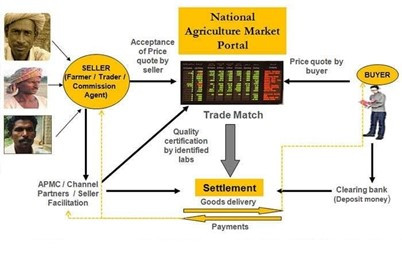
  • Single-window service: It connects APMC mandis across India and develops a single unified national market for agricultural commodities; Commodity arrivals, quality assaying, bidding, payment, all on one platform;
  • Unique Lot ID tracking: Each lot tracked from gate entry to final sale via mobile
  • Live price dashboard: Real-time commodity prices, mandi arrivals, trade volumes, publicly accessible.
  • Inter-state trade facility: State Unified License enables traders to bid across State boundaries
  • The platform integrates multiple digital payment modes, including NEFT, RTGS, internet banking, and UPI, enabling it to adapt across states.
  • Unique lot ID tracking system ensuring transparency from arrival to sale
  • Multilingual mobile application enabling wider accessibility for farmers (12-language interface: Hindi, English, Gujarati, Marathi, Telugu, Bengali, Tamil, Odia and others).
  • A key advancement in the evolution of e-NAM was the introduction of the Platform of Platforms (PoP) on 14 July 2022, which integrates a wide range of services through a unified digital interface on the e-NAM mobile application.
    • It enables farmers and stakeholders to access services across the agricultural value chain, including logistics, warehousing, quality assurance, grading and packaging, agri-inputs, financial and insurance services, along with advisory support such as weather updates and crop forecasting.
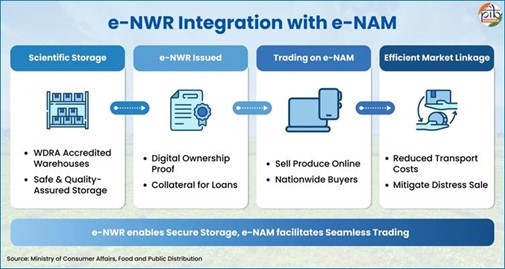
  • The Electronic Negotiable Warehouse Receipt (e-NWR) system has been integrated with e-NAM to enable a more seamless and efficient agricultural.

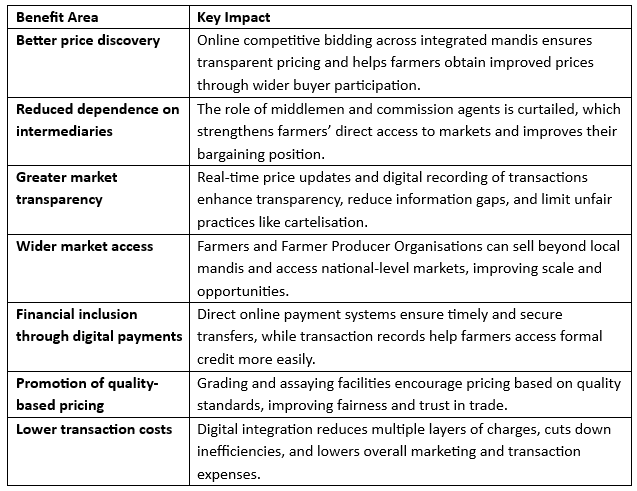
Benefits of e-NAM

Challenges

  • Uneven digital infrastructure and internet connectivity in rural areas
  • Limited digital literacy among small and marginal farmers
  • Slow integration and adoption by some APMC mandis and states
  • Inadequate standardization of quality grading and assaying infrastructure
  • Resistance from traditional market intermediaries
  • Logistics bottlenecks in inter-state agricultural movement
  • Limited awareness about advanced features like PoP and e-NWR linkage

Way Forward

  • Strengthen rural digital and physical infrastructure by improving internet connectivity, standardizing grading facilities, and ensuring better APMC reforms across states for smoother e-NAM integration.
  • Promote digital literacy among farmers through targeted training and capacity-building programs so that small and marginal farmers can effectively participate in online agricultural markets.
  • Enhance collective participation and partnerships by empowering Farmer Producer Organisations (FPOs) and collaborating with private logistics and fintech companies to improve market access and backend support systems.
  • Improved coordination between states for seamless inter-state trade
  • Wider awareness of e-NWR-based trading and collateral financing
  • Integration of AI-based price forecasting and market intelligence tools

 Conclusion

The National Agriculture Market (e-NAM) represents a structural shift in India’s agricultural marketing system by transitioning from fragmented mandi-based trade to a digitally integrated national marketplace. While challenges in adoption and infrastructure remain, its expanding ecosystem—linking markets, storage, finance, and logistics—positions it as a key instrument for achieving efficient, transparent, and farmer-centric agricultural transformation in India.

Source:
PIB
Research Gate
footer image

The most trusted learning platform on your phone

With our training programs, learning online can be a very exciting experience! Take the next step toward achieving your professional and personal objectives


app-storeplay-store
logo
Khan Global Studies Pvt. Ltd. 5th Floor,
A13A, Graphix 1 Tower B, Sector 62,
Noida, Uttar Pradesh 201309

Course Related Query:

Ask Your DoubtsStore Related Query:[email protected]

Get Free Academic Counseling & Course Details

KGS best learning platform

About Khan Global Studies

We love learning. Through our innovative solutions, we encourage ourselves, our teams, and our Students to grow. We welcome and look for diverse perspectives and opinions because they enhance our decisions. We strive to understand the big picture and how we contribute to the company’s objectives. We approach challenges with optimism and harness the power of teamwork to accomplish our goals. These aren’t just pretty words to post on the office wall. This is who we are. It’s how we work. And it’s how we approach every interaction with each other and our Students.


What Makes Us Different

Come with an open mind, hungry to learn, and you’ll experience unmatched personal and professional growth, a world of different backgrounds and perspectives, and the freedom to be you—every day. We strive to build and sustain diverse teams and foster a culture of belonging. Creating an inclusive environment where every students feels welcome, appreciated, and heard gives us something to feel (really) good about.

Copyright 2026 KhanGlobalStudies

Have a question?

Get Free academic Counseling & Course Details

floatButton