You're all caught up—no notifications available.
Explore All Exams at KGS


All Exams
Explore All Exams at KGS

Khan Sir Courses
Geography I Polity I History | World Map I Indian Map I Economics I Biology

UPSC & State PSC
UPSC I BPSC I UP-PSC I MP-PSC

State Exams
UP I Bihar I MP | Rajasthan

NEET | JEE | CUET
NEET | JEE | CUET

Defence Exams
NDA I CDS I CAPF I AFCAT I SSB I Agniveer

Police Exams
UP SI | Bihar SI | Delhi Police | UP Constable

SSC Exams
CGL I CPO I CHSL I MTS I SSC GD I Delhi Police

Foundation Courses
Physics I Chemistry I Biology I History I Geography I Polity I NCERT I Math I English | Map I Reasoning

Railway Exams
RRB | RPF

Teaching Exams
TET | Teaching | UGC

Banking Exams
SBI | RBI | IBPS

Engineering Exams
Civil | Electrical | Mechanical
UGC NET
UGC NET/JRF
Current Affairs provides you with the best compilation of the Daily Current Affairs taking place across the globe: National, International, Sports, Science and Technology, Banking, Economy, Agreement, Appointments, Ranks, and Report and General Studies

SYLLABUS
GS-3: Achievements of Indians in science & technology; indigenization of technology and developing new technology.
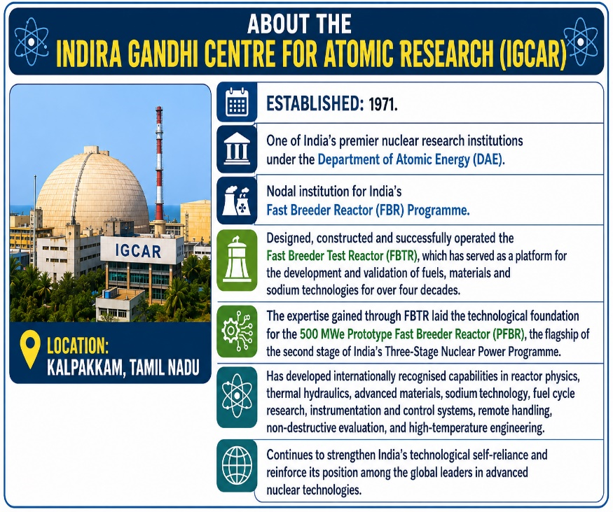
Context: The Department of Atomic Energy (DAE) inaugurated the world's first Hydrogen Production Facility based on the Copper–Chlorine (Cu–Cl) Thermochemical Cycle using nuclear process heat from the Fast Breeder Test Reactor (FBTR) at the Indira Gandhi Centre for Atomic Research (IGCAR), Kalpakkam.
About the Hydrogen Production Facility
• It is the world's first hydrogen production facility based on the Copper–Chlorine (Cu–Cl) Thermochemical Cycle using nuclear process heat from the Fast Breeder Test Reactor (FBTR).
• The facility has been established as a technology demonstrator to validate hydrogen production using nuclear energy through the indigenously developed Cu–Cl process by the Bhabha Atomic Research Centre (BARC), Mumbai.
• It successfully integrates nuclear process heat with hydrogen generation, demonstrating the feasibility of large-scale, carbon-free hydrogen production using advanced nuclear reactors.
• The project is the result of joint efforts by BARC and IGCAR, involving research, process development, engineering design, equipment fabrication, installation, testing and commissioning.
• The facility will:
About the Copper–Chlorine (Cu–Cl) Thermochemical Cycle
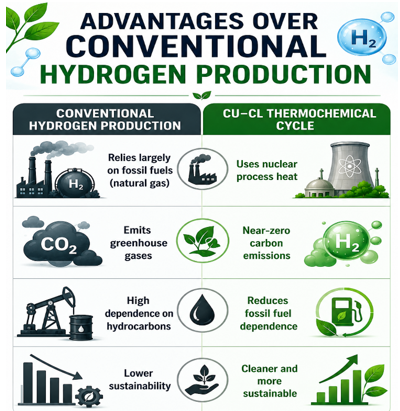
• The Copper–Chlorine (Cu–Cl) Thermochemical Cycle is an advanced hydrogen production process that uses nuclear process heat to split water into hydrogen and oxygen through a series of thermochemical reactions.
• The process involves multiple thermochemical reactions in which copper and chlorine compounds are continuously recycled, while water is ultimately split into hydrogen and oxygen.
• The process has been developed indigenously by the BARC.
• It utilises high-temperature process heat generated from the Fast Breeder Test Reactor (FBTR) instead of relying on fossil fuels.
• The process produces carbon-free (Pink) Hydrogen by utilising nuclear energy as the primary heat source.
• Nuclear reactors provide continuous high-temperature process heat, enabling round-the-clock hydrogen production unlike intermittent renewable sources.
• It is considered one of the most promising thermochemical hydrogen production technologies because of:
• The process:
Significance of the Facility
• World First Achievement: Establishes India as the first country to demonstrate hydrogen production through the Cu–Cl thermochemical cycle using nuclear process heat.
• Clean Energy Transition: Provides a carbon-free pathway for hydrogen production, supporting India's decarbonisation and Net Zero ambitions.
• Energy Security: Reduces dependence on imported fossil fuels by producing hydrogen using indigenous nuclear resources.
• Technological Breakthrough: Demonstrates successful integration of advanced nuclear reactors with hydrogen production technologies.
• Commercial Potential: Generates valuable operational experience for scaling up nuclear-assisted hydrogen production for industrial and commercial deployment.
• Strengthening India's Nuclear Programme: Showcases the versatility of fast breeder reactors beyond electricity generation by utilising high-temperature process heat.
• Boost to Indigenous Innovation: Reflects the technological capabilities of BARC and IGCAR in advanced nuclear systems and clean energy technologies.
• Supports India's Three-Stage Nuclear Programme: Builds upon the expertise developed through the FBTR, which laid the foundation for the 500 MWe Prototype Fast Breeder Reactor (PFBR).
• Promotes AtmaNirbhar Bharat & Viksit Bharat: Reinforces India's commitment to technological self-reliance, sustainable development and a secure low-carbon energy future.
The most trusted learning platform on your phone
With our training programs, learning online can be a very exciting experience! Take the next step toward achieving your professional and personal objectives



Course Related Query:
Ask Your DoubtsStore Related Query:[email protected]NEET | JEE | CUET
NCERT Books
Resources
We love learning. Through our innovative solutions, we encourage ourselves, our teams, and our Students to grow. We welcome and look for diverse perspectives and opinions because they enhance our decisions. We strive to understand the big picture and how we contribute to the company’s objectives. We approach challenges with optimism and harness the power of teamwork to accomplish our goals. These aren’t just pretty words to post on the office wall. This is who we are. It’s how we work. And it’s how we approach every interaction with each other and our Students.
Come with an open mind, hungry to learn, and you’ll experience unmatched personal and professional growth, a world of different backgrounds and perspectives, and the freedom to be you—every day. We strive to build and sustain diverse teams and foster a culture of belonging. Creating an inclusive environment where every students feels welcome, appreciated, and heard gives us something to feel (really) good about.
Get Free academic Counseling & Course Details