logo

All Exams

Notifications

All Exams

Explore All Exams at KGS

All Exams
Home>Current Affairs>World Health Statistics 2026
Current Affairs made simple.

Current Affairs provides you with the best compilation of the Daily Current Affairs taking place across the globe: National, International, Sports, Science and Technology, Banking, Economy, Agreement, Appointments, Ranks, and Report and General Studies
banner-image

World Health Statistics 2026

SYLLABUS

GS-2: Issues Relating to Development and Management of Social Sector/Services relating to Health; Important International Institutions, agencies and fora - their Structure, Mandate.

Context: The World Health Organization (WHO) has released the World Health Statistics 2026 report, warning that global progress towards health-related Sustainable Development Goals (SDGs) remains uneven and insufficient to achieve the 2030 targets. 

More on the News
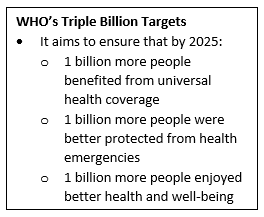
  • World Health Statistics is WHO’s annual flagship publication that compiles health-related statistics and SDG indicators for WHO Member States. 
  • The 2026 edition monitors progress towards SDG 3 (Good Health and Well-Being) and other health-related SDG targets, while also assessing WHO’s “Triple Billion Targets”. 
  • The report highlights that the COVID-19 pandemic caused severe disruptions to global health systems, reversing several years of progress in life expectancy, maternal and child health, immunisation, and disease control.
  • The assessment is based on country reporting systems, WHO databases, SDG indicators, and excess mortality estimates associated with the COVID-19 pandemic.

Key Findings of the Report

  • Slow Progress Towards Health SDGs: WHO warned that global progress towards health-related SDGs remains uneven and insufficient to achieve the 2030 targets. 
  • Trends in Infectious Diseases: The report noted long-term improvements in some infectious diseases between 2010 and 2024:
    New HIV infections declined by nearly 40%.
    Tuberculosis incidence declined by around 12%.
    The number of people requiring interventions for neglected tropical diseases declined by 36%.
    However, global malaria incidence increased by 8.5% since 2015, moving away from the SDG target. 
  • COVID-19 and Excess Mortality
    WHO estimated around 22.1 million excess deaths globally between 2020 and 2023 due to the direct and indirect impacts of the COVID-19 pandemic — nearly three times the officially reported 7 million deaths.
    The pandemic erased nearly a decade of gains in global life expectancy and Healthy Life Expectancy (HALE). 
  • Maternal, Child and Non-Communicable Diseases: Since 2000, 
    Maternal mortality declined by around 40%.
    Under-five mortality declined by around 51%.
    Premature mortality from four major non-communicable diseases (cardiovascular diseases, cancer, diabetes, and chronic respiratory diseases) declined by more than 20%.
    However, progress has slowed in the SDG era, and many countries remain off track to meet the targets. 
  • Universal Health Coverage (UHC) and Financial Burden
    Progress towards Universal Health Coverage has slowed significantly, with the global UHC service coverage index increasing only from 68 (2015) to 71 (2023).
    Around one-fourth of the global population faces financial hardship due to out-of-pocket health expenditure, while nearly 1.6 billion people were living in or pushed into poverty because of health expenses in 2022. 

Policy Recommendations

  • Strengthening Universal Health Coverage: Countries need to expand affordable and equitable access to healthcare services while reducing out-of-pocket expenditure and financial hardship. 
  • Improving Pandemic Preparedness: Greater investments are required in disease surveillance, emergency preparedness, vaccine systems, and resilient public health infrastructure. 
  • Bridging Health Inequalities: Governments should prioritise vulnerable populations through improved maternal health, nutrition, immunisation, and primary healthcare services. 
  • Strengthening Health Data Systems: WHO emphasised the need for timely mortality reporting, robust civil registration systems, and improved health data collection and monitoring mechanisms.

SOURCES
Down to Earth
The Hindu

footer image

The most trusted learning platform on your phone

With our training programs, learning online can be a very exciting experience! Take the next step toward achieving your professional and personal objectives


app-storeplay-store
logo
Khan Global Studies Pvt. Ltd. 5th Floor,
A13A, Graphix 1 Tower B, Sector 62,
Noida, Uttar Pradesh 201309

Course Related Query:

Ask Your DoubtsStore Related Query:[email protected]

Get Free Academic Counseling & Course Details

KGS best learning platform

About Khan Global Studies

We love learning. Through our innovative solutions, we encourage ourselves, our teams, and our Students to grow. We welcome and look for diverse perspectives and opinions because they enhance our decisions. We strive to understand the big picture and how we contribute to the company’s objectives. We approach challenges with optimism and harness the power of teamwork to accomplish our goals. These aren’t just pretty words to post on the office wall. This is who we are. It’s how we work. And it’s how we approach every interaction with each other and our Students.


What Makes Us Different

Come with an open mind, hungry to learn, and you’ll experience unmatched personal and professional growth, a world of different backgrounds and perspectives, and the freedom to be you—every day. We strive to build and sustain diverse teams and foster a culture of belonging. Creating an inclusive environment where every students feels welcome, appreciated, and heard gives us something to feel (really) good about.

Copyright 2026 KhanGlobalStudies

Have a question?

Get Free academic Counseling & Course Details

floatButton
World Health Statistics 2026 | Current Affairs