You're all caught up—no notifications available.
Explore All Exams at KGS


All Exams
Explore All Exams at KGS

Khan Sir Courses
Geography I Polity I History | World Map I Indian Map I Economics I Biology

UPSC & State PSC
UPSC I BPSC I UP-PSC I MP-PSC

State Exams
UP I Bihar I MP | Rajasthan

NEET | JEE | CUET
NEET | JEE | CUET

Defence Exams
NDA I CDS I CAPF I AFCAT I SSB I Agniveer

Police Exams
UP SI | Bihar SI | Delhi Police | UP Constable

SSC Exams
CGL I CPO I CHSL I MTS I SSC GD I Delhi Police

Foundation Courses
Physics I Chemistry I Biology I History I Geography I Polity I NCERT I Math I English | Map I Reasoning

Railway Exams
RRB | RPF

Teaching Exams
TET | Teaching | UGC

Banking Exams
SBI | RBI | IBPS

Engineering Exams
Civil | Electrical | Mechanical
UGC NET
UGC NET/JRF
Current Affairs provides you with the best compilation of the Daily Current Affairs taking place across the globe: National, International, Sports, Science and Technology, Banking, Economy, Agreement, Appointments, Ranks, and Report and General Studies

SYLLABUS
GS-2: Functions and responsibilities of the Union and the States, issues and challenges pertaining to the federal structure, devolution of powers and finances up to local levels and challenges therein.
Context: Recently, the Ministry of Panchayati Raj released the Panchayat Advancement Index (PAI) 2.0 report on National Panchayati Raj Day (24 April 2026) to assess grassroots governance performance across rural India.
More on the News
• PAI 2.0 serves as a nationwide report card for over 2.5 lakh Gram Panchayats, with a high participation rate of 97.30% (2,59,867 Panchayats across 33 States/UTs), significantly improving from 80.79% in version 1.0.
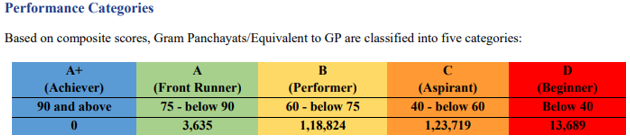
• Based on composite scores, 3,635 Panchayats are classified as Front Runners, while 1,18,824 (45.72%) fall under the Performer category.
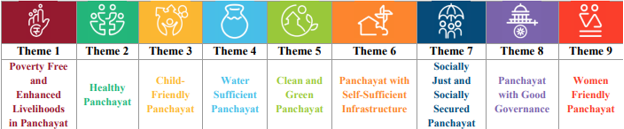
• The report highlights strong outcomes in themes like Poverty-Free and Enhanced Livelihoods and Healthy Panchayats, reflecting progress in rural development indicators.
• The initiative strengthens transparency, accountability, and data-driven governance through mandatory Gram Sabha validation and real-time monitoring systems.
About Panchayat Advancement Index (PAI) 2.0
• Launched by the Ministry of Panchayati Raj, the PAI is the world’s first nationwide framework to measure the progress of Rural Local Government Institutions (Gram Panchayats (GPs)/Traditional Local Bodies (TLBs)) using objective and verifiable indicators.
• It is aligned with the Localization of Sustainable Development Goals (LSDGs), adapting global SDGs into locally relevant governance themes.
• PAI 2.0 evaluates Panchayats using 150 indicators and 230 data points, significantly reduced from 516 indicators and 794 data points in version 1.0, ensuring better usability and sharper focus.
• The framework is aligned with the National Indicator Framework (NIF) and uses a 0–100 scoring system based on multi-level data collection, validation by line departments, and mandatory Gram Sabha verification.
• PAI is widely used for evidence-based planning, Gram Panchayat Development Plans (GPDPs), resource allocation, and incentivisation, and is linked with initiatives like National Panchayat Awards and creation of Panchayat Learning Centres/Beacon Panchayats.
• Nine LSDG Themes Covered:
• Performance Categories:
Key Findings of the Report
• No Panchayat achieved the Achiever (A+) category overall, indicating scope for improvement in holistic development.
• 3,635 Panchayats are Front Runners, while the majority, 1,18,824 Panchayats (45.72%), fall in the Performer category, reflecting moderate but stable performance.
• A large number, 1,23,719 Panchayats, are in the Aspirant category, showing uneven development across regions.
• 13,689 Panchayats fall under the Beginner category, requiring targeted interventions.
• Theme-wise Highlights:
• Participation & Coverage:
• Governance Impact:

The most trusted learning platform on your phone
With our training programs, learning online can be a very exciting experience! Take the next step toward achieving your professional and personal objectives


Course Related Query:
Ask Your DoubtsStore Related Query:[email protected]NCERT Books
Resources
We love learning. Through our innovative solutions, we encourage ourselves, our teams, and our Students to grow. We welcome and look for diverse perspectives and opinions because they enhance our decisions. We strive to understand the big picture and how we contribute to the company’s objectives. We approach challenges with optimism and harness the power of teamwork to accomplish our goals. These aren’t just pretty words to post on the office wall. This is who we are. It’s how we work. And it’s how we approach every interaction with each other and our Students.
Come with an open mind, hungry to learn, and you’ll experience unmatched personal and professional growth, a world of different backgrounds and perspectives, and the freedom to be you—every day. We strive to build and sustain diverse teams and foster a culture of belonging. Creating an inclusive environment where every students feels welcome, appreciated, and heard gives us something to feel (really) good about.
Get Free academic Counseling & Course Details