You're all caught up—no notifications available.
Explore All Exams at KGS


All Exams
Explore All Exams at KGS

Khan Sir Courses
Geography I Polity I History | World Map I Indian Map I Economics I Biology

UPSC & State PSC
UPSC I BPSC I UP-PSC I MP-PSC

State Exams
UP I Bihar I MP | Rajasthan

NEET | JEE | CUET
NEET | JEE | CUET

Defence Exams
NDA I CDS I CAPF I AFCAT I SSB I Agniveer

Police Exams
UP SI | Bihar SI | Delhi Police | UP Constable

SSC Exams
CGL I CPO I CHSL I MTS I SSC GD I Delhi Police

Foundation Courses
Physics I Chemistry I Biology I History I Geography I Polity I NCERT I Math I English | Map I Reasoning

Railway Exams
RRB | RPF

Teaching Exams
TET | Teaching | UGC

Banking Exams
SBI | RBI | IBPS

Engineering Exams
Civil | Electrical | Mechanical
UGC NET
UGC NET/JRF
Current Affairs provides you with the best compilation of the Daily Current Affairs taking place across the globe: National, International, Sports, Science and Technology, Banking, Economy, Agreement, Appointments, Ranks, and Report and General Studies
SYLLABUS
GS-3: Indian Economy and issues relating to planning, mobilization of resources, growth, development and employment; Inclusive growth and issues arising from it.
Context: Recently, NITI Aayog launched the DPI@2047 roadmap to guide India’s next phase of Digital Public Infrastructure (DPI) for inclusive, non-linear, and productivity-led growth.
More on the News
• The report titled ‘DPI@2047: The Roadmap to Prosperity’ was released by the NITI Frontier Tech Hub under NITI Aayog.
• It presents a three-stage evolution of DPI (1.0, 2.0, 3.0), moving from foundational digital inclusion to productivity-driven and innovation-led growth.
• The document builds on the successes of Aadhaar and Unified Payments Interface to expand access to economic opportunities.
• It targets $18,000 per capita income by focusing on mass livelihood empowerment, human capability development, and systemic digital transformation.
• The roadmap was developed in partnership with EkStep Foundation and Deloitte, reflecting a collaborative ecosystem-driven approach.
About Digital Public Infrastructure (DPI) 2.0
• DPI 2.0 (2025–2035) is designed to move India from foundational inclusion to livelihood-led, productivity-driven growth, forming the base for DPI 3.0 (2035–2047), which aims at broad-based prosperity and high-value economic expansion.
• It represents a shift from earlier focus areas like identity and payments to mass livelihood empowerment, innovation diffusion, and economic participation at scale.
• The roadmap envisions India becoming a $30 trillion economy with a per capita income of $18,000 by 2047, supported by DPI-led transformation.
• DPI 2.0 integrates AI, trusted data systems, and interoperable digital infrastructure to democratise access to knowledge, markets, and opportunities across society.
Implementation Roadmap (DPI 2.0 & 3.0)
• The DPI@2047 roadmap proposes a two-phase strategy:
• For DPI 2.0, the roadmap identifies eight sectoral transformations and outlines four execution imperatives:
1. District-led Demand Aggregation: Linking DPI initiatives with district-level development goals to ensure hyper-local adoption and create demand for digital solutions.
2. Scaling Technology Entrepreneurship: Expanding India’s base of innovators through incubators, accelerators, mission-driven R&D, and enabling policy frameworks to build a distributed innovation ecosystem.
3. Leveraging AI Momentum: Using AI as a key productivity engine to solve structural challenges and ensure its accessibility for both citizens and enterprises.
4. Cross-Sectoral Strategic Unlocks: Include unlocking data for insights and trust-based systems, democratising AI to remove digital and language barriers, enhancing human capacity and knowledge access, and expanding digital transactions through open networks.
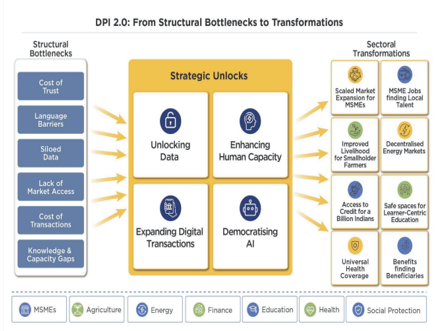
Key Sectoral Transformations under DPI 2.0
• Mass Inclusion at Scale (Livelihood Expansion):
• Foundations of Human Capability:
• Systemic Enablers:
Key Achievements of DPI 1.0
• India’s DPI 1.0 laid the foundation for mass inclusion and digital governance at scale, enabling rapid expansion of services and economic activity.
• It demonstrated the power of open, interoperable digital rails, contributing nearly 1% of GDP today and projected up to 4% by 2030.
• Significance:
Way Forward / Call to Action
• State-led, decentralised execution models to ensure contextual and scalable solutions.
• Iterative 2-year transformation cycles, allowing experimentation, learning, and scaling of successful models.
• Initial focus (2026–27) on MSMEs and agriculture, with lighthouse pilots in select states followed by wider rollout.
• Building a strong entrepreneurial ecosystem aligned with DPI demand.
• Establishing a global DPI collaboration platform to position India as a leader in DPI and AI for public good.
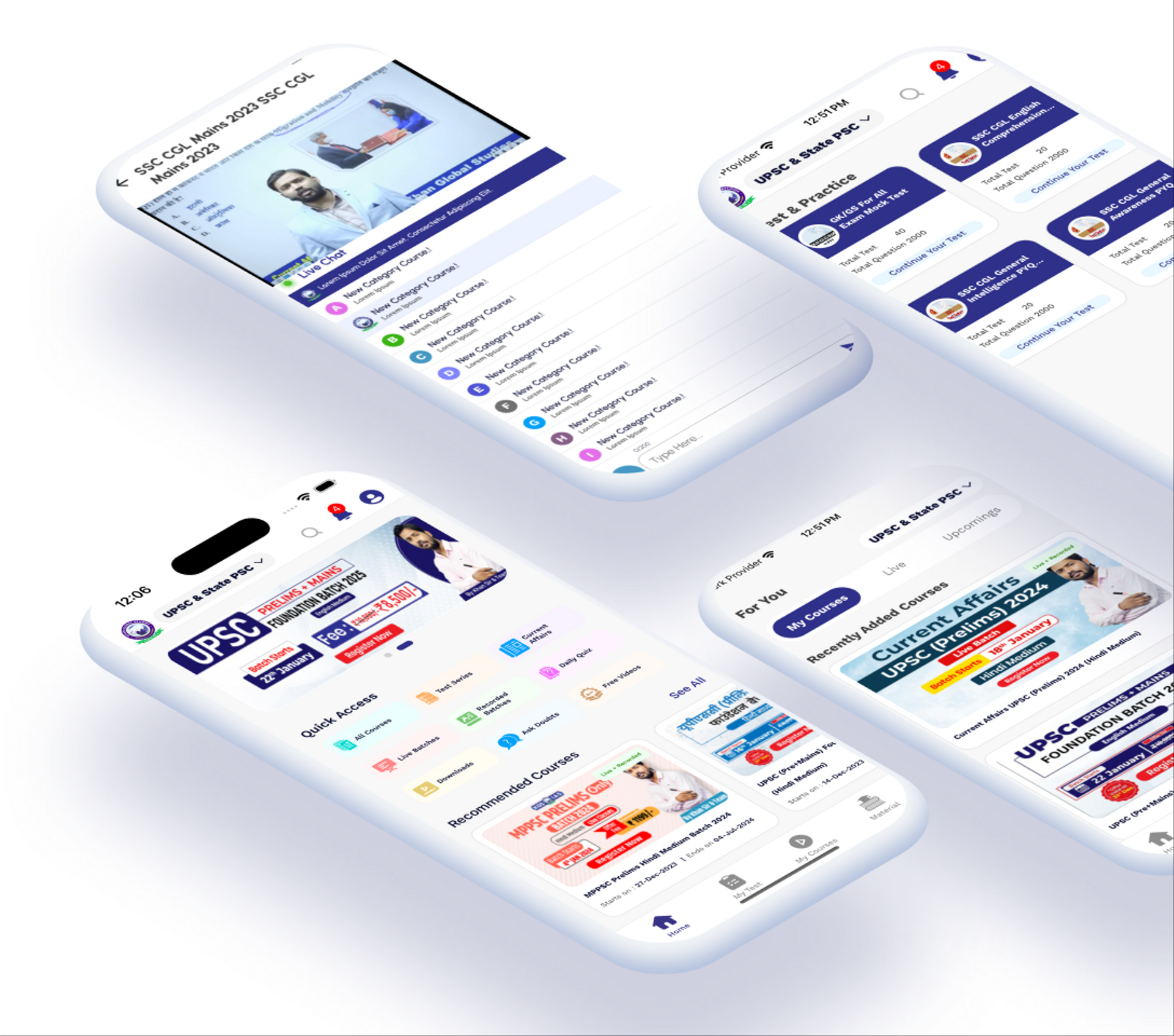
The most trusted learning platform on your phone
With our training programs, learning online can be a very exciting experience! Take the next step toward achieving your professional and personal objectives



Course Related Query:
Ask Your DoubtsStore Related Query:[email protected]NCERT Books
Resources
We love learning. Through our innovative solutions, we encourage ourselves, our teams, and our Students to grow. We welcome and look for diverse perspectives and opinions because they enhance our decisions. We strive to understand the big picture and how we contribute to the company’s objectives. We approach challenges with optimism and harness the power of teamwork to accomplish our goals. These aren’t just pretty words to post on the office wall. This is who we are. It’s how we work. And it’s how we approach every interaction with each other and our Students.
Come with an open mind, hungry to learn, and you’ll experience unmatched personal and professional growth, a world of different backgrounds and perspectives, and the freedom to be you—every day. We strive to build and sustain diverse teams and foster a culture of belonging. Creating an inclusive environment where every students feels welcome, appreciated, and heard gives us something to feel (really) good about.
Get Free academic Counseling & Course Details