You're all caught up—no notifications available.
Explore All Exams at KGS


All Exams
Explore All Exams at KGS

Khan Sir Courses
Geography I Polity I History | World Map I Indian Map I Economics I Biology

UPSC & State PSC
UPSC I BPSC I UP-PSC I MP-PSC

State Exams
UP I Bihar I MP | Rajasthan

NEET | JEE | CUET
NEET | JEE | CUET

Defence Exams
NDA I CDS I CAPF I AFCAT I SSB I Agniveer

Police Exams
UP SI | Bihar SI | Delhi Police | UP Constable

SSC Exams
CGL I CPO I CHSL I MTS I SSC GD I Delhi Police

Foundation Courses
Physics I Chemistry I Biology I History I Geography I Polity I NCERT I Math I English | Map I Reasoning

Railway Exams
RRB | RPF

Teaching Exams
TET | Teaching | UGC

Banking Exams
SBI | RBI | IBPS

Engineering Exams
Civil | Electrical | Mechanical
UGC NET
UGC NET/JRF
Current Affairs provides you with the best compilation of the Daily Current Affairs taking place across the globe: National, International, Sports, Science and Technology, Banking, Economy, Agreement, Appointments, Ranks, and Report and General Studies

SYLLABUS
GS-3: Conservation, environmental pollution and degradation, environmental impact assessment.
Context: Recently, Union Minister for Environment, Forest and Climate Change announced that Project Great Indian Bustard (GIB) has entered its fourth year of captive breeding with the hatching of two new chicks, raising the total number of birds in captivity to 70.
More on the News
• The two chicks were hatched at the Conservation Breeding Centre in Rajasthan, a key facility for the species’ recovery.
• Of the two chicks one was born through natural mating and the other through artificial insemination, indicating success in assisted breeding techniques.
• The development represents a significant milestone under Project GIB, which aims to revive the critically endangered species.
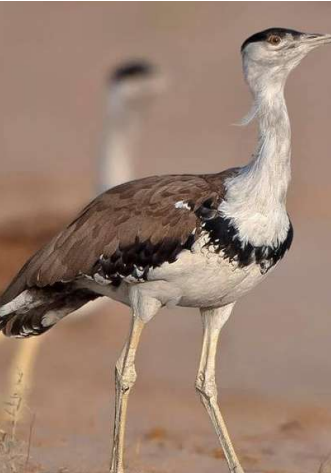
About the Project Great Indian Bustard (GIB)
• It is an ambitious conservation programme launched on 5 June 2013 by the Government of Rajasthan to conserve the critically endangered Great Indian Bustard (Ardeotis nigriceps), locally known as Godawan.
• The project marks a significant step towards conservation of neglected species and is especially important as the Great Indian Bustard is the State Bird of Rajasthan.
• The project was initially implemented in the Desert National Park (DNP), Jaisalmer.
• Objectives of Project GIB:
• Population Decline Trend: The population declined sharply from over 1,000 individuals a few decades ago to 745 (1978), 600 (2001), 300 (2008), and about 125 (2013).
About the Great Indian Bustard
• Scientific Name: Ardeotis nigriceps.
• Also known as the Godawan, the state bird of Rajasthan.
• One of the largest flying birds endemic to India.
• Among the heaviest Flying birds in the world.
• GIBs are the largest among the 4 bustard species found in India
• Habitat: Open grasslands and semi-arid regions.
• Omnivorous Diet: Insects, lizards, grass seeds, etc.
• Status:
• Threats:
• Conservation Status:
Major Conservation Initiatives for the GIB
• National Bustard Recovery Programme (2013–16; Phase II: 2024–33): A long-term MoEFCC–WII initiative focused on habitat restoration and conservation breeding to create a viable founder population of the critically endangered Great Indian Bustard, with a ₹56 crore outlay for 2024–33.
• CAMPA-Funded Conservation Action Plan (2024): CAMPA has approved ₹77.05 crore for a five-year Conservation Action Plan for the Great Indian Bustard and Lesser Florican, focusing on integrated conservation measures.
• Integrated GIB Conservation Programme (2016): A ₹33.85 crore CAMPA-supported programme titled “Habitat Improvement and Conservation Breeding of GIB” that established breeding centres (Sam & Ramdeora), initiated captive breeding, and advanced ecological research and habitat management.
• Conservation Action Plan for GIB & Lesser Florican: A comprehensive strategy combining in-situ and ex-situ conservation, including surveys, artificial insemination, telemetry tracking, habitat improvement, predator control, and community participation.
• India–UAE Collaboration on GIB Conservation: An MoU between the Wildlife Institute of India and the International Fund for Houbara Conservation (UAE) to promote collaborative research and conservation of the Great Indian Bustard.
• Project Godawan (2013, Rajasthan Government): A state-led conservation programme in Desert National Park, Jaisalmer, focusing on habitat management, predator control, and captive breeding to protect the remaining GIB population.

The most trusted learning platform on your phone
With our training programs, learning online can be a very exciting experience! Take the next step toward achieving your professional and personal objectives


Course Related Query:
Ask Your DoubtsStore Related Query:[email protected]NCERT Books
Resources
We love learning. Through our innovative solutions, we encourage ourselves, our teams, and our Students to grow. We welcome and look for diverse perspectives and opinions because they enhance our decisions. We strive to understand the big picture and how we contribute to the company’s objectives. We approach challenges with optimism and harness the power of teamwork to accomplish our goals. These aren’t just pretty words to post on the office wall. This is who we are. It’s how we work. And it’s how we approach every interaction with each other and our Students.
Come with an open mind, hungry to learn, and you’ll experience unmatched personal and professional growth, a world of different backgrounds and perspectives, and the freedom to be you—every day. We strive to build and sustain diverse teams and foster a culture of belonging. Creating an inclusive environment where every students feels welcome, appreciated, and heard gives us something to feel (really) good about.
Get Free academic Counseling & Course Details