You're all caught up—no notifications available.
Explore All Exams at KGS


All Exams
Explore All Exams at KGS

Khan Sir Courses
Geography I Polity I History | World Map I Indian Map I Economics I Biology

UPSC & State PSC
UPSC I BPSC I UP-PSC I MP-PSC

State Exams
UP I Bihar I MP | Rajasthan

NEET | JEE | CUET | Boards
NEET | JEE | CUET | Boards

Defence Exams
NDA I CDS I CAPF I AFCAT I SSB I Agniveer

Police Exams
UP SI | Bihar SI | Delhi Police | UP Constable

SSC Exams
CGL I CPO I CHSL I MTS I SSC GD I Delhi Police

Foundation Courses
Physics I Chemistry I Biology I History I Geography I Polity I NCERT I Math I English | Map I Reasoning

Railway Exams
RRB | RPF

Teaching Exams
TET | Teaching | UGC

Banking Exams
SBI | RBI | IBPS

Engineering Exams
Civil | Electrical | Mechanical
UGC NET
UGC NET/JRF
Current Affairs provides you with the best compilation of the Daily Current Affairs taking place across the globe: National, International, Sports, Science and Technology, Banking, Economy, Agreement, Appointments, Ranks, and Report and General Studies

SYLLABUS
GS-2: Bilateral, regional and global groupings and agreements involving India and/or affecting India’s interests
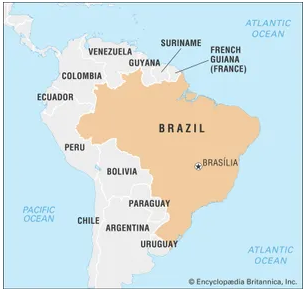
Context: Recently, Brazilian President Luiz Inácio Lula da Silva paid a State Visit to India at the invitation of Prime Minister Narendra Modi.
More on the News
• It was the Brazilian President’s fifth visit to India and second State Visit, following PM Modi’s visit to Brazil in July 2025.
• During the visit, the Brazilian President attended the AI Impact Summit and addressed the India–Brazil Economic Forum in New Delhi, where he described India as a “democratic brother of the Global South.”
• The visit reaffirmed the India–Brazil Strategic Partnership (2006) and deepened cooperation across political, economic, digital, and multilateral domains.
Key Highlights of the Visit
• Trade and Economic Cooperation: The Brazilian President has set an ambitious target of $30 billion in bilateral trade, surpassing India’s earlier goal of $20 billion for 2030.
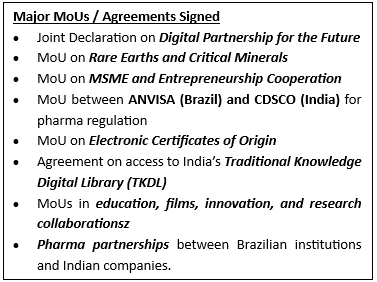
• Digital, AI and Innovation Partnership: The visit marked a major push in digital cooperation, including a Joint Declaration on Digital Partnership for the Future.
• Health, Pharma and Traditional Medicine: The countries agreed to expand collaboration in:
• Defence, Security and Strategic Cooperation: Both sides agreed to deepen defence cooperation through co-development and co-production, including submarine maintenance and industry partnerships.
• Energy, Climate and Critical Minerals: The leaders committed to cooperation in energy transition and climate action, including biofuels, hydrogen, renewables, and sustainable fuels.
• People-to-People and Cultural Diplomacy: Both countries extended tourist and business visas to 10 years and expanded cooperation in education, tourism, sports, cinema, and youth exchanges.
• Multilateral Cooperation: India and Brazil reiterated support for reformed multilateralism and stronger Global South representation in global institutions.
India and Brazil Bilateral Relations
|
Political Relations: |
·
Diplomatic
relations were established in 1948, with both countries opening
embassies the same year. ·
The
relationship was elevated to a Strategic Partnership in 2006
based on a common global vision, shared democratic values and inclusive
growth. ·
Both countries
cooperate in plurilateral fora such as BRICS, IBSA, G20, G4,
International Solar Alliance, Global Biofuel Alliance, Coalition for Disaster
Resilient Infrastructure, and multilateral bodies like UN, WTO,
UNESCO and WIPO. ·
Institutional
mechanisms include: o
Joint
Commission Meeting (Foreign Ministers) o
Strategic
Dialogue (NSAs) o
Foreign Office
Consultations o
Trade
Monitoring Mechanism o
Cyber Dialogue.
|
|
Defence Relations: |
·
A defence
cooperation agreement signed in 2003 (ratified 2006) established a Joint
Defence Committee (JDC). ·
A 2+2
Political-Military Dialogue was inaugurated in March 2024. ·
An MoU on
maintenance of Scorpene-class submarines was signed between the
Brazilian Navy, Indian Navy, and Mazagon Dock Shipbuilders in December.
|
|
Economic Relations: |
·
Bilateral trade
reached USD 15.21 billion in 2025 (up from USD 12.20 billion in
2024). ·
Indian
exports: diesel, agro-chemicals,
chemicals, pharmaceuticals, engineering goods, yarn, aluminium. ·
Brazilian
exports: crude oil, soybean oil,
gold, sugar, cotton, chemicals, iron ore. ·
Total Indian
investment in Brazil exceeds USD 15 billion, spanning
pharmaceuticals, automobiles, IT, oil & gas, and chemicals. o
Investment
Cooperation and Facilitation Treaty (ICFT). o
Protocol
amending Double Taxation Avoidance Agreement (DTAA) entered into force in 2025.
|
|
Space Cooperation: |
·
Both countries
signed a framework agreement for peaceful use of outer space in 2004,
alongside inter-agency cooperation. ·
India launched
Brazil’s Amazonia-1 satellite (2021), Brazil’s first
fully indigenous Earth observation satellite.
|
|
Indian Diaspora: |
·
The Indian
community in Brazil is estimated to be around 5,000 people,
which are mainly immigrants or expatriates from India. |
Significance of Brazil for India
• Key Economic and Trade Partner: Brazil is India’s largest trading partner in Latin America and the Caribbean, with bilateral trade of around USD 15 billion.
• Strategic Resource Partner: Brazil possesses critical minerals such as niobium, lithium, and iron ore that are essential for energy transition, electric vehicles and batteries, and advanced manufacturing, helping India diversify supply chains and reduce resource dependency.
• South–South and Multilateral Alignment: As major developing economies, India and Brazil cooperate in BRICS, IBSA Dialogue Forum, G20, and WTO to promote South–South cooperation, equitable global governance, and intellectual property balance.
• Response to U.S. Trade Pressures: Both countries have faced 50% U.S. tariffs and potential further trade actions and share concerns over trade unilateralism, energy policies, sanctions, and tariffs, making coordination necessary for effective negotiation with the U.S.
• Geopolitical Significance: The engagement occurred amid U.S. trade turmoil, BRICS tensions, and supply chain realignments, reinforcing India–Brazil alignment in strategic autonomy and non-aligned diplomacy.
The most trusted learning platform on your phone
With our training programs, learning online can be a very exciting experience! Take the next step toward achieving your professional and personal objectives



Course Related Query:
Ask Your DoubtsStore Related Query:[email protected]NCERT Books
Resources
We love learning. Through our innovative solutions, we encourage ourselves, our teams, and our Students to grow. We welcome and look for diverse perspectives and opinions because they enhance our decisions. We strive to understand the big picture and how we contribute to the company’s objectives. We approach challenges with optimism and harness the power of teamwork to accomplish our goals. These aren’t just pretty words to post on the office wall. This is who we are. It’s how we work. And it’s how we approach every interaction with each other and our Students.
Come with an open mind, hungry to learn, and you’ll experience unmatched personal and professional growth, a world of different backgrounds and perspectives, and the freedom to be you—every day. We strive to build and sustain diverse teams and foster a culture of belonging. Creating an inclusive environment where every students feels welcome, appreciated, and heard gives us something to feel (really) good about.
Get Free academic Counseling & Course Details