You're all caught up—no notifications available.
Explore All Exams at KGS


All Exams
Explore All Exams at KGS

Khan Sir Courses
Geography I Polity I History | World Map I Indian Map I Economics I Biology

UPSC & State PSC
UPSC I BPSC I UP-PSC I MP-PSC

State Exams
UP I Bihar I MP | Rajasthan

NEET | JEE | CUET | Boards
NEET | JEE | CUET | Boards

Defence Exams
NDA I CDS I CAPF I AFCAT I SSB I Agniveer

Police Exams
UP SI | Bihar SI | Delhi Police | UP Constable

SSC Exams
CGL I CPO I CHSL I MTS I SSC GD I Delhi Police

Foundation Courses
Physics I Chemistry I Biology I History I Geography I Polity I NCERT I Math I English | Map I Reasoning

Railway Exams
RRB | RPF

Teaching Exams
TET | Teaching | UGC

Banking Exams
SBI | RBI | IBPS

Engineering Exams
Civil | Electrical | Mechanical
UGC NET
UGC NET/JRF
Current Affairs provides you with the best compilation of the Daily Current Affairs taking place across the globe: National, International, Sports, Science and Technology, Banking, Economy, Agreement, Appointments, Ranks, and Report and General Studies

SYLLABUS
GS-2: Structure, organization and functioning of the Executive and the Judiciary Ministries and Departments of the Government.
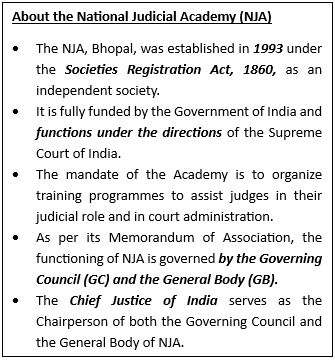
Context: The Supreme Court has directed the National Judicial Academy (NJA) to prepare comprehensive guidelines to inculcate sensitivity and compassion in judges while handling sexual offence cases and other matters involving vulnerable victims.
More on the News
• The direction came while setting aside a controversial 2025 Allahabad High Court order that had diluted charges in an attempted rape case involving a minor.
• The court expanded the matter into a broader institutional concern about judicial insensitivity and the need for survivor-centric justice delivery.
• The case arose from a 2022 complaint alleging sexual assault of an 11-year-old girl.
• The trial court issued a summons under Section 376 IPC, read with Section 18 of the POCSO Act.
• The Allahabad High Court diluted the charges to Section 354B IPC and aggravated sexual assault under POCSO, holding that the acts were preparation, not an attempt to rape.
• The ruling triggered nationwide outrage and led the Supreme Court to take suo motu cognisance.
Key Highlights of the Supreme Court Judgment
• High Court Order Set Aside: The Supreme Court termed the High Court ruling “patently erroneous” and restored the trial court’s charges under the attempt to rape provisions.
• Concern Over Judicial Sensitivity: The Court flagged systemic insensitivity in judicial reasoning in sexual offence cases, including patriarchal stereotypes, lack of empathy, and failure to recognise survivors’ lived realities.
• Guidelines via National Judicial Academy: Instead of framing guidelines itself, the Court directed the National Judicial Academy to form an expert committee led by Justice (Retd.) Aniruddha Bose.
• Mandate of the Committee: The committee will prepare draft guidelines for judges and judicial systems dealing with sexual offences and vulnerable victims.
• Indian Social Ethos Emphasised: The Court cautioned against importing foreign frameworks and said the guidelines must reflect India’s social realities.
• Simple Language and Accessibility: The Court directed that the guidelines be written in simple, non-technical language and translated into regional languages.
• Offensive Social Language Issue: The Court observed that offensive expressions in local dialects are often socially normalised despite legal implications.
• Restoration of Trial Proceeding: The Supreme Court restored the original charges and clarified that the trial should proceed without prejudice.
Significance of the Ruling
• Legal Significance: Clarifies the threshold between preparation and attempt in rape cases and strengthens the interpretation of POCSO provisions.
• Institutional Significance: Signals zero tolerance for insensitive judicial reasoning and pushes structural judicial reform through the National Judicial Academy.
• Social Significance: Recognises survivors' lived realities and promotes victim-centric justice by linking language, empathy, and justice delivery.

The most trusted learning platform on your phone
With our training programs, learning online can be a very exciting experience! Take the next step toward achieving your professional and personal objectives



Course Related Query:
Ask Your DoubtsStore Related Query:[email protected]NCERT Books
Resources
We love learning. Through our innovative solutions, we encourage ourselves, our teams, and our Students to grow. We welcome and look for diverse perspectives and opinions because they enhance our decisions. We strive to understand the big picture and how we contribute to the company’s objectives. We approach challenges with optimism and harness the power of teamwork to accomplish our goals. These aren’t just pretty words to post on the office wall. This is who we are. It’s how we work. And it’s how we approach every interaction with each other and our Students.
Come with an open mind, hungry to learn, and you’ll experience unmatched personal and professional growth, a world of different backgrounds and perspectives, and the freedom to be you—every day. We strive to build and sustain diverse teams and foster a culture of belonging. Creating an inclusive environment where every students feels welcome, appreciated, and heard gives us something to feel (really) good about.
Get Free academic Counseling & Course Details