Current Affairs provides you with the best compilation of the Daily Current Affairs taking place across the globe: National, International, Sports, Science and Technology, Banking, Economy, Agreement, Appointments, Ranks, and Report and General Studies
Key Highlights of the Union Budget 2026-27
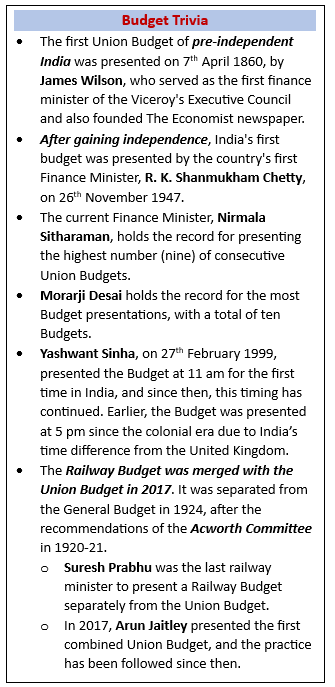
The Finance Minister of India, Smt Nirmala Sitharaman, presented the Union Budget 2026-27 on 1st February 2026 (9th Consecutive Budget). Here are the Key Highlights of the Budget:
ABOUT UNION BUDGET
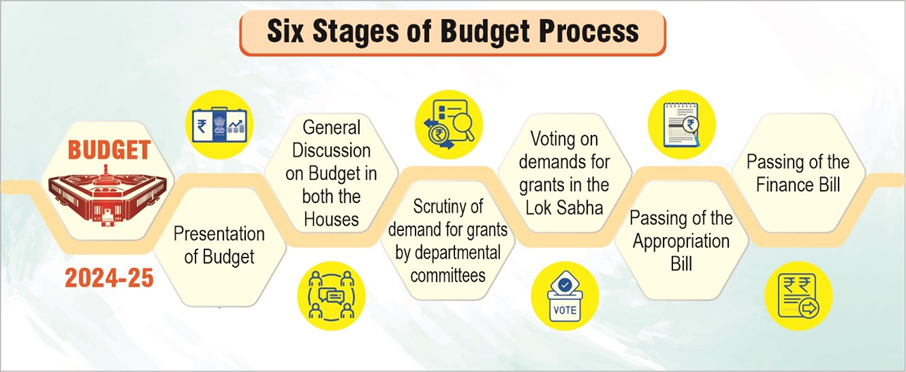
Article 112 of the Constitution provides that the “annual financial statement” for every financial year, popularly known as the Budget, shall be laid before both the Houses of Parliament.
The term ‘budget’ has not been used in the Constitution.
The Budget Division of the Department of Economic Affairs (DEA) in the Ministry of Finance is responsible for preparing the Union Budget.
The Budget is a statement of the estimated receipts and expenditures of the Government in a financial year.
Besides the Finance Minister’s Budget speech, the following Budget documents are presented to the Parliament:
Annual Financial Statement (AFS) as provided under Article 112
Demands for Grants of Central Government (under Article 113)
Finance Bill (as required under Article 110 (1)(a))
Memorandum Explaining the Provisions in the Finance Bill
Statements of Fiscal Policy under Fiscal Responsibility and Budget Management (FRBM) Act, 2003.
Expenditure Budget
Receipt Budget
Expenditure Profile
Budget at a Glance
Budget Highlights (Key Features)
Output Outcome Framework for Schemes 2026-27
Explanatory Memorandum as to the Action Taken on the Recommendations Made by the Sixteenth Finance Commission.
The Budget speech of the Finance Minister has two sections – Part A and Part B
Part A: The first part of the budget speech provides an overview of the economy of the previous and current years, and also gives Budget estimates for the next financial year. Thus, it is concerned with the ‘macro’ aspect of the economy.
Part B: The second part of the Budget speech highlights the government’s tax proposals for the next financial year, and it has a direct bearing on the personal finances of citizens.
BUDGET AT A GLANCE
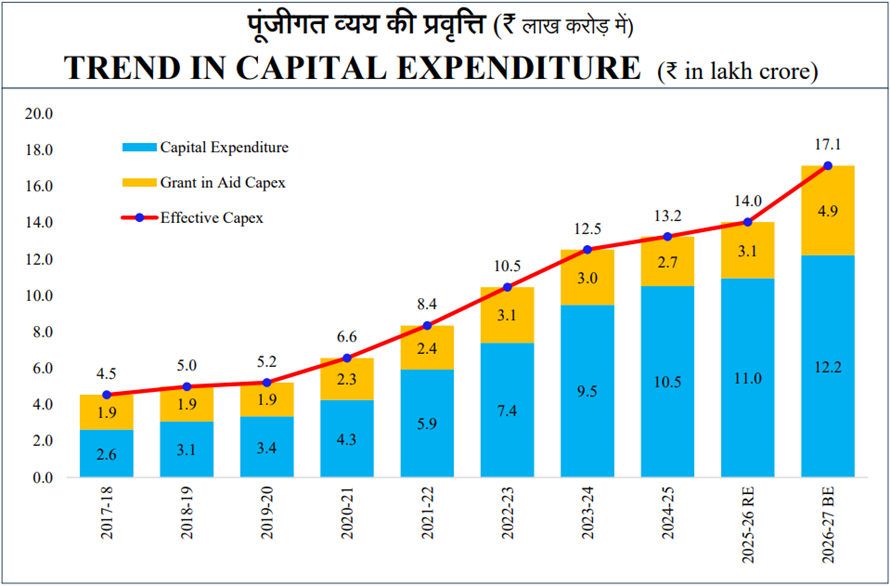
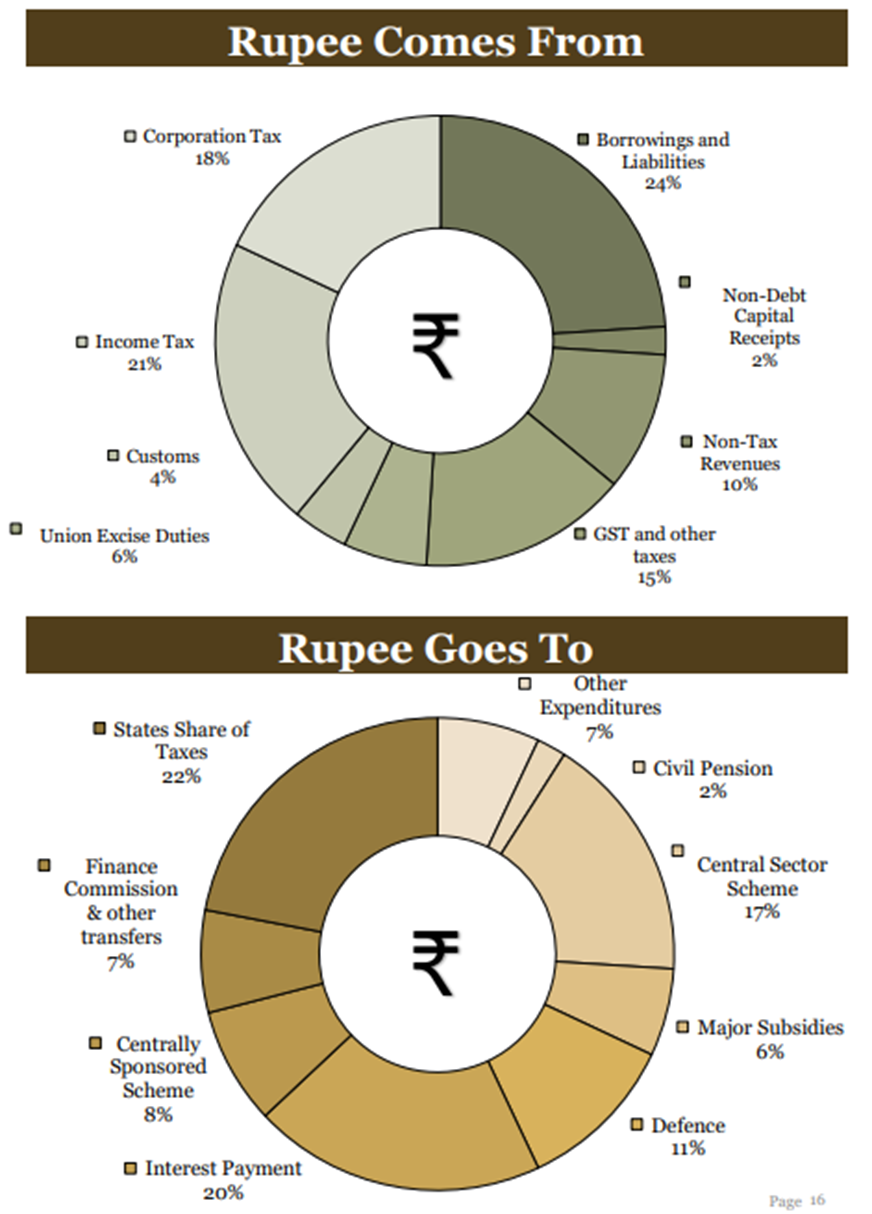
Expenditure: The total expenditure in Budget Estimates (BE) 2026-27 is estimated at ₹53,47,315 crore of which total capital expenditure is ₹12,21,821 crore and effective capital expenditure is ₹17,14,523 crore.
Interest payments are estimated at ₹14,03,972, which accounts for above 26% of the total expenditure.
Receipts: The total receipts other than borrowings are estimated at ₹36,51,547 crore, of which revenue receipts are ₹35,33,150 and capital receipts (excluding borrowings) are ₹1,18,397 crore.
The market borrowings are estimated at ₹16,95,768.
Deficits:
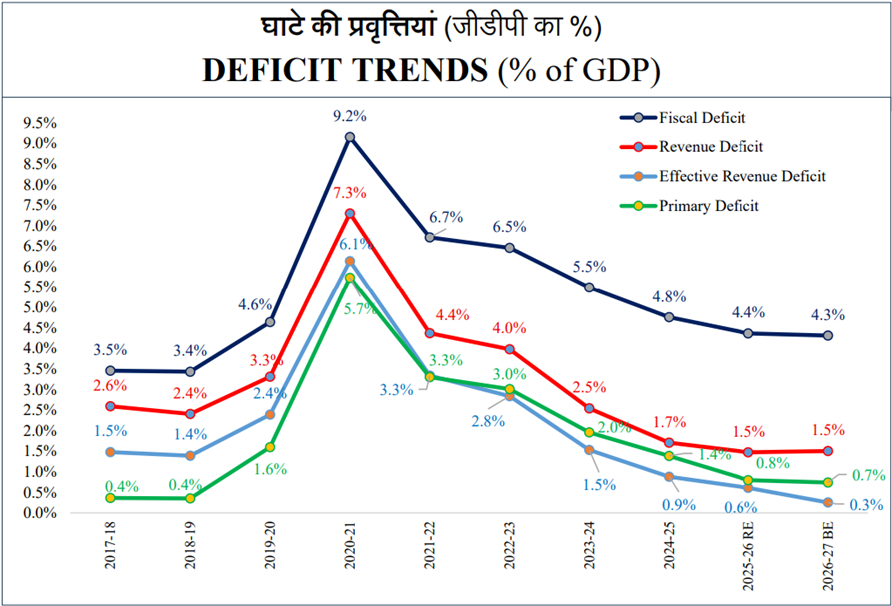
Fiscal deficit in 2026-27 is targeted at 4.3% of GDP, which is lower than the revised estimate of 4.4% of GDP in 2025-26.
Revenue deficit in 2026-27 is targeted at 1.5% of GDP, which is the same as the revised estimate of 1.5% in 2025- 26.
GDP: The nominal GDP is projected to grow by 10.1% in FY2026-27 over the first Advance Estimates of FY 2025-26. (Nominal GDP growth rate is real growth plus inflation)
As per the first advance estimates published by the National Statistics Office, India’s real GDP is estimated to grow by 7.4% in FY 2025–26.
Debt: The central government aims to reach a debt to GDP ratio of 50±1 per cent by FY 2030-31. In BE 2026- 27, outstanding liabilities are estimated to be 55.6% of the GDP.
PART A
The Union Budget 2026-27 is guided by 3 Kartavya:
Sustainable Economic Growth: To accelerate and sustain economic growth, by enhancing productivity and competitiveness, and building resilience to volatile global dynamics.
Capacity Building: To fulfil the aspirations of people and build their capacity, making them strong partners in India’s path to prosperity.
Sabka Sath, Sabka Vikas: To ensure that every family, community, region and sector has access to resources, amenities and opportunities for meaningful participation.
A. First Kartavya — Accelerate and Sustain Economic Growth (it proposes 6 interventions)
Scaling up Manufacturing in Strategic and Frontier Sectors
Biopharma SHAKTI
₹10,000 crore outlay over 5 years to develop India as a global biopharma manufacturing hub.
Establishment of a biopharma network with 3 new NIPERs and upgradation of 7 existing NIPERs.
Creation of 1,000+ accredited clinical trial sites across India.
India Semiconductor Mission (ISM) 2.0
Focus on production of equipment and materials, full-stack Indian IP design, and resilient supply chains.
Industry-led research and training centres to develop advanced technology and skilled manpower.
Electronics & Critical Minerals
Electronics Components Manufacturing Scheme outlay enhanced to ₹40,000 crore.
Dedicated Rare Earth Corridors in Odisha, Kerala, Andhra Pradesh, and Tamil Nadu for mining, processing, and manufacturing.
Chemicals & Capital Goods
Support to States for 3 Chemical Parks via challenge-based, cluster-oriented plug-and-play model.
Strengthening capital goods sector through:
Hi-Tech Tool Rooms by CPSEs at two locations.
Scheme for Enhancement of Construction and Infrastructure Equipment (CIE).
Container Manufacturing Scheme with ₹10,000 crore outlay over 5 years.
Textile Sector
Integrated Programme for Textiles including:
National Fibre Scheme for natural, man-made, and new-age fibres.
Textile Expansion and Employment Scheme for traditional clusters.
Mega Textile Parks focused on technical textiles.
Mahatma Gandhi Gram Swaraj Initiative for khadi, handloom, handicrafts with global branding and skilling support.
Rejuvenating Legacy Industrial Sectors
Scheme to revive 200 legacy industrial clusters through infrastructure and technology upgradation to enhance cost competitiveness and efficiency.
Creating Champion SMEs and Supporting Micro Enterprises
₹10,000 crore SME Growth Fund to nurture globally competitive “Champion SMEs”.
Additional ₹2,000 crore to the Self-Reliant India Fund for micro-enterprise risk capital.
Professional institutions (ICAI, ICSI, ICMAI) to design modular courses to create ‘Corporate Mitras’, especially in Tier-II and Tier-III towns.
Delivering a Powerful Push to Infrastructure
Public capital expenditure increased to ₹12.2 lakh crore in FY 2026-27.
Infrastructure Risk Guarantee Fund to de-risk private investment during the construction phase.
Monetisation of CPSE real estate through dedicated REITs.
Green Logistics & Transport
New Dedicated Freight Corridor connecting Dankuni–Surat.
Operationalisation of 20 National Waterways over 5 years.
Inland ship repair ecosystems at Varanasi and Patna.
Coastal Cargo Promotion Scheme to raise modal share of waterways and coastal shipping to 12% by 2047.
Seaplane VGF Scheme and incentives for indigenous seaplane manufacturing.
Ensuring Long-Term Energy Security
₹20,000 crore over 5 years allocated for Carbon Capture, Utilisation and Storage (CCUS) technologies.
Developing City Economic Regions (CERs)
₹5,000 crore per CER over 5 years through challenge-based, reform-linked financing.
Development of 7 High-Speed Rail Corridors as growth connectors:
With our training programs, learning online can be a very exciting experience! Take the next step toward achieving your professional and personal objectives
We love learning. Through our innovative solutions, we encourage ourselves, our teams, and our Students to grow. We welcome and look for diverse perspectives and opinions because they enhance our decisions. We strive to understand the big picture and how we contribute to the company’s objectives. We approach challenges with optimism and harness the power of teamwork to accomplish our goals. These aren’t just pretty words to post on the office wall. This is who we are. It’s how we work. And it’s how we approach every interaction with each other and our Students.
What Makes Us Different
Come with an open mind, hungry to learn, and you’ll experience unmatched personal and professional growth, a world of different backgrounds and perspectives, and the freedom to be you—every day. We strive to build and sustain diverse teams and foster a culture of belonging. Creating an inclusive environment where every students feels welcome, appreciated, and heard gives us something to feel (really) good about.