logo

All Exams

Notifications

All Exams

Explore All Exams at KGS

All Exams
Home>Current Affairs>National Quantum Mission
Current Affairs made simple.

Current Affairs provides you with the best compilation of the Daily Current Affairs taking place across the globe: National, International, Sports, Science and Technology, Banking, Economy, Agreement, Appointments, Ranks, and Report and General Studies
banner-image

National Quantum Mission

SYLLABUS

GS-3: Achievements of Indians in science & technology; indigenization of technology and developing new technology and awareness in the fields of IT and Computers.

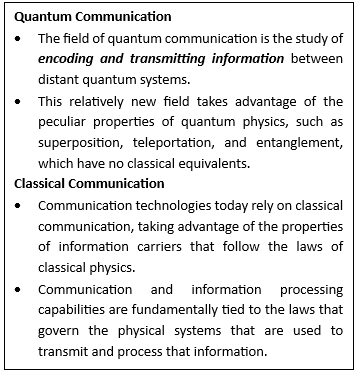
Context: Under the National Quantum Mission (NQM), India has successfully demonstrated a 1,000 km quantum communication network within two years of launch.

More on the News
  • This milestone has been achieved ahead of schedule against the target of 2,000 km secure quantum communication over 8 years.
  • The network is based on Quantum Key Distribution (QKD) and developed using indigenous technology by QNu Labs.
  • The 1,000 km network is among the longest QKD deployments globally, marking a landmark advancement in secure quantum communication.
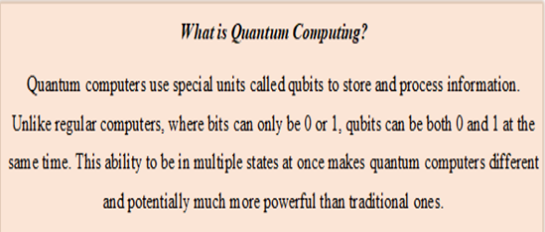
  • It enables data transmission using quantum principles, replacing classical binary systems (0s and 1s).

Significance

  • Strengthens secure communication infrastructure for defence, financial systems, and critical sectors.
  • Demonstrates rapid progress in indigenous quantum capability, reducing dependence on foreign technologies.
  • Enhances India’s position in the global quantum technology race.
  • Contributes to building a secure digital ecosystem against cyber threats.
  • Expanding startup participation and R&D funding reflects growing industry interest and ecosystem development.

About the National Quantum Mission (NQM)

  • It was approved by the Union Cabinet on 19 April 2023 with a financial outlay of ₹6003.65 crore for the period 2023–24 to 2030–31.
  • It is one of the nine initiatives under the Prime Minister’s Science, Technology and Innovation Advisory Council (PMSTIAC).
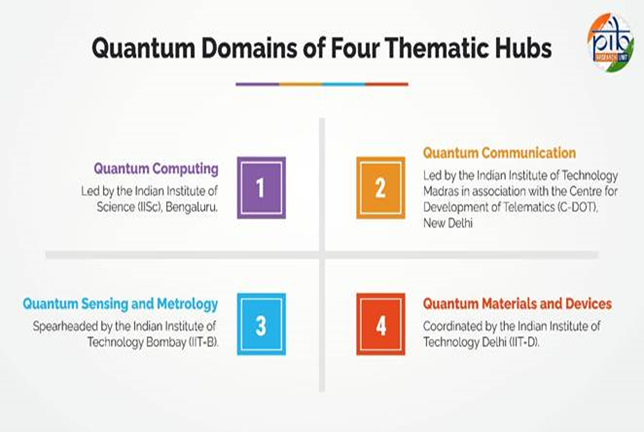
  • It focuses on advancing quantum computing, communication, sensing, and materials.
  • The mission aims to seed, nurture, and scale quantum technologies in the country while fostering a vibrant ecosystem of R&D, startups, and skilled human resources.
  • It seeks to accelerate quantum-led economic growth, enhance technological self-reliance, and position India at the forefront of next-generation technologies.
  • Core Objectives:
    • Quantum Computing Development: Build quantum computers with 20–50 qubits (3 years), 50–100 qubits (5 years), and up to 1000 qubits (8 years) across superconducting and photonic platforms.
    • Satellite-Based Quantum Communication: Enable quantum-secured communication over 2000 km and expand for international connectivity.
    • Inter-City QKD Network: Develop 2000 km quantum communication networks using optical fibre infrastructure with trusted nodes.
    • Multi-Node Quantum Networks: Establish scalable quantum networks (2–3 nodes) using entanglement swapping and quantum repeaters.
    • Quantum Sensing & Atomic Clocks: Develop ultra-sensitive sensors and high-precision clocks for navigation, communication, and defence applications.
    • Quantum Materials & Devices: Develop advanced materials like superconductors and topological materials for quantum devices and photon systems.
  • Implementation Strategy:
    • Four Thematic Hubs (T-Hubs) have been established across India.
    • These hubs bring together 14 Technical Groups across 17 states and 2 Union Territories.
    • Focus areas include technology innovation, skill development, entrepreneurship, industry partnerships, and global collaborations.
    • Participation of women scientists is actively encouraged.
  • Hub-Spoke-Spike Model: Each T-Hub follows a Hub-Spoke-Spike structure.
    • Hubs: Central institutions coordinating research.
    • Spokes: Thematic research projects.
    • Spikes: Individual research groups.

Initiatives under the National Quantum Mission (NQM)
  • Quantum-Safe Ecosystem Framework: A concept paper outlines a strategic roadmap to secure India’s digital infrastructure against quantum threats.
  • Defence Research and Development Organisation (DRDO): DRDO is developing and testing quantum-resilient security schemes along with quantum-safe symmetric and asymmetric cryptographic algorithms.
  • Society for Electronic Transactions and Security (SETS): SETS is advancing PQC research and has implemented it in FIDO authentication systems and IoT security applications.
  • Centre for Development of Telematics (C-DoT): C-DoT has developed solutions such as QKD, PQC frameworks, and quantum secure video IP phones.
footer image

The most trusted learning platform on your phone

With our training programs, learning online can be a very exciting experience! Take the next step toward achieving your professional and personal objectives


app-storeplay-store
logo
Khan Global Studies Pvt. Ltd. 5th Floor,
A13A, Graphix 1 Tower B, Sector 62,
Noida, Uttar Pradesh 201309

Course Related Query:

Ask Your DoubtsStore Related Query:[email protected]

Get Free Academic Counseling & Course Details

KGS best learning platform

About Khan Global Studies

We love learning. Through our innovative solutions, we encourage ourselves, our teams, and our Students to grow. We welcome and look for diverse perspectives and opinions because they enhance our decisions. We strive to understand the big picture and how we contribute to the company’s objectives. We approach challenges with optimism and harness the power of teamwork to accomplish our goals. These aren’t just pretty words to post on the office wall. This is who we are. It’s how we work. And it’s how we approach every interaction with each other and our Students.


What Makes Us Different

Come with an open mind, hungry to learn, and you’ll experience unmatched personal and professional growth, a world of different backgrounds and perspectives, and the freedom to be you—every day. We strive to build and sustain diverse teams and foster a culture of belonging. Creating an inclusive environment where every students feels welcome, appreciated, and heard gives us something to feel (really) good about.

Copyright 2026 KhanGlobalStudies

Have a question?

Get Free academic Counseling & Course Details

floatButton