You're all caught up—no notifications available.
Explore All Exams at KGS


All Exams
Explore All Exams at KGS

Khan Sir Courses
Geography I Polity I History | World Map I Indian Map I Economics I Biology

UPSC & State PSC
UPSC I BPSC I UP-PSC I MP-PSC

State Exams
UP I Bihar I MP | Rajasthan

NEET | JEE | CUET
NEET | JEE | CUET

Defence Exams
NDA I CDS I CAPF I AFCAT I SSB I Agniveer

Police Exams
UP SI | Bihar SI | Delhi Police | UP Constable

SSC Exams
CGL I CPO I CHSL I MTS I SSC GD I Delhi Police

Foundation Courses
Physics I Chemistry I Biology I History I Geography I Polity I NCERT I Math I English | Map I Reasoning

Railway Exams
RRB | RPF

Teaching Exams
TET | Teaching | UGC

Banking Exams
SBI | RBI | IBPS

Engineering Exams
Civil | Electrical | Mechanical
UGC NET
UGC NET/JRF
Current Affairs provides you with the best compilation of the Daily Current Affairs taking place across the globe: National, International, Sports, Science and Technology, Banking, Economy, Agreement, Appointments, Ranks, and Report and General Studies
SYLLABUS
GS-3: Science and Technology- Developments and their Applications and Effects in Everyday Life; Achievements of Indians in Science & Technology.
Context: Recently, scientists from the Indian Institute of Astrophysics (IIA) used nearly a century of observations from the Kodaikanal Solar Observatory (KSO) to uncover new insights into how the Sun's surface magnetic features track its 11-year activity cycle and influence future solar activity.
More on the News
• The study analysed digitised solar observations spanning multiple solar cycles, making use of one of the world's longest continuous records of solar data.
• Researchers examined Calcium-K (Ca-K) spectroheliogram images, which reveal magnetic activity in the Sun's chromosphere.
• The findings provide fresh evidence on the relationship between solar surface features, polar magnetic fields and the Sun's periodic activity cycle.
• The study enhances understanding of the mechanisms governing solar magnetism and long-term solar variability.
Understanding the Solar Activity Cycle
• The Sun undergoes a periodic cycle of activity approximately every 11 years, marked by fluctuations in sunspots, solar flares, coronal mass ejections and magnetic activity.
• The cycle alternates between Solar Minimum (low activity) and Solar Maximum (peak activity).
• The cycle is driven by the Sun's internal magnetic dynamo, generated through interactions between plasma flows and magnetic fields within the solar interior.
• Although solar activity follows an 11-year cycle, the Sun's magnetic field reverses polarity every cycle and returns to its original orientation after about 22 years (Hale Cycle).
• Variations in the Sun's magnetic field influence space weather and can affect satellites, communication systems, navigation networks and power infrastructure on Earth.
Key Findings of the Study
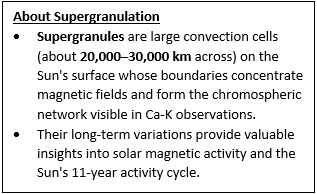
• Supergranulation Tracks Solar Activity: Analysis of century-long Kodaikanal observations showed that variations in supergranulation patterns closely follow the Sun's 11-year activity cycle.
• Polar Network Index (PNI) as a Magnetic Proxy: Researchers used supergranulation-derived network structures to develop the Polar Network Index (PNI), enabling reconstruction of long-term variations in the Sun's polar magnetic fields.
• Polar Fields Predict Future Solar Cycles: The study found a strong correlation between the PNI and the strength of subsequent solar cycles, confirming that polar magnetic fields serve as reliable precursors of future solar activity.
• Evidence for Solar Dynamo Theory: The findings provide observational support for the Babcock–Leighton Solar Dynamo Model, which explains the generation and evolution of the Sun's magnetic cycle.
Significance of the Study
• Improving Solar Cycle Prediction: A better understanding of polar magnetic fields can enhance forecasting of future solar cycles and solar activity levels.
• Advancing Space Weather Forecasting: Improved predictions of solar storms can help protect satellites, navigation systems, communication networks and power grids.
• Strengthening Solar Dynamo Research: The findings provide important observational evidence for theories explaining the generation and evolution of solar magnetic fields.
• Supporting Space Exploration: Reliable forecasts of solar activity are critical for the safety of astronauts and future space missions.
• Showcasing India's Scientific Contribution: The study highlights the global importance of India's long-term solar observations and research infrastructure in advancing solar physics.
About Kodaikanal Solar Observatory (KSO)
• Established in 1899 at Kodaikanal, Tamil Nadu, the observatory is one of India's premier solar research facilities and is currently operated by the Indian Institute of Astrophysics (IIA), Bengaluru.
• KSO is renowned for maintaining one of the world's longest continuous records of solar observations, with systematic observations of the Sun being carried out since 1904.
• The observatory houses several historic and modern solar instruments and has made significant contributions to solar physics, including studies related to sunspots, solar magnetic activity and solar variability.
The most trusted learning platform on your phone
With our training programs, learning online can be a very exciting experience! Take the next step toward achieving your professional and personal objectives


Course Related Query:
Ask Your DoubtsStore Related Query:[email protected]NEET | JEE | CUET
NCERT Books
Resources
We love learning. Through our innovative solutions, we encourage ourselves, our teams, and our Students to grow. We welcome and look for diverse perspectives and opinions because they enhance our decisions. We strive to understand the big picture and how we contribute to the company’s objectives. We approach challenges with optimism and harness the power of teamwork to accomplish our goals. These aren’t just pretty words to post on the office wall. This is who we are. It’s how we work. And it’s how we approach every interaction with each other and our Students.
Come with an open mind, hungry to learn, and you’ll experience unmatched personal and professional growth, a world of different backgrounds and perspectives, and the freedom to be you—every day. We strive to build and sustain diverse teams and foster a culture of belonging. Creating an inclusive environment where every students feels welcome, appreciated, and heard gives us something to feel (really) good about.
Get Free academic Counseling & Course Details