logo

All Exams

Notifications

All Exams

Explore All Exams at KGS

All Exams
Home>Current Affairs>India’s 7th National Report to the Convention on Biological Diversity (CBD)
Current Affairs made simple.

Current Affairs provides you with the best compilation of the Daily Current Affairs taking place across the globe: National, International, Sports, Science and Technology, Banking, Economy, Agreement, Appointments, Ranks, and Report and General Studies

banner-image

India’s 7th National Report to the Convention on Biological Diversity (CBD)

SYLLABUS

GS-3: Conservation, environmental pollution and degradation, environmental impact assessment.

Context: India has submitted its 7th National Report (NR7) to the Convention on Biological Diversity, presenting a national assessment of progress towards biodiversity targets for 2030 under the Kunming-Montreal Global Biodiversity Framework (KMGBF).

More on the News
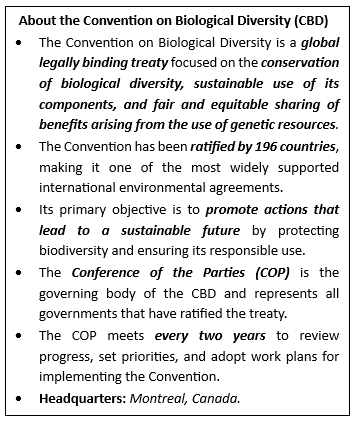
  • The report is India’s official submission under the CBD, an international treaty through which countries commit to conserving biodiversity and using natural resources sustainably.
  • All member countries are required to submit periodic national reports describing actions taken, progress achieved, and challenges faced in biodiversity conservation.
  • India’s 7th National Report is the first comprehensive progress review since the adoption of the Kunming–Montreal Global Biodiversity Framework (KMGBF) in 2022.
  • India evaluated its progress against 23 National Biodiversity Targets (NBTs) aligned with these global goals.
  • The report was prepared by the Ministry of Environment, Forest and Climate Change with inputs from 33 ministries and departments.

About the Kunming–Montreal Global Biodiversity Framework (GBF)

  • The Kunming–Montreal Global Biodiversity Framework was adopted during the 15th Conference of the Parties (COP-15) to the Convention on Biological Diversity after a four-year consultation and negotiation process.
  • The framework provides an ambitious pathway to achieve the global vision of “living in harmony with nature” by 2050, while supporting the achievement of the Sustainable Development Goals (SDGs) and building on earlier CBD Strategic Plans.
  • The framework establishes 4 global goals for 2050 and 23 targets to be achieved by 2030 to guide global biodiversity conservation and sustainable use.
  • The KMGBF sets 23 global biodiversity targets to be achieved by 2030, including:
    o Conserving 30% of global land and seas (30×30 goal)
    o Restoring degraded ecosystems
    o Reducing pollution
    o Controlling invasive alien species
    o Halting human-induced species extinction

Key Highlights of the Report

  • Policy Alignment and Monitoring Framework: India updated its National Biodiversity Strategy and Action Plan (NBSAP) to align with the KMGBF.
    o The revised framework includes 23 national biodiversity targets and 142 indicators forming a national biodiversity monitoring system.
    o The planning and policy alignment phase is largely completed, but implementation remains the key challenge.
  • Biodiversity-Inclusive Planning (NBT1): India’s forest and tree cover stands at 827,357 sq km (25.17% of geographical area).
    o Forest and tree cover increased by 1,445.81 sq km between 2021 and 2023.
    o Progress in ecosystem planning includes nationwide wetland inventories, Integrated Coastal Zone Management Plans in coastal states, the declaration of Eco-Sensitive Zones around most protected areas, and the introduction of digital environmental clearance through PARIVESH 2.0.
  • Ecosystem Restoration (NBT2): About 29.77% of India’s geographical area (≈97 million hectares) is undergoing land degradation.
    o Under the Bonn Challenge, India pledged to restore 26 million hectares of degraded land by 2030.
    o 24.1 million hectares have already been restored or are under restoration.
    o Forest carbon stock increased to 7,285.5 million tonnes.
    o Mangrove cover and bamboo area have also expanded.
  • Conservation Coverage (NBT3): India continues to expand its protected area network, which currently covers just over 5% of the country’s geographical area.
    o Marine protected areas are increasing, and identification of Other Effective Area-Based Conservation Measures (OECMs) is underway.
    o However, achieving the 30% conservation target by 2030 remains uncertain.
  • Species Recovery (NBT4): Conservation success has been recorded for several flagship species:
    o Tiger population: 3,167
    o Increasing Asiatic lion population.
    o Stable or growing one-horned rhinoceros populations.
    o First national snow leopard population assessment completed.
    o Vulture conservation breeding programmes are ongoing.
  • Biodiversity in Agriculture and Landscapes: Trees Outside Forests (TOF) contribute significantly to India’s tree cover.
    o Agroforestry covers about 8.65% of India’s geographical area.
    o Expansion of mangroves and increased forest carbon stock contribute to climate mitigation and biodiversity conservation.
  • Monitoring and Governance Challenges: Biodiversity data remains fragmented across multiple departments.
    o Several indicators lack standardized monitoring protocols.
    o Differences in data collection intervals affect long-term trend analysis.
    o Climate change impacts such as floods, droughts, and forest fires are increasing ecological stress.
  • Overall Progress Toward 2030 Targets: Of the 23 national biodiversity targets, only NBT1 (biodiversity-inclusive land and sea-use planning) and NBT2 (ecosystem restoration) are clearly on track.
    o Many other targets still rely on policy initiatives rather than measurable outcomes, indicating the need for stronger implementation.

 Sources:
Down to Earth
UN ORG
CBD

footer image

The most trusted learning platform on your phone

With our training programs, learning online can be a very exciting experience! Take the next step toward achieving your professional and personal objectives


app-storeplay-store
logo
Khan Global Studies Pvt. Ltd. 5th Floor,
A13A, Graphix 1 Tower B, Sector 62,
Noida, Uttar Pradesh 201309

Course Related Query:

Ask Your DoubtsStore Related Query:[email protected]

Get Free Academic Counseling & Course Details

KGS best learning platform

About Khan Global Studies

We love learning. Through our innovative solutions, we encourage ourselves, our teams, and our Students to grow. We welcome and look for diverse perspectives and opinions because they enhance our decisions. We strive to understand the big picture and how we contribute to the company’s objectives. We approach challenges with optimism and harness the power of teamwork to accomplish our goals. These aren’t just pretty words to post on the office wall. This is who we are. It’s how we work. And it’s how we approach every interaction with each other and our Students.


What Makes Us Different

Come with an open mind, hungry to learn, and you’ll experience unmatched personal and professional growth, a world of different backgrounds and perspectives, and the freedom to be you—every day. We strive to build and sustain diverse teams and foster a culture of belonging. Creating an inclusive environment where every students feels welcome, appreciated, and heard gives us something to feel (really) good about.

Copyright 2026 KhanGlobalStudies

Have a question?

Get Free academic Counseling & Course Details

floatButton