You're all caught up—no notifications available.
Explore All Exams at KGS


All Exams
Explore All Exams at KGS

Khan Sir Courses
Geography I Polity I History | World Map I Indian Map I Economics I Biology

UPSC & State PSC
UPSC I BPSC I UP-PSC I MP-PSC

State Exams
UP I Bihar I MP | Rajasthan

NEET | JEE | CUET | Boards
NEET | JEE | CUET | Boards

Defence Exams
NDA I CDS I CAPF I AFCAT I SSB I Agniveer

Police Exams
UP SI | Bihar SI | Delhi Police | UP Constable

SSC Exams
CGL I CPO I CHSL I MTS I SSC GD I Delhi Police

Foundation Courses
Physics I Chemistry I Biology I History I Geography I Polity I NCERT I Math I English | Map I Reasoning

Railway Exams
RRB | RPF

Teaching Exams
TET | Teaching | UGC

Banking Exams
SBI | RBI | IBPS

Engineering Exams
Civil | Electrical | Mechanical
UGC NET
UGC NET/JRF
Current Affairs provides you with the best compilation of the Daily Current Affairs taking place across the globe: National, International, Sports, Science and Technology, Banking, Economy, Agreement, Appointments, Ranks, and Report and General Studies

Bio-Bitumen Technology
Context: India has launched an indigenous bio-bitumen technology for road construction, marking a shift towards sustainable highways and reduced dependence on imported fossil-fuel-based materials.
More on the News
• The Union Minister of State for Science and Technology announced the successful technology transfer of “Bio-Bitumen via Pyrolysis: From Farm Residue to Roads.”
• The technology was jointly developed by CSIR–Central Road Research Institute (CRRI), New Delhi, and CSIR–Indian Institute of Petroleum (IIP), Dehradun.
About the Bio-Bitumen Technology
• The technology converts farm residue into bio-bitumen through the process of pyrolysis.
• The innovation provides a bio-based alternative to conventional petroleum-derived bitumen used in road construction.
• Roads constructed using bio-bitumen are expected to be more durable while requiring lower construction and maintenance costs.
• The process is emission-free and aligns with circular economy and waste-to-wealth principles.
Economic and Strategic Significance
• India currently imports nearly 50 percent of its bitumen requirement.
• Indigenous bio-bitumen has the potential to replace imports worth ₹25,000–30,000 crore annually.
• The technology strengthens Atmanirbhar Bharat by reducing foreign dependence on infrastructure materials.
• It supports economic self-reliance while creating value from agricultural waste.
India Assumes BRICS Chairmanship for 2026
Context: The BRICS chairmanship officially passed from Brazil to India on January 1, 2026, aiming to strengthen resilience, innovation and Global South cooperation amid changing global economic and geopolitical conditions.
More on the News
• Brazil formally handed over the chairmanship to India during a meeting of BRICS sherpas.
• The announcement and priorities were outlined by Prime Minister of India at the BRICS 2025 Summit in Rio de Janeiro.
• The remarks were published on the website of the Ministry of External Affairs of India.
About BRICS
• The term "BRIC" (Brazil, Russia, India, China) was first coined by Goldman Sachs economist Jim O’Neill in 2001.
• BRIC, as a formal grouping, started after the meeting of the Leaders of Russia, India and China in St Petersburg on the margins of the G8 Outreach Summit in 2006.
• The grouping was formalised during the first meeting of BRIC Foreign Ministers on the margins of UNGA in New York in 2006.
• Members: Brazil, Russia, India, China, South Africa, Egypt, Ethiopia, Indonesia, Iran, and the United Arab Emirates.
About India’s BRICS Chairmanship
• India will lead BRICS for the first time in its expanded format of ten member countries.
• The chairmanship theme focuses on strengthening resilience and fostering innovation for cooperation and sustainability.
• India seeks to redefine BRICS as a people-centric platform guided by the principle of Humanity First.
• India will host the 18th BRICS Summit in 2026.
Cashless Treatment Scheme for Road Accident Victims
Context: The Union Minister for Road Transport and Highways is set to launch a nationwide cashless treatment scheme to reduce road accident fatalities by ensuring timely medical care during the critical golden hour.
Key Features of the Scheme
• The scheme will provide cashless medical treatment up to ₹1.5 lakh for road accident victims.
• The coverage will be applicable across all roads in the country and not limited to national highways.
• The treatment will be available for a minimum period of seven days after the accident.
• The scheme is expected to be launched nationwide by the Prime Minister.
Funding and Insurance Framework
• The medical expenses will be covered under the third-party motor insurance purchased at the time of vehicle registration.
• In cases where the accident involves an uninsured vehicle, the cost of treatment will be borne by the government from the Road Safety Fund.
• Individuals who take accident victims to hospitals will be recognised as Rahveers under the scheme.
• A cash award of ₹25,000 will be provided to such Good Samaritans.
• The incentive can be claimed by only one individual per accident victim.
India’s data centre capacity more than doubled in 2025
Context: Recently, India recorded a sharp rise in data centre capacity additions in 2025, with new supply doubling to 387 MW IT compared to 191 MW IT.
More in the News
• India’s data centre absorption rose 5% year-on-year to 427 MW IT in 2025, up from 407 MW IT in 2024.
• Mumbai and Chennai led demand, together accounting for nearly 70% of total absorption, driven by hyperscale operators amid rapid growth in cloud adoption, AI workloads, 5G rollout, and IoT usage.
• Emerging hubs Visakhapatnam, Kolkata (48% CAGR), and Hyderabad (44% CAGR) are gaining traction, driven by policy support, cost advantages, undersea cable links, and 5G–IoT-led low-latency demand.
• The report projects India’s data centre market to triple to over 4 GW IT capacity by 2030, growing at a CAGR of 23%.
• 5G expansion and rising digital consumption are fueling hyperscale data centre demand in Tier-2 cities to support local processing and low-latency requirements.
• These trends strengthen India’s emergence as a global hub for scalable, long-term data centre investments.
About the Data Centre
• A data centre is a physical room, building or facility that houses IT infrastructure for building, running and delivering applications and services.
• It stores and manages the data associated with those applications and services.
• In 2006, Google launched the first hyperscale data centre in The Dalles, Oregon.
• Types of data centres:
UIDAI launched Aadhaar Mascot ‘Udai’
Context: Recently, UIDAI launched the Aadhaar mascot Udai in Thiruvananthapuram.
More on the News
• The mascot has been selected from various entries received through a national design and name competition on the MyGov platform.
• Udai is a new resident-facing communication companion to simplify public understanding of Aadhaar services.
• It will make Aadhaar-related information more relatable and people-friendly.
• It will simplify communication of Aadhaar services, covering updates, authentication, offline verification, selective data sharing, new technologies, and responsible usage.
• The launch adds to UIDAI’s broader push to enhance user awareness, responsible adoption and citizen-friendly communication surrounding Aadhaar services.
• Arun Gokul (Thrissur, Kerala) won first prize in the mascot design competition, followed by Idris Dawaiwala (Pune, Maharashtra) in second place and Krishna Sharma (Ghazipur, Uttar Pradesh) in third.

About Unique Identification Authority of India (UIDAI):
• UIDAI is a statutory authority under the Aadhaar Act, 2016, established on 12 July 2016 under the Ministry of Electronics and Information Technology (MeitY), and amended by the Aadhaar and Other Laws (Amendment) Act, 2019.
• It was created to issue Unique Identification numbers (UID), named as "Aadhaar", to all residents of India.
• It is designed to eliminate duplicate and fake identities through secure, cost-effective authentication.
PANKHUDI Portal
Context: The Ministry of Women and Child Development launched PANKHUDI (8 January 2026), an integrated digital portal designed to streamline Corporate Social Responsibility (CSR) and partnership initiatives focused on women and child development.
More on the News
• PANKHUDI is a single-window digital platform that brings together individuals, Non-Resident Indians (NRIs), Non-Governmental Organisations (NGOs), Corporate Social Responsibility (CSR) contributors, corporate entities, and government agencies working in women and child development.
• The platform is intended to strengthen transparency, enhance coordination, and build a structured digital ecosystem for voluntary and institutional participation.
• It enables contributors to register, identify initiatives, submit proposals and track project progress through defined approval workflows.
• PANKHUDI supports flagship missions of the Ministry, including Mission Saksham Anganwadi & Poshan 2.0, Mission Vatsalya and Mission Shakti.
• All contributions on the platform will be processed through non-cash modes to ensure traceability and accountability.
• The launch of the PANKHUDI portal marks a significant step in leveraging digital solutions for inclusive, collaborative, and outcome-oriented development of women and children across India, while enhancing ease of doing CSR and partnerships with the Government through a transparent, trusted, and technology-enabled framework.
• It will strengthen infrastructure and services across more than 14 lakh Anganwadi Centres, 5,000 Child Care Institutions, around 800 One Stop Centres (OSCs), over 500 Shakhi Niwas, and more than 400 Shakti Sadan, ultimately improving ease of living for crores of citizens served by these institutions.
• It represents the spirit of Jan Bhagidari by providing a digital platform that unites government, citizens, and institutions to collaborate on social development.
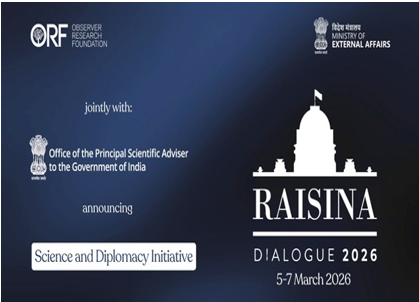
Raisina Science Diplomacy Initiative 2026
Context: The Raisina Science Diplomacy Initiative is India’s new science diplomacy platform launched to bring science, technology, and diplomacy together under Raisina Dialogue framework at the 2026 edition.
More on the News
• The Office of the Principal Scientific Adviser to the Government of India and the Observer Research Foundation (ORF) announced a partnership for the inaugural of Raisina Science Diplomacy Initiative.
• The announcement took place during a meeting held at the Office of the Principal Scientific Adviser.
Objective of the Initiative
• The initiative aims to create a dedicated platform within the Raisina Dialogue to deliberate on science technology and diplomacy.
• It seeks to highlight the role of science and technology in shaping global policy and diplomatic engagement.
• It reflects India’s changing priorities and opportunities in international cooperation.
• It provides a forum for capacity building and informed global dialogue on science-policy interfaces, strengthening collaboration between governments, scientific communities, and diplomacy practitioners.
The most trusted learning platform on your phone
With our training programs, learning online can be a very exciting experience! Take the next step toward achieving your professional and personal objectives



NCERT Books
Resources
We love learning. Through our innovative solutions, we encourage ourselves, our teams, and our Students to grow. We welcome and look for diverse perspectives and opinions because they enhance our decisions. We strive to understand the big picture and how we contribute to the company’s objectives. We approach challenges with optimism and harness the power of teamwork to accomplish our goals. These aren’t just pretty words to post on the office wall. This is who we are. It’s how we work. And it’s how we approach every interaction with each other and our Students.
Come with an open mind, hungry to learn, and you’ll experience unmatched personal and professional growth, a world of different backgrounds and perspectives, and the freedom to be you—every day. We strive to build and sustain diverse teams and foster a culture of belonging. Creating an inclusive environment where every students feels welcome, appreciated, and heard gives us something to feel (really) good about.
Get Free academic Counseling & Course Details