You're all caught up—no notifications available.
Explore All Exams at KGS


All Exams
Explore All Exams at KGS

Khan Sir Courses
Geography I Polity I History | World Map I Indian Map I Economics I Biology

UPSC & State PSC
UPSC I BPSC I UP-PSC I MP-PSC

State Exams
UP I Bihar I MP | Rajasthan

NEET | JEE | CUET | Boards
NEET | JEE | CUET | Boards

Defence Exams
NDA I CDS I CAPF I AFCAT I SSB I Agniveer

Police Exams
UP SI | Bihar SI | Delhi Police | UP Constable

SSC Exams
CGL I CPO I CHSL I MTS I SSC GD I Delhi Police

Foundation Courses
Physics I Chemistry I Biology I History I Geography I Polity I NCERT I Math I English | Map I Reasoning

Railway Exams
RRB | RPF

Teaching Exams
TET | Teaching | UGC

Banking Exams
SBI | RBI | IBPS

Engineering Exams
Civil | Electrical | Mechanical
UGC NET
UGC NET/JRF
Current Affairs provides you with the best compilation of the Daily Current Affairs taking place across the globe: National, International, Sports, Science and Technology, Banking, Economy, Agreement, Appointments, Ranks, and Report and General Studies

SYLLABUS
GS-2: Government policies and interventions for development in various sectors and issues arising out of their design and implementation.
Context: Recently, Union Home Minister and Minister of Cooperation launched the Vibrant Villages Programme–II (VVP–II) at Nathanpur village in Assam’s Cachar district along the Indo-Bangladesh border.
More on the News
• The launch marks the expansion of the Vibrant Villages initiative beyond the northern border areas, with the second phase targeting strategic villages along multiple international borders.
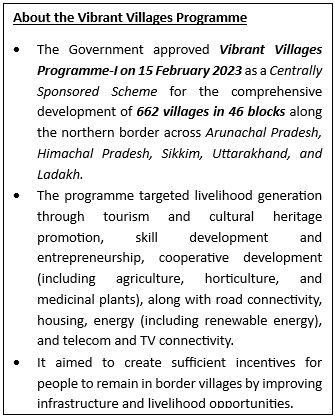
• The programme builds on Vibrant Villages Programme–I, which focused on villages along the China border.
About the Vibrant Villages Programme–II (VVP-II)
• To further the vision of Viksit Bharat@2047 for safe and vibrant land borders, the Government approved Vibrant Villages Programme-II on 2 April 2025 as a Central Sector Scheme with an outlay of ₹6,839 crore up to FY 2028–29.
• VVP-II seeks saturation of villages across four thematic areas, all-weather roads, telecom connectivity, television connectivity, and electrification, through convergence with existing schemes.
• The main goal of VVP–II is to develop border villages as vibrant growth centres and ensure they are not left behind in India’s development journey.
• Key objectives include:
• Coverage: 1,954 villages across 334 blocks.
• Geographic spread: 15 States and 2 Union Territories.
• Borders covered: Pakistan, Nepal, Bangladesh, Bhutan, and Myanmar.
• States include: Arunachal Pradesh, Assam, Bihar, Gujarat, Jammu & Kashmir, Ladakh, Manipur, Meghalaya, Mizoram, Nagaland, Punjab, Rajasthan, Sikkim, Tripura, Uttarakhand, Uttar Pradesh and West Bengal.
Strategy and Components
• Infrastructure Development: The programme focuses on improving roads, telecommunications, and basic amenities to enhance connectivity and social infrastructure in border areas.
• Scheme Saturation: It aims to ensure full coverage of existing government welfare schemes through targeted delivery to individual beneficiaries.
• Livelihood Promotion: The initiative promotes economic opportunities in border regions through enabling infrastructure and capacity-building measures.
• Security Integration: It integrates residents into border management by encouraging them to act as the “eyes and ears” of security forces to curb illegal activities and trans-border crimes.
• Community Outreach: The programme emphasises culturally sensitive engagement with border communities to build trust, enhance awareness of border security, and promote understanding of immigration laws.
Significance
• Strategic Security Importance: The programme strengthens border management through community participation, helping counter infiltration, smuggling, and trans-border crimes while enhancing civilian presence in sensitive regions.
• Development of Border Regions: It reduces regional disparities by improving infrastructure, connectivity, and access to welfare schemes while preventing out-migration from border areas.
• National Integration: The initiative promotes socio-cultural integration of border populations, builds trust between citizens and security agencies, and reinforces national unity in peripheral regions.
• Economic and Livelihood Impact: It generates local employment opportunities, promotes rural growth centres along borders, and integrates border economies with national markets.
• Governance Significance: The programme reflects a convergence model combining development, welfare, and security, marking an expansion from the China-focused VVP-I to a multi-border VVP-II with a long-term border stabilisation strategy.
Sources :
PIB
Indian Express
VVP

The most trusted learning platform on your phone
With our training programs, learning online can be a very exciting experience! Take the next step toward achieving your professional and personal objectives



Course Related Query:
Ask Your DoubtsStore Related Query:[email protected]NCERT Books
Resources
We love learning. Through our innovative solutions, we encourage ourselves, our teams, and our Students to grow. We welcome and look for diverse perspectives and opinions because they enhance our decisions. We strive to understand the big picture and how we contribute to the company’s objectives. We approach challenges with optimism and harness the power of teamwork to accomplish our goals. These aren’t just pretty words to post on the office wall. This is who we are. It’s how we work. And it’s how we approach every interaction with each other and our Students.
Come with an open mind, hungry to learn, and you’ll experience unmatched personal and professional growth, a world of different backgrounds and perspectives, and the freedom to be you—every day. We strive to build and sustain diverse teams and foster a culture of belonging. Creating an inclusive environment where every students feels welcome, appreciated, and heard gives us something to feel (really) good about.
Get Free academic Counseling & Course Details