You're all caught up—no notifications available.
Explore All Exams at KGS


All Exams
Explore All Exams at KGS

Khan Sir Courses
Geography I Polity I History | World Map I Indian Map I Economics I Biology

UPSC & State PSC
UPSC I BPSC I UP-PSC I MP-PSC

State Exams
UP I Bihar I MP | Rajasthan

NEET | JEE | CUET
NEET | JEE | CUET

Defence Exams
NDA I CDS I CAPF I AFCAT I SSB I Agniveer

Police Exams
UP SI | Bihar SI | Delhi Police | UP Constable

SSC Exams
CGL I CPO I CHSL I MTS I SSC GD I Delhi Police

Foundation Courses
Physics I Chemistry I Biology I History I Geography I Polity I NCERT I Math I English | Map I Reasoning

Railway Exams
RRB | RPF

Teaching Exams
TET | Teaching | UGC

Banking Exams
SBI | RBI | IBPS

Engineering Exams
Civil | Electrical | Mechanical
UGC NET
UGC NET/JRF
Current Affairs provides you with the best compilation of the Daily Current Affairs taking place across the globe: National, International, Sports, Science and Technology, Banking, Economy, Agreement, Appointments, Ranks, and Report and General Studies

SYLLABUS
GS 3: Indian Economy and issues relating to Planning, Mobilization of Resources, Growth, Development and Employment.
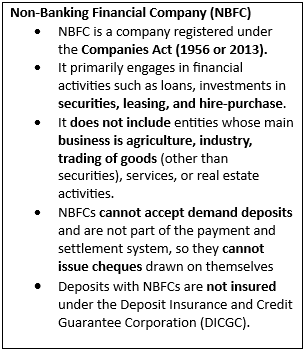
Context: The Reserve Bank of India has issued draft Amendment Directions to revise the methodology for identifying NBFC-Upper Layer (NBFC-UL) entities under the Scale-Based Regulatory (SBR) Framework and to include Government-owned NBFCs in this category.
Background:
• The Scale-Based Regulatory (SBR) Framework identifies NBFC-Upper Layer (NBFC-UL) using two methods: top 10 eligible NBFCs by asset size and a parametric scoring methodology.
• Government-owned NBFCs are currently placed only in the Base Layer or Middle Layer and are not considered for the Upper Layer.
Objective and Proposed Changes:
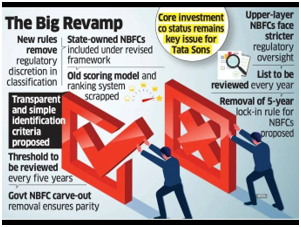
• Asset Size-Based Classification: To ensure a transparent, simple, and objective system, it is proposed to replace the existing methodology with a single asset size criterion of ₹1,00,000 crore and above.
• Removal of Automatic Top 10 Rule:
• Inclusion of Government-Owned NBFCs: To promote an ownership-neutral regulatory regime, eligible Government-owned NBFCs are proposed to be included in the NBFC-UL category based on the revised criteria.
• Additionally, all NBFC-UL entities are proposed to be allowed to use State Government guarantees as credit risk transfer instruments without any limit, subject to specified conditions.
Scale Based Regulation Framework for NBFC:
|
Layer |
Category |
Criteria |
|
Base Layer
(NBFC-BL) |
Low-risk NBFCs |
Non-deposit
NBFC with asset size below ₹1000 crore; NBFC Peer-to-Peer; NBFC Account
Aggregator |
|
Middle Layer
(NBFC-ML) |
Moderate-risk
NBFCs |
Deposit-taking
NBFC (irrespective of size); NBFCs with asset size of ₹1000 crore and above;
Standalone Primary Dealer; Infrastructure Debt Fund NBFCs |
|
Upper Layer
(NBFC-UL) |
High-risk /
systemically important NBFCs |
NBFCs
identified by RBI based on parameters and scoring methodology; eligible NBFCs
based on asset size irrespective of other factors |
|
Top Layer
(NBFC-TL) |
Extreme risk
(empty by default) |
Ideally remains
empty; includes NBFCs from Upper Layer with substantial increase in systemic
risk as identified by RBI |
Implications of the New Approach:
• Regulatory clarity:
• Impact on large conglomerates:
• Listing debate relevance:
Key Challenges:
• Increased regulatory burden may raise compliance costs due to stricter norms for more NBFCs entering the upper layer.
• Asset-based classification may overlook risk diversity and qualitative factors like interconnectedness.
• Inclusion of government NBFCs may reduce operational flexibility and increase compliance pressure.
• Ownership and governance issues (e.g., Tata Sons case) may create regulatory and restructuring challenges.
Significance of the Proposal
• Simplification of regulatory framework through clear asset-based criteria
• Enhances transparency and predictability in classification
• Moves towards uniform treatment of public and private NBFCs
• Strengthens systemic risk monitoring for large NBFCs
• May expand the number of NBFCs classified under the Upper Layer
The most trusted learning platform on your phone
With our training programs, learning online can be a very exciting experience! Take the next step toward achieving your professional and personal objectives



Course Related Query:
Ask Your DoubtsStore Related Query:[email protected]NCERT Books
Resources
We love learning. Through our innovative solutions, we encourage ourselves, our teams, and our Students to grow. We welcome and look for diverse perspectives and opinions because they enhance our decisions. We strive to understand the big picture and how we contribute to the company’s objectives. We approach challenges with optimism and harness the power of teamwork to accomplish our goals. These aren’t just pretty words to post on the office wall. This is who we are. It’s how we work. And it’s how we approach every interaction with each other and our Students.
Come with an open mind, hungry to learn, and you’ll experience unmatched personal and professional growth, a world of different backgrounds and perspectives, and the freedom to be you—every day. We strive to build and sustain diverse teams and foster a culture of belonging. Creating an inclusive environment where every students feels welcome, appreciated, and heard gives us something to feel (really) good about.
Get Free academic Counseling & Course Details