You're all caught up—no notifications available.
Explore All Exams at KGS


All Exams
Explore All Exams at KGS

Khan Sir Courses
Geography I Polity I History | World Map I Indian Map I Economics I Biology

UPSC & State PSC
UPSC I BPSC I UP-PSC I MP-PSC

State Exams
UP I Bihar I MP | Rajasthan

NEET | JEE | CUET
NEET | JEE | CUET

Defence Exams
NDA I CDS I CAPF I AFCAT I SSB I Agniveer

Police Exams
UP SI | Bihar SI | Delhi Police | UP Constable

SSC Exams
CGL I CPO I CHSL I MTS I SSC GD I Delhi Police

Foundation Courses
Physics I Chemistry I Biology I History I Geography I Polity I NCERT I Math I English | Map I Reasoning

Railway Exams
RRB | RPF

Teaching Exams
TET | Teaching | UGC

Banking Exams
SBI | RBI | IBPS

Engineering Exams
Civil | Electrical | Mechanical
UGC NET
UGC NET/JRF
Current Affairs provides you with the best compilation of the Daily Current Affairs taking place across the globe: National, International, Sports, Science and Technology, Banking, Economy, Agreement, Appointments, Ranks, and Report and General Studies

SYLLABUS
GS-3: Indian Economy and issues relating to planning, mobilization of resources, growth, development and employment.
Context: India completed nine years of the Goods and Services Tax (GST) on 1 July 2026, marking a major milestone in the country's journey towards a unified, technology-driven, and transparent indirect tax system, further strengthened by the Next-Generation GST (GST 2.0) reforms.
About the Goods and Services Tax (GST)
• GST was enabled through the 101st Constitutional Amendment Act, 2016, which empowered both the Centre and the States to levy GST by amending the constitutional distribution of taxation powers.
• It was launched on 1 July 2017 based on the principle of "One Nation, One Tax, One Market."
• GST is implemented through four key laws enacted in 2017—Central GST (CGST) Act, Integrated GST (IGST) Act, Union Territory GST (UTGST) Act, and GST (Compensation to States) Act.
• It replaced 17 Central and State taxes and 13 cesses, eliminating the cascading "tax-on-tax" effect and creating a common national market.
• GST is a destination-based consumption tax, levied on the supply of goods and services, with tax revenue accruing to the state where consumption occurs.
• It follows a Dual GST Model:
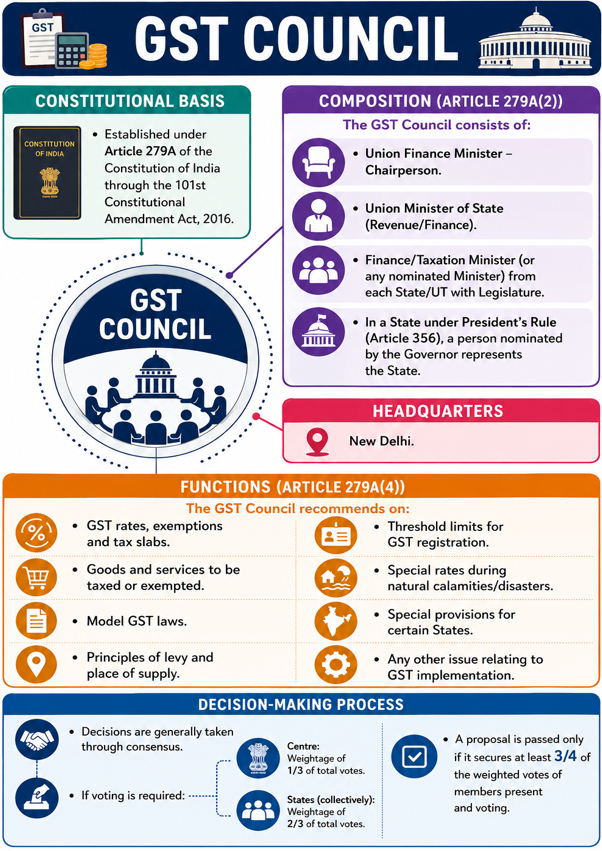
• GST Council is a constitutional body established under Article 279A that promotes co-operative federalism by enabling consensus-based decisions between the Centre and States.
• Goods and Services Tax Network (GSTN), jointly owned by the Centre and States (50:50), provides the digital backbone for registration, return filing, payments, refunds and e-invoicing.
• Coverage: GST applies to almost all goods and services, while alcohol for human consumption remains outside its ambit. Constitutionally, five petroleum products can be brought under GST on the recommendation of the GST Council.
• GST has progressively adopted AI, machine learning and data analytics to improve compliance, risk assessment, fraud detection and tax administration.
• Taxpayer base expanded from 66.5 lakh (2017) to 1.65 crore (May 2026), while gross GST collections increased from ₹7.4 lakh crore (2017-18) to ₹22.27 lakh crore (2025-26).
• Collections during April-May 2026 stood at around ₹4.37 lakh crore.
About GST 2.0 (Next-Generation GST Reforms)
• Approved in the 56th GST Council Meeting, the reforms came into effect on 22 September 2025 to simplify taxation and improve ease of doing business.
• Tax structure simplified to two principal slabs:
• Compliance reforms include:
• Relief measures for MSMEs and small taxpayers:
• Technology-driven administration has been strengthened through:
Significance
• Creates a unified national market by replacing multiple indirect taxes with a single integrated tax framework.
• Promotes co-operative federalism through consensus-based decision-making in the GST Council.
• Improves ease of doing business by simplifying tax rates, reducing compliance burden and accelerating refunds, especially for MSMEs and startups.
• Enhances transparency and tax compliance through digital platforms, e-invoicing, AI-based analytics and real-time validation.
• Supports formalisation of the economy, reflected in a significant rise in registered taxpayers and sustained growth in GST revenues.
• Reduces production costs through rationalised tax rates and correction of inverted duty structures, improving domestic manufacturing and export competitiveness.
• Benefits consumers by lowering prices on several goods and services, increasing affordability and improving access to essential sectors such as healthcare.
• Contributes to macroeconomic stability by strengthening revenue buoyancy, fiscal transparency and data-driven tax administration while supporting the vision of Viksit Bharat.

The most trusted learning platform on your phone
With our training programs, learning online can be a very exciting experience! Take the next step toward achieving your professional and personal objectives



Course Related Query:
Ask Your DoubtsStore Related Query:[email protected]NEET | JEE | CUET
NCERT Books
Resources
We love learning. Through our innovative solutions, we encourage ourselves, our teams, and our Students to grow. We welcome and look for diverse perspectives and opinions because they enhance our decisions. We strive to understand the big picture and how we contribute to the company’s objectives. We approach challenges with optimism and harness the power of teamwork to accomplish our goals. These aren’t just pretty words to post on the office wall. This is who we are. It’s how we work. And it’s how we approach every interaction with each other and our Students.
Come with an open mind, hungry to learn, and you’ll experience unmatched personal and professional growth, a world of different backgrounds and perspectives, and the freedom to be you—every day. We strive to build and sustain diverse teams and foster a culture of belonging. Creating an inclusive environment where every students feels welcome, appreciated, and heard gives us something to feel (really) good about.
Get Free academic Counseling & Course Details