Explore All Exams at KGS


All Exams
Explore All Exams at KGS

Khan Sir Courses
Geography I Polity I History | World Map I Indian Map I Economics I Biology

UPSC & State PSC
UPSC I BPSC I UP-PSC I MP-PSC

State Exams
UP I Bihar I MP | Rajasthan

NEET | JEE | CUET
NEET | JEE | CUET

Defence Exams
NDA I CDS I CAPF I AFCAT I SSB I Agniveer

Police Exams
UP SI | Bihar SI | Delhi Police | UP Constable

SSC Exams
CGL I CPO I CHSL I MTS I SSC GD I Delhi Police

Foundation Courses
Physics I Chemistry I Biology I History I Geography I Polity I NCERT I Math I English | Map I Reasoning

Railway Exams
RRB | RPF

Teaching Exams
TET | Teaching | UGC

Banking Exams
SBI | RBI | IBPS

Engineering Exams
Civil | Electrical | Mechanical
UGC NET
UGC NET/JRF
Current Affairs provides you with the best compilation of the Daily Current Affairs taking place across the globe: National, International, Sports, Science and Technology, Banking, Economy, Agreement, Appointments, Ranks, and Report and General Studies
Current Affairs
SYLLABUS
GS-2: Structure, organization and functioning of the Executive and the Judiciary Ministries and Departments of the Government.
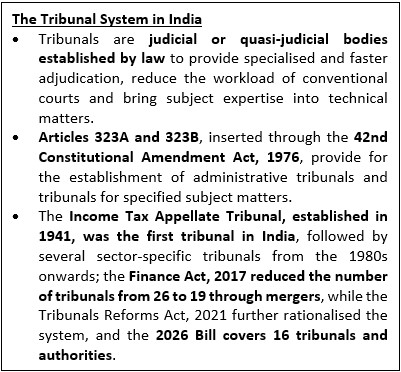
Context: The Tribunals Reforms Bill, 2026 was passed by the Lok Sabha, seeking to repeal the Tribunals Reforms Act, 2021 and establish a National Tribunals Commission (NTC) to improve the efficiency, independence, transparency and uniformity of tribunals.
Key Provisions of the Bill
• Establishment of National Tribunals Commission (NTC): The Bill establishes the NTC as an overarching body to oversee the appointment, administration and functioning of tribunals.
• Functions of the NTC:
• Uniform Tenure and Service Conditions:
• Removal and Accountability: Central Government may remove NTC or Tribunal Chairpersons/Members for insolvency, moral-turpitude conviction, incapacity, abuse of position or conflicting interests; Tribunal members may also be removed for incompetence, inefficiency or paid assignments.
• National Tribunals Data Grid (NTDG): The Bill proposes a NTDG with tribunal case information to improve transparency and performance monitoring.
• Tribunals Covered: 16 Tribunals/Authorities: Includes Central and State Administrative Tribunals, Securities Appellate Tribunal, Debts Recovery Tribunal, Telecom Disputes Settlement and Appellate Tribunal, Armed Forces Tribunal, National Green Tribunal, National Company Law Appellate Tribunal, National Consumer Disputes Redressal Commission and Income-tax Appellate Tribunal.
• Repeal and Financial Provision: Repeals the Tribunals Reforms Act, 2021 and provides a framework for appointments and service conditions in line with Supreme Court directions.
Need and Significance of the Bill
• Strengthening Judicial Independence: The Bill seeks to insulate tribunals from excessive executive interference by establishing an overarching NTC with judicial and technical expertise for appointments and oversight.
• Addressing Tribunal Vacancies: The requirement for the Central Government to make appointments within three months of receiving recommendations can help address chronic vacancies and improve the timely functioning of tribunals.
• Ensuring Uniformity and Transparency: The Bill introduces uniform standards for qualifications, selection, tenure and service conditions while creating transparent Search-cum-Selection Committees for tribunal appointments.
• Improving Tribunal Accountability: The NTC's role in reviewing tribunal performance and overseeing inquiries into complaints against Chairpersons and Members can strengthen institutional accountability.
• Strengthening Access to Justice: The NTDG and a more efficient tribunal system can improve transparency, case monitoring and the delivery of specialised and speedy justice in areas such as taxation, company law, environment and securities.
Khan Global Studies App
With our training programs, learning online can be a very exciting experience. Take the next step toward achieving your professional and personal objectives.



Course Related Query:
Ask Your DoubtsStore Related Query:[email protected]NEET | JEE | CUET
NCERT Books
Resources
We love learning. Through our innovative solutions, we encourage ourselves, our teams, and our Students to grow. We welcome and look for diverse perspectives and opinions because they enhance our decisions. We strive to understand the big picture and how we contribute to the company’s objectives. We approach challenges with optimism and harness the power of teamwork to accomplish our goals. These aren’t just pretty words to post on the office wall. This is who we are. It’s how we work. And it’s how we approach every interaction with each other and our Students.
Come with an open mind, hungry to learn, and you’ll experience unmatched personal and professional growth, a world of different backgrounds and perspectives, and the freedom to be you—every day. We strive to build and sustain diverse teams and foster a culture of belonging. Creating an inclusive environment where every students feels welcome, appreciated, and heard gives us something to feel (really) good about.