Explore All Exams at KGS


All Exams
Explore All Exams at KGS

Khan Sir Courses
Geography I Polity I History | World Map I Indian Map I Economics I Biology

UPSC & State PSC
UPSC I BPSC I UP-PSC I MP-PSC

Judiciary
CLAT

State Exams
UP I Bihar I MP | Rajasthan

NEET | JEE | CUET
NEET | JEE | CUET

Defence Exams
NDA I CDS I CAPF I AFCAT I SSB I Agniveer

Police Exams
UP SI | Bihar SI | Delhi Police | UP Constable

SSC Exams
CGL I CPO I CHSL I MTS I SSC GD I Delhi Police

Foundation Courses
Physics I Chemistry I Biology I History I Geography I Polity I NCERT I Math I English | Map I Reasoning

Railway Exams
RRB | RPF

Teaching Exams
TET | Teaching | UGC

Banking Exams
SBI | RBI | IBPS

Engineering Exams
Civil | Electrical | Mechanical
UGC NET
UGC NET/JRF
Current Affairs provides you with the best compilation of the Daily Current Affairs taking place across the globe: National, International, Sports, Science and Technology, Banking, Economy, Agreement, Appointments, Ranks, and Report and General Studies
Current Affairs
SYLLABUS
GS-3: Conservation, environmental pollution and degradation, environmental impact assessment.
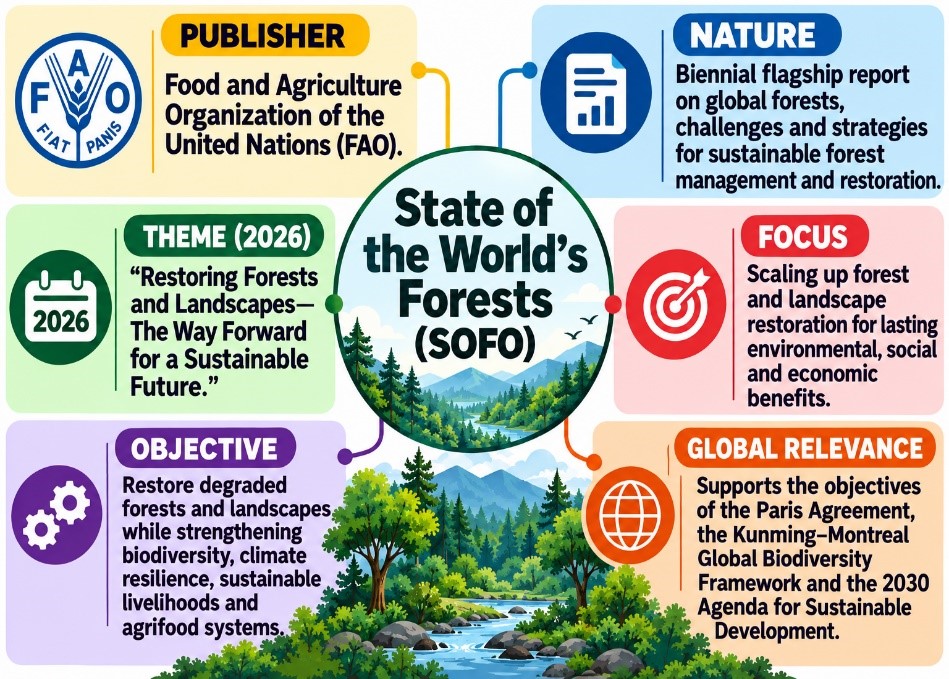
Context: The Food and Agriculture Organization (FAO) released the State of the World’s Forests (SOFO) 2026 report, highlighting the importance of scaling up forest and landscape restoration to address climate change, biodiversity loss, land degradation and food insecurity.
Key Findings of the Report
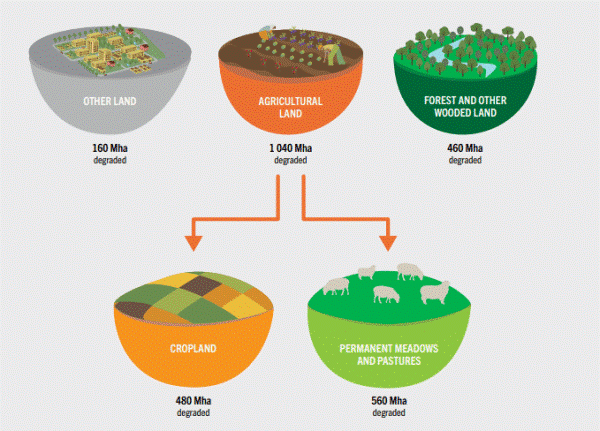
• Global Forest and Land Degradation:
• Restoration Progress and Global Targets
• India’s Contribution to Forest and Landscape Restoration: India ranks second globally, with 18.9 million ha under restoration, after China (127.4 million ha), followed by Sudan, Mongolia and Indonesia.
• Regional Distribution of Degraded Land: The report highlights the following figures for degraded land in 2019:
• Benefits of Restoration:
• Monitoring Challenges:
Recommendations of the Report
• Empower People and Strengthen Rights: Secure land rights, respect Indigenous knowledge and consent, and ensure inclusive participation and fair benefit-sharing.
• Adopt Landscape-Scale Restoration: Integrate agroforestry, natural regeneration and sustainable land management while balancing conservation, production and livelihoods.
• Mobilise Finance and Sustainable Business Models: Mobilise public and private finance, including blended finance, and promote profitable value chains and long-term restoration funding.
• Strengthen Policies and Institutions: Ensure coherent laws and policies, secure land tenure, align fiscal incentives and coordinate institutions.
• Improve Monitoring and Innovation: Standardise indicators, expand geospatial technologies and digital platforms, and track biodiversity, forest health and livelihood outcomes.
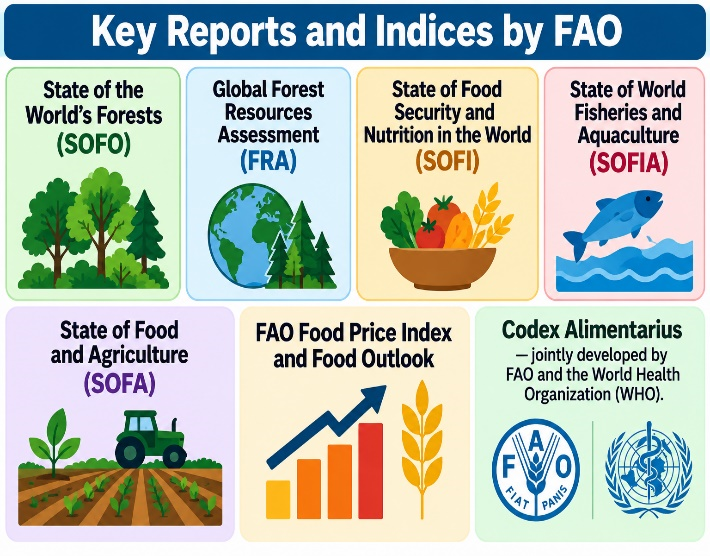
About the Food and Agriculture Organization (FAO)
• The FAO is a specialized United Nations agency established on 16 October 1945 to lead international efforts to defeat hunger.
• It is headquartered in Rome, Italy, and World Food Day is observed annually on 16 October.
• FAO provides technical expertise in food security, agriculture, forestry, fisheries and rural development, promoting the sustainable management of natural resources.
• FAO has 194 members—193 countries and the European Union—and works in over 130 countries worldwide.
• It receives funding from member contributions and other sources.
• Three Main Objectives:
Khan Global Studies App
With our training programs, learning online can be a very exciting experience. Take the next step toward achieving your professional and personal objectives.


Course Related Query:
Ask Your DoubtsStore Related Query:[email protected]NEET | JEE | CUET
NCERT Books
Resources
We love learning. Through our innovative solutions, we encourage ourselves, our teams, and our Students to grow. We welcome and look for diverse perspectives and opinions because they enhance our decisions. We strive to understand the big picture and how we contribute to the company’s objectives. We approach challenges with optimism and harness the power of teamwork to accomplish our goals. These aren’t just pretty words to post on the office wall. This is who we are. It’s how we work. And it’s how we approach every interaction with each other and our Students.
Come with an open mind, hungry to learn, and you’ll experience unmatched personal and professional growth, a world of different backgrounds and perspectives, and the freedom to be you—every day. We strive to build and sustain diverse teams and foster a culture of belonging. Creating an inclusive environment where every students feels welcome, appreciated, and heard gives us something to feel (really) good about.