KGS

All Exams

Explore All Exams at KGS

All Exams
Current Affairs made simple.

Current Affairs provides you with the best compilation of the Daily Current Affairs taking place across the globe: National, International, Sports, Science and Technology, Banking, Economy, Agreement, Appointments, Ranks, and Report and General Studies

Current Affairs

Sea-Level Rise is a Threat to Fundamental Human Rights – UN Report

SYLLABUS

GS-3: Conservation, environmental pollution and degradation; Disaster and disaster management.

Context: The recently released UN Secretary-General’s Special Report, “Challenges related to sea-level rise and ways and approaches to address it”, warns that rising seas threaten human rights, livelihoods, economies, infrastructure and the territorial integrity of States.

A Rapidly Intensifying Global Threat

  • Accelerating rise: Global mean sea level rose by 4.7 mm annually during 2014–2023, reaching a record 5.9 mm in 2024. The principal drivers are warming oceans and melting glaciers and ice sheets.
  • Growing exposure: Around 770 million people, nearly one in ten globally, live in coastal areas less than 5 metres above the high-tide line and face significant risks.
  • Future rise: Even under a very-low-emissions scenario, global mean sea level could rise by 0.23 m by 2050.
  • Displacement: Without urgent adaptation, up to 1.2 billion people could be displaced by 2050. Several Pacific Island communities have already begun relocation processes.
  • Unequal exposure: Cities such as Miami, New York and Guangzhou face $2–3.5 trillion in coastal assets at risk, while low-lying South Asian deltas face particularly severe human-displacement risks.
  • Wider impacts: In the Caribbean, nearly 40% of beaches could disappear by 2050, threatening tourism-dependent economies. Historically once-in-a-century coastal floods are also projected to occur 10 times more frequently before 2050 at many Mediterranean and Atlantic locations.

Unequal Human and Regional Consequences

  • Human rights: Rising seas threaten access to adequate housing, safe drinking water, sanitation, food, healthcare and education. Flooding and erosion can damage homes, schools, hospitals and agricultural land.
  • Water and health: Saltwater intrusion can contaminate freshwater and soils, affecting drinking water, agriculture and irrigation, while damage to sanitation systems can increase exposure to water-borne diseases.
  • Vulnerable communities: Small Island Developing States (SIDS), Indigenous Peoples and low-lying coastal communities face disproportionate risks.
  • Culture and identity: Loss of ancestral lands can disrupt Indigenous Peoples’ cultural identity, spiritual connections and transmission of traditional knowledge.
  • South Asia: More than 14 million people in Mumbai, Kolkata and Dhaka are at immediate risk of losing their homes to permanent inundation. Land subsidence can further intensify flooding and displacement.

Economic and Legal Stakes

  • Economic losses: Damage to coastal infrastructure is already estimated at more than $1.8 trillion, while annual global losses could reach $1.2–4 trillion by 2100 without adequate adaptation.
  • Finance gap: Developing countries require an estimated $310–365 billion annually for adaptation, compared with only $26 billion in adaptation finance in 2023.
  • Economic disruption: Ports, tourism, fisheries and other coastal activities face increasing exposure, threatening livelihoods and wider economic activity.
  • Statehood and sovereignty: Permanent territorial loss raises complex questions concerning statehood, sovereignty and nationality, particularly for island States.
  • Maritime rights: The report stresses the need to preserve the continuity of affected States and their existing maritime zones and rights over ocean resources under international law, while providing legal certainty for affected populations.

India in the Line of Rising Seas

  • High-risk cities: The report identifies Mumbai and Kolkata, alongside Dhaka, as low-lying South Asian cities facing growing displacement risks; more than 14 million people in these areas are at immediate risk of losing their homes to permanent inundation.
  • Compounding risks: Land subsidence can intensify flooding and displacement, while saltwater intrusion threatens drinking water, agriculture, irrigation and groundwater ecosystems.
  • Wider exposure: Coastal infrastructure, essential services, livelihoods and economic activity are increasingly exposed to rising mean and extreme sea levels.

Report Recommendations

  • The report puts forward 18 recommendations for an integrated response:
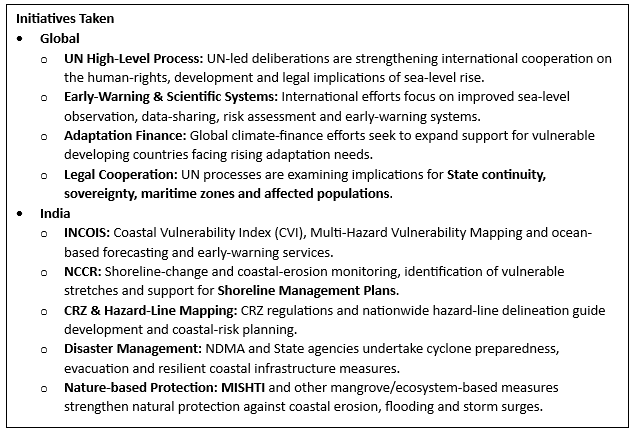
  • Mitigation: Accelerate greenhouse-gas emission reductions to limit further sea-level rise.
  • Science and early warning: Strengthen sea-level observation, scientific data, modelling, risk assessment and early-warning systems.
  • Adaptation and resilience: Integrate sea-level risks into development and coastal planning and strengthen resilient infrastructure and essential services.
  • Finance and capacity: Increase predictable adaptation finance, technology and capacity support, particularly for developing countries and vulnerable communities.
  • Rights and legal protection: Protect vulnerable populations and cultural heritage while strengthening international cooperation on displacement, State continuity, maritime rights and legal certainty.

Khan Global Studies App

The most trusted learning platform on your phone

With our training programs, learning online can be a very exciting experience. Take the next step toward achieving your professional and personal objectives.


Download on the App StoreGet it on Google Play
KGS learning dashboard and mobile application
logo
Khan Global Studies Pvt. Ltd. 5th Floor,
A13A, Graphix 1 Tower B, Sector 62,
Noida, Uttar Pradesh 201309

Course Related Query:

Ask Your DoubtsStore Related Query:[email protected]

Get Free Academic Counseling & Course Details

KGS best learning platform

About Khan Global Studies

We love learning. Through our innovative solutions, we encourage ourselves, our teams, and our Students to grow. We welcome and look for diverse perspectives and opinions because they enhance our decisions. We strive to understand the big picture and how we contribute to the company’s objectives. We approach challenges with optimism and harness the power of teamwork to accomplish our goals. These aren’t just pretty words to post on the office wall. This is who we are. It’s how we work. And it’s how we approach every interaction with each other and our Students.


What Makes Us Different

Come with an open mind, hungry to learn, and you’ll experience unmatched personal and professional growth, a world of different backgrounds and perspectives, and the freedom to be you—every day. We strive to build and sustain diverse teams and foster a culture of belonging. Creating an inclusive environment where every students feels welcome, appreciated, and heard gives us something to feel (really) good about.

©Copyright 2026 KhanGlobalStudies