Explore All Exams at KGS


All Exams
Explore All Exams at KGS

Khan Sir Courses
Geography I Polity I History | World Map I Indian Map I Economics I Biology

UPSC & State PSC
UPSC I BPSC I UP-PSC I MP-PSC

Judiciary
CLAT

State Exams
UP I Bihar I MP | Rajasthan

NEET | JEE | CUET
NEET | JEE | CUET

Defence Exams
NDA I CDS I CAPF I AFCAT I SSB I Agniveer

Police Exams
UP SI | Bihar SI | Delhi Police | UP Constable

SSC Exams
CGL I CPO I CHSL I MTS I SSC GD I Delhi Police

Foundation Courses
Physics I Chemistry I Biology I History I Geography I Polity I NCERT I Math I English | Map I Reasoning

Railway Exams
RRB | RPF

Teaching Exams
TET | Teaching | UGC

Banking Exams
SBI | RBI | IBPS

Engineering Exams
Civil | Electrical | Mechanical
UGC NET
UGC NET/JRF
Current Affairs provides you with the best compilation of the Daily Current Affairs taking place across the globe: National, International, Sports, Science and Technology, Banking, Economy, Agreement, Appointments, Ranks, and Report and General Studies
Current Affairs
SYLLABUS
GS-2: Government Policies and Interventions for Development in various sectors and Issues arising out of their Design and Implementation.
GS-3: Conservation, Environmental Pollution and Degradation, Environmental Impact Assessment.
Context: India is expanding Pumped Storage Hydropower (PSH) to integrate renewable energy, meet growing electricity demand and strengthen grid stability while pursuing its target of 500 GW of non-fossil fuel capacity by 2030.
Understanding Pumped Storage Hydropower
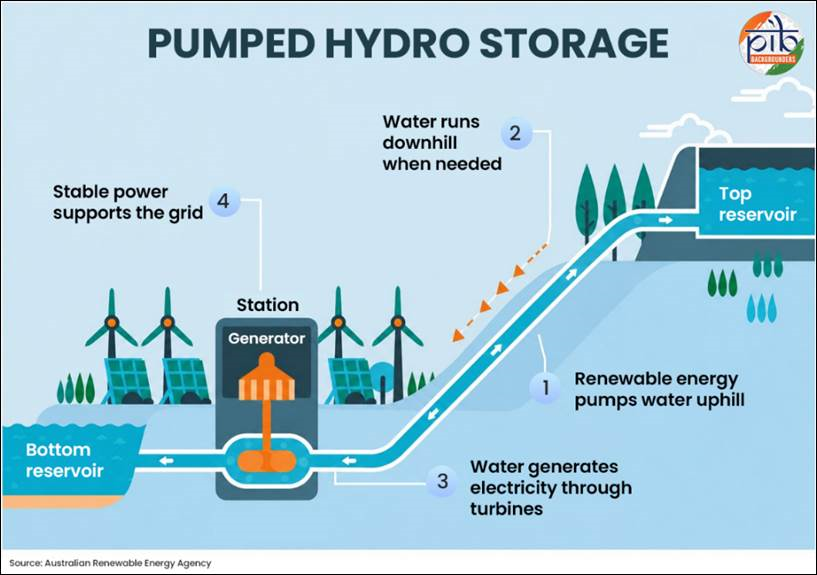
• A Pumped Storage Project (PSP) is a large-scale energy storage system that stores surplus electricity by pumping water to an upper reservoir and generates electricity by releasing the stored water through turbines when demand rises.
• Working Mechanism of Pumped Storage Projects (PSPs): A typical PSP consists of two reservoirs located at different elevations, connected through waterways and reversible pump-turbines.
• Types of Pumped Storage Projects: PSPs are classified according to the location of their reservoirs in relation to rivers, streams and perennial natural watercourses.
India’s Status in Pumped Storage Hydropower
• As of July 2026, India had crossed 300 GW of installed non-fossil fuel capacity.
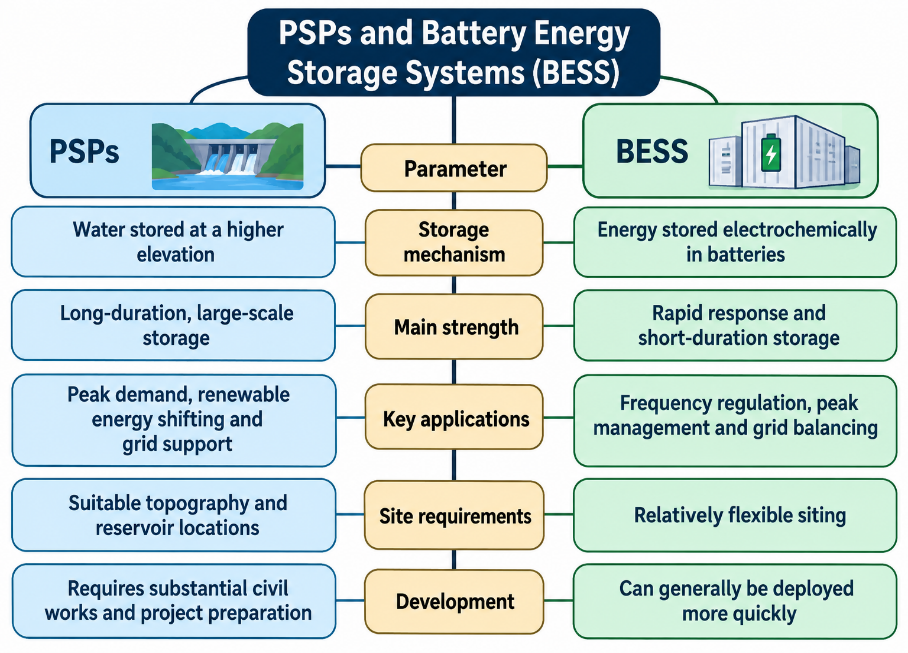
• The CEA projects a storage requirement of 73.93 GW by 2031–32, comprising 26.69 GW from PSPs and 47.24 GW from BESS.
• As of August 2026, India had 7.43 GW of operational PSP capacity across 10 projects. Another 15.87 GW was under construction or implementation, while 10.40 GW had been concurred or appraised by the CEA.
• India has identified 320 PSPs with 345.38 GW potential—56.67 GW from on-stream and 288.71 GW from off-stream projects.
• The Western Region leads with 129.72 GW, followed by the Southern Region with 97.76 GW.
• The CEA envisages adding 100.81 GW by 2035–36, taking cumulative PSP capacity to approximately 105.56 GW.
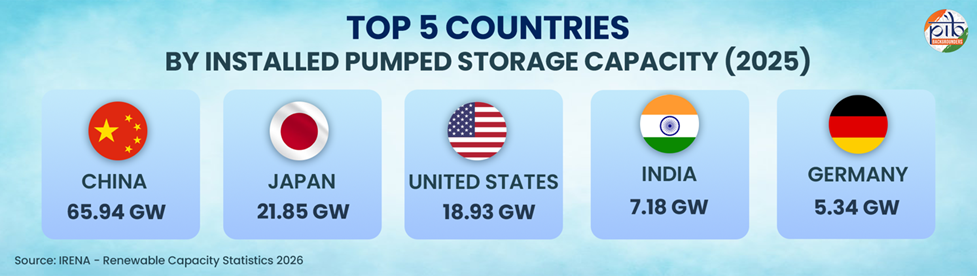
• India ranked fourth globally in installed PSP capacity at the end of 2025, with 7.18 GW.
Challenges in Pumped Storage Hydropower
• Clearances and Project Delays: Delays in environmental and forest clearances, statutory approvals and Detailed Project Report preparation slow project execution.
• Land Acquisition and Environmental Concerns: Large reservoir requirements, complex land ownership and rehabilitation issues can cause local opposition and affect forests and biodiversity.
• Geographical and Technical Constraints: Projects require suitable terrain, elevation differences and detailed geological, hydrological and seismic assessments.
• High Investment and Financing Risks: Substantial capital requirements, long construction periods and uncertainties over project viability make financing difficult.
Government Initiatives
• PSP Development Guidelines, 2023: The Ministry of Power issued dedicated guidelines on 10 April 2023 to facilitate project allocation and accelerate development.
• National Framework for Energy Storage, 2023: The framework promotes energy storage through measures including an Energy Storage Obligation trajectory.
• Transmission Charge Waiver: Eligible hydro PSP projects awarded construction work by 30 June 2028 receive a 100% waiver of Inter-State Transmission System charges.
• Competitive Procurement and Regulatory Support: Tariff-based competitive bidding and Central Electricity Regulatory Commission regulations support procurement and enable eligible PSPs to provide ancillary grid services.
Khan Global Studies App
With our training programs, learning online can be a very exciting experience. Take the next step toward achieving your professional and personal objectives.


Course Related Query:
Ask Your DoubtsStore Related Query:[email protected]NEET | JEE | CUET
NCERT Books
Resources
We love learning. Through our innovative solutions, we encourage ourselves, our teams, and our Students to grow. We welcome and look for diverse perspectives and opinions because they enhance our decisions. We strive to understand the big picture and how we contribute to the company’s objectives. We approach challenges with optimism and harness the power of teamwork to accomplish our goals. These aren’t just pretty words to post on the office wall. This is who we are. It’s how we work. And it’s how we approach every interaction with each other and our Students.
Come with an open mind, hungry to learn, and you’ll experience unmatched personal and professional growth, a world of different backgrounds and perspectives, and the freedom to be you—every day. We strive to build and sustain diverse teams and foster a culture of belonging. Creating an inclusive environment where every students feels welcome, appreciated, and heard gives us something to feel (really) good about.