Explore All Exams at KGS


All Exams
Explore All Exams at KGS

Khan Sir Courses
Geography I Polity I History | World Map I Indian Map I Economics I Biology

UPSC & State PSC
UPSC I BPSC I UP-PSC I MP-PSC

State Exams
UP I Bihar I MP | Rajasthan

NEET | JEE | CUET
NEET | JEE | CUET

Defence Exams
NDA I CDS I CAPF I AFCAT I SSB I Agniveer

Police Exams
UP SI | Bihar SI | Delhi Police | UP Constable

SSC Exams
CGL I CPO I CHSL I MTS I SSC GD I Delhi Police

Foundation Courses
Physics I Chemistry I Biology I History I Geography I Polity I NCERT I Math I English | Map I Reasoning

Railway Exams
RRB | RPF

Teaching Exams
TET | Teaching | UGC

Banking Exams
SBI | RBI | IBPS

Engineering Exams
Civil | Electrical | Mechanical
UGC NET
UGC NET/JRF
Current Affairs provides you with the best compilation of the Daily Current Affairs taking place across the globe: National, International, Sports, Science and Technology, Banking, Economy, Agreement, Appointments, Ranks, and Report and General Studies
Current Affairs
SYLLABUS
GS-3: Indian Economy and issues relating to planning, mobilization of resources, growth, development and employment.
Context: The Ministry of Electronics and Information Technology (MeitY) has notified the Mobile Phone Manufacturing Scheme (MPMS) with a ₹62,500-crore outlay to sustain India’s mobile manufacturing growth, deepen domestic value addition and strengthen Indian mobile phone brands.
About the Mobile Phone Manufacturing Scheme (MPMS)
• Tenure: Five years, from FY 2026–27 to FY 2030–31, effective from April 1, 2026.
• Objective: To enhance the global competitiveness of Indian mobile manufacturing by increasing scale, deepening the domestic supply chain, raising Domestic Value Addition (DVA) and strengthening manufacturing capabilities.
• The scheme also seeks to promote Indian-owned mobile brands, domestic intellectual property, product design and research and development (R&D).
• It follows the Production Linked Incentive Scheme for Large Scale Electronics Manufacturing (PLI-LSEM), whose tenure ended on March 31, 2026.
• India is currently the world’s second-largest mobile phone manufacturer by volume, while 99.2% of mobile phones used in India are manufactured domestically.
• Smartphones emerged as India’s single-largest exported product category in 2025.
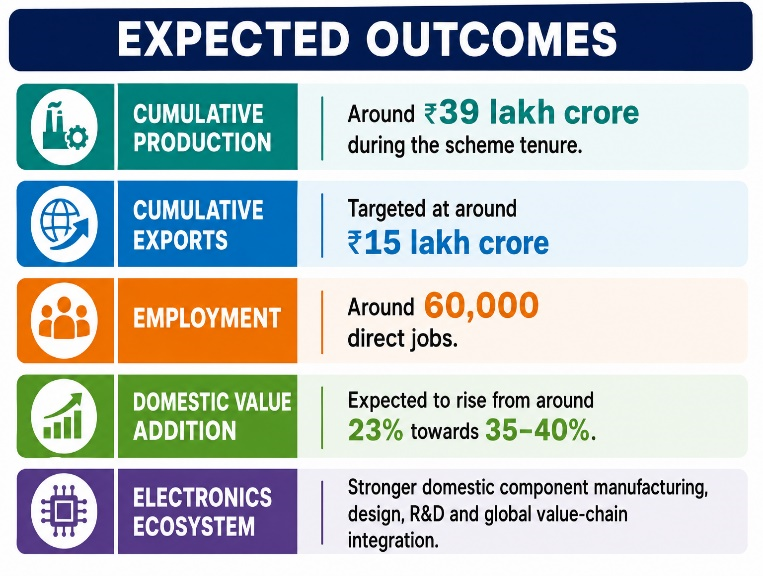
Key Features of the Scheme
• Two Target Segments: The scheme has Target Segment 1 (TS1) for mobile phone manufacturing and Target Segment 2 (TS2) for supporting Indian mobile phone brands.
• Eligibility under TS1: Mobile phone manufacturers, including Electronics Manufacturing Services (EMS) companies registered in India, require a minimum turnover of ₹10,000 crore in FY 2025–26.
• TS1 Incentive Structure: The scheme introduces a moving baseline, with baseline sales equal to the previous financial year’s domestic sales plus 15%.
• Support for Indian Brands: Under TS2, applicants require a minimum turnover of ₹1,000 crore in FY 2025–26 and must meet Indian-brand criteria.
• Design and Domestic Sourcing Incentives: Indian brands receive an additional 3% incentive for Indian design and R&D, while both target segments can receive up to 1.5% for domestic sourcing of key components and sub-assemblies.
• Institutional and Non-Fiscal Support: The government may provide non-fiscal support to Indian brands, with an Empowered Committee evaluating applications and recommending support.
Need and Significance of the Scheme
• Sustaining Manufacturing Momentum: PLI-LSEM helped mobile phone production reach ₹11.61 lakh crore against a ₹8.12 lakh crore target, while investment crossed ₹20,500 crore against ₹7,000 crore targeted, and MPMS provides continuity after PLI-LSEM ended in March 2026.
• Deepening Domestic Value Addition: Domestic value addition in mobile manufacturing has risen to around 23% from about 15%, while MPMS shifts greater focus towards localisation of components and sub-assemblies.
• Promoting Indian Technology and IP: The scheme supports Indian-owned brands, domestic IP, product design and R&D, helping India move from large-scale assembly towards greater technological sovereignty.
• Strengthening the Electronics Ecosystem: Mobile manufacturing can generate technology and skill spillovers into laptops, gaming consoles, drones, medical devices, tablets, smartwatches and other electronics-intensive sectors.
• Expanding India’s Global Role: Mobile phone exports grew 166 times between 2014 and 2025, while mobile phones accounted for about 61% of India’s electronics exports in FY26, and MPMS seeks to further strengthen India as a global electronics manufacturing hub.
Khan Global Studies App
With our training programs, learning online can be a very exciting experience. Take the next step toward achieving your professional and personal objectives.



Course Related Query:
Ask Your DoubtsStore Related Query:[email protected]NEET | JEE | CUET
NCERT Books
Resources
We love learning. Through our innovative solutions, we encourage ourselves, our teams, and our Students to grow. We welcome and look for diverse perspectives and opinions because they enhance our decisions. We strive to understand the big picture and how we contribute to the company’s objectives. We approach challenges with optimism and harness the power of teamwork to accomplish our goals. These aren’t just pretty words to post on the office wall. This is who we are. It’s how we work. And it’s how we approach every interaction with each other and our Students.
Come with an open mind, hungry to learn, and you’ll experience unmatched personal and professional growth, a world of different backgrounds and perspectives, and the freedom to be you—every day. We strive to build and sustain diverse teams and foster a culture of belonging. Creating an inclusive environment where every students feels welcome, appreciated, and heard gives us something to feel (really) good about.