Explore All Exams at KGS


All Exams
Explore All Exams at KGS

Khan Sir Courses
Geography I Polity I History | World Map I Indian Map I Economics I Biology

UPSC & State PSC
UPSC I BPSC I UP-PSC I MP-PSC

State Exams
UP I Bihar I MP | Rajasthan

NEET | JEE | CUET
NEET | JEE | CUET

Defence Exams
NDA I CDS I CAPF I AFCAT I SSB I Agniveer

Police Exams
UP SI | Bihar SI | Delhi Police | UP Constable

SSC Exams
CGL I CPO I CHSL I MTS I SSC GD I Delhi Police

Foundation Courses
Physics I Chemistry I Biology I History I Geography I Polity I NCERT I Math I English | Map I Reasoning

Railway Exams
RRB | RPF

Teaching Exams
TET | Teaching | UGC

Banking Exams
SBI | RBI | IBPS

Engineering Exams
Civil | Electrical | Mechanical
UGC NET
UGC NET/JRF
Current Affairs provides you with the best compilation of the Daily Current Affairs taking place across the globe: National, International, Sports, Science and Technology, Banking, Economy, Agreement, Appointments, Ranks, and Report and General Studies
Current Affairs
SYLLABUS
GS-2: India and its Neighborhood- Relations; Bilateral, regional and global groupings and agreements involving India and/or affecting India’s interests.
Context: India has rejected the Pakistan-China Boundary Joint Commission, reiterating that “there is no boundary between Pakistan and China” and that the mechanism has no legal basis concerning Indian territory.
More on the News
• Pakistan and China have operationalised the Boundary Joint Commission and held its first meeting in Islamabad.
• The mechanism originates from the 2013 Agreement on the Boundary Management System and covers border management, joint surveys, trade flows and people-to-people connectivity.
• India has rejected the Commission and reiterated that it has never recognised the 1963 China-Pakistan Boundary Agreement, which it considers illegal and invalid.
India’s Position on China-Pakistan Boundary Question
• India's position arises from its claim that the territories through which the Pakistan-China boundary is asserted form part of the erstwhile State of Jammu and Kashmir and, therefore, are part of the present-day Union Territories of Jammu & Kashmir and Ladakh.
• India maintains that Pakistan has no locus standi to enter into arrangements concerning Indian territory under its illegal and forcible occupation. Consequently, it rejects any China-Pakistan boundary cooperation concerning such territories.
• This position is also why India rejects the 1963 China-Pakistan Boundary Agreement and considers subsequent arrangements concerning the territory covered by that agreement unacceptable.
Historical Background of the Dispute
• The 1963 Agreement: China and Pakistan signed the China-Pakistan Boundary Agreement on 2 March 1963 to delimit and demarcate the boundary between China's Xinjiang and the contiguous areas under Pakistan's actual control.
• Shaksgam Valley: Under the agreement, Pakistan ceded to China the Shaksgam Valley, also known as the Trans-Karakoram Tract, which India considers part of its territory. The Government of India puts the area ceded at approximately 5,180 sq km.
• Article 6: Article 6 provided that after settlement of the Kashmir dispute between India and Pakistan, the sovereign authority concerned would reopen negotiations with China and conclude a formal boundary treaty to replace the existing agreement.
• India's response: India protested the agreement at the time and has consistently maintained that Pakistan had no legal authority to alter the status of territory claimed by India. It consequently does not recognise the 1963 agreement and considers it illegal and invalid.
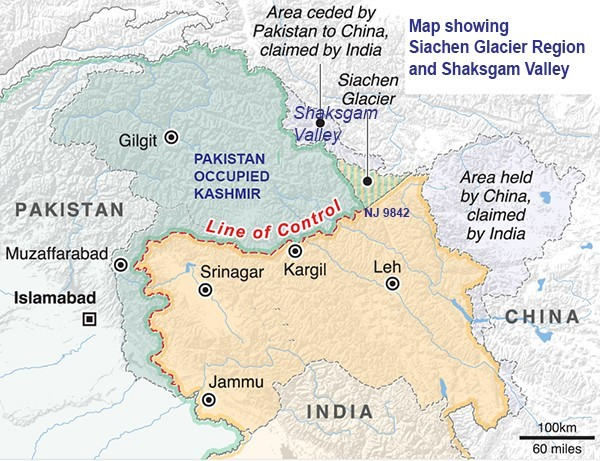
Geography and Strategic Significance of Shaksgam Valley
• Location: The Shaksgam Valley, or Trans-Karakoram Tract, lies in the Karakoram region north of the Karakoram Range, adjoining China's Xinjiang region and Pakistan-controlled Gilgit-Baltistan; its location places it within the strategic India-China-Pakistan interface of the western Himalayas.
• Strategic significance: Its proximity to the Siachen region, Karakoram routes and the China-Pakistan connectivity axis gives the territory significance beyond its territorial status, particularly for India's northern security environment.
• Broader territorial context: India separately maintains that approximately 38,000 sq km of its territory in Ladakh is under Chinese occupation, in addition to the 5,180 sq km it says Pakistan ceded to China under the 1963 agreement.
From Territorial Arrangement to China-Pakistan Connectivity
• CPEC: The China-Pakistan Economic Corridor (CPEC) is a major component of China's Belt and Road Initiative (BRI), connecting Kashgar in Xinjiang with Gwadar Port in Balochistan through Pakistan, including routes through Gilgit-Baltistan.
• Connectivity: The Khunjerab corridor provides the principal overland connection between China and Pakistan in this region, making border management, movement of goods and people, and infrastructure development strategically relevant to India.
• India’s Objection: India opposes CPEC because portions of its infrastructure and connectivity pass through Pakistan-controlled areas of Jammu and Kashmir, which India considers its territory under illegal occupation.
India’s Concerns: Territorial Sovereignty and Strategic Implications
• Territorial Sovereignty: India is concerned that institutionalised China-Pakistan arrangements over territories it claims could normalise or legitimise the 1963 territorial arrangement and the subsequent control of the Shaksgam Valley, although India maintains that such arrangements have no bearing on its sovereignty.
• China-Pakistan Strategic Convergence: The Commission adds an institutional layer to the broader China-Pakistan strategic partnership, extending cooperation in the sensitive western Himalayan region beyond infrastructure and security to regularised border management.
• Connectivity and Security: Greater China-Pakistan connectivity through the Khunjerab–Gilgit-Baltistan–CPEC axis can strengthen infrastructure and logistical links in proximity to India's northern and western security environment.
• Two-Front Context: The development has relevance to India's broader strategic environment involving both China and Pakistan, although the Boundary Joint Commission itself remains a border-management mechanism and not a military arrangement.
Way Ahead
• Reiterate the Territorial Position: India should maintain its consistent legal and diplomatic position that Jammu & Kashmir and Ladakh are integral parts of India and that third-party arrangements cannot alter India's sovereignty claims.
• Sustain Diplomatic Engagement: India should continue conveying its objections through appropriate diplomatic channels while handling its separate territorial and boundary issues with Pakistan and China through their respective bilateral mechanisms.
• Monitor Strategic Connectivity: India should closely monitor infrastructure and connectivity developments along the Shaksgam–Gilgit-Baltistan–Khunjerab–CPEC axis and assess their implications for territorial integrity and national security.
• Strengthen Border Preparedness: Continued strengthening of border infrastructure, surveillance and logistical capabilities along the northern and western frontiers is necessary to respond to changes in the wider India-China-Pakistan strategic environment.
Khan Global Studies App
With our training programs, learning online can be a very exciting experience. Take the next step toward achieving your professional and personal objectives.



Course Related Query:
Ask Your DoubtsStore Related Query:[email protected]NEET | JEE | CUET
NCERT Books
Resources
We love learning. Through our innovative solutions, we encourage ourselves, our teams, and our Students to grow. We welcome and look for diverse perspectives and opinions because they enhance our decisions. We strive to understand the big picture and how we contribute to the company’s objectives. We approach challenges with optimism and harness the power of teamwork to accomplish our goals. These aren’t just pretty words to post on the office wall. This is who we are. It’s how we work. And it’s how we approach every interaction with each other and our Students.
Come with an open mind, hungry to learn, and you’ll experience unmatched personal and professional growth, a world of different backgrounds and perspectives, and the freedom to be you—every day. We strive to build and sustain diverse teams and foster a culture of belonging. Creating an inclusive environment where every students feels welcome, appreciated, and heard gives us something to feel (really) good about.