• What is it?
- A Geographical Indication (GI) tag is a name or sign used on products that have a specific geographical origin or are associated with a particular geographical location.
• Benefits:
- The GI tag ensures that only authorized users or people residing in the specified geographical area are permitted to use the name of the popular product.
- It protects the reputation and quality of Indian products.
- Legal protection helps prevent counterfeit products, increases the market credibility of original producers, and empowers producers.
- Economically, a GI tag increases the brand value of products and promotes exports.
- It creates new employment opportunities at the local level.
- It promotes the economic development of the production regions.
• Indian Status
- Validity: A registered GI tag is valid for 10 years.
- Nodal Department: The Department for Promotion of Industry and Internal Trade (DPIIT) under the Ministry of Commerce and Industry.
- GI Registry: The GI tag is granted by the Geographical Indications Registry, whose headquarters is located in Chennai.
- Regulation of GI at the National Level: GI is regulated under the Geographical Indications of Goods (Registration and Protection) Act, 1999, which came into force in September 2003.
- In India, GI is regulated under the Geographical Indications of Goods (Registration and Protection) Act, 1999 and the Geographical Indications of Goods (Registration and Protection) Rules, 2002.
- In 2004, Darjeeling Tea became the first Indian product to receive a GI tag.
- Current Status of GI Tags: As of September 2026, India has more than 800 GI-registered products.
- Target: The Union Ministry of Commerce and Industry has set an ambitious target of granting 10,000 Geographical Indication (GI) tags by 2030.
• Global Status:
- The GI tag has been included as a component of Intellectual Property Rights (IPR) under the Paris Convention for the Protection of Industrial Property.
- At the international level, GI is regulated under the World Trade Organization (WTO)’s Agreement on Trade-Related Aspects of Intellectual Property Rights (TRIPS).
• Important Geographical Indication (GI) Tags:
- As of December 2025, Uttar Pradesh was the leading state with 81 GI-tagged products, followed by Tamil Nadu (76) and Maharashtra (55).
o Recently GI-Tagged Products:
- Ponduru Khadi — Andhra Pradesh
- Ambasamudram Choppu Saman — Tamil Nadu
- Woraiyur Cotton Saree — Tamil Nadu
- Namakkal Makkal Pathirangal — Tamil Nadu
- Thuyamalli Rice — Tamil Nadu
- Kavindapadi Nattu Sakkarai — Tamil Nadu
- Assam Bihu Dhol — Assam
- Kasi Dhaniya — Maharashtra
- Koraput Kalajeera Rice — Odisha
- Uttarakhand Lal Chawal — Uttarakhand
- Warangal Chapata Chilli (Tomato Chilli), Banganapalle Mango and Tandur Red Gram — Telangana
- Kannadippaya (Tribal Handicraft) — Kerala
- Banaras Thandai, Banaras Metal Casting Craft, Lakhimpur Kheri Tharu Embroidery, Bareilly Cane and Bamboo Craft, Bareilly Zardozi Craft, Pilkhuwa Hand Block Print Textile and the famous ‘Trirangi Barfi’ of Kashi — Uttar Pradesh
o Geographical Indication (GI) Tags of Madhya Pradesh:
- Handicrafts / Handloom:
- Chanderi Sarees of Ashoknagar — Madhya Pradesh’s first GI tag (2005–06)
- Maheshwari Saree and Fabrics — Khargone
- Bagh Print — Dhar
- Leather Toys — Indore
- Bell Metal Ware — Datia and Tikamgarh
- Gond Painting — Dindori
- Iron Craft — Dindori
- Batik Print — Ujjain
- Gwalior Handmade Carpets
- Waraseoni Saree and Fabrics — Balaghat
- Jabalpur Stone Craft
- Agricultural Products
- Chinnor Rice — Balaghat
- Sundarja Mango — Rewa
- Sharbati Wheat — Vidisha and Sehore
- Riyawan Garlic — Ratlam
- Bundelkhand Kathiya Wheat — Madhya Pradesh
- Food Products
- Ratlam Sev — Ratlam
- Jhabua Kadaknath — Jhabua
- Morena Gajak — Morena
• Challenges:
- Lack of awareness among consumers and producers about GI products.
- Inadequate marketing and branding of GI-tagged products.
- Counterfeit and imitation products reduce the benefits received by genuine producers.
- Lack of adequate infrastructure, modern technology and financial support for local producers.
- Difficulties in maintaining consistent quality and meeting national and international standards.
- Weak market linkages and limited access to international markets.
- Lack of adequate participation and awareness among authorized producers regarding GI registration and protection.
• Initiatives to Promote GI Tags in India:
- GI Logo and Tagline: The tagline “Invaluable Treasures of Incredible India” reflects the spirit of India’s Geographical Indications (GI).
- Promoting Exports of GI Products: The Agricultural and Processed Food Products Export Development Authority (APEDA) promotes the export of GI products. For example, Naga Chilli (Nagaland) and Black Rice (Manipur) are exported to the United Kingdom, while Assam Lemon is exported to Italy.
- One District One Product (ODOP): Under this initiative, one major product from each district is promoted. These products are identified as “District Export Hubs (DEHs)” and GI-tagged products.
- Open Network for Digital Commerce (ONDC): ONDC connects GI-tagged products with buyers in India and across the globe.
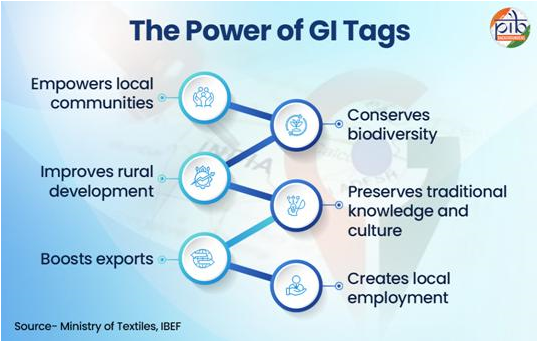
• Power of GI Tags
- GI tags help protect the unique identity, reputation and traditional knowledge associated with regional products.
- They empower local producers by providing better market opportunities and increasing the value of their products.
- They promote rural employment, entrepreneurship and sustainable economic development.
- GI tags also strengthen India’s cultural and economic presence in national and international markets.
• Way Forward:
- Greater awareness about GI products should be created among producers and consumers.
- Marketing, branding and packaging of GI products should be improved.
- Digital platforms and e-commerce should be used extensively to connect local producers with national and global markets.
- Financial assistance, modern technology and infrastructure should be provided to GI producers.
- Stronger enforcement mechanisms should be developed to prevent the sale of counterfeit products.
- GI products should be integrated more effectively with initiatives such as ODOP, District Export Hubs and tourism.
- Greater emphasis should be placed on quality standards, value addition and international certification to increase exports.
Conclusion: GI tags are an important means of identifying and preserving India’s rich cultural, agricultural and traditional heritage. They provide local producers with better market, employment and income opportunities while giving Indian products recognition at both the national and global levels.