Explore All Exams at KGS


All Exams
Explore All Exams at KGS

Khan Sir Courses
Geography I Polity I History | World Map I Indian Map I Economics I Biology

UPSC & State PSC
UPSC I BPSC I UP-PSC I MP-PSC

Judiciary
CLAT

State Exams
UP I Bihar I MP | Rajasthan

NEET | JEE | CUET
NEET | JEE | CUET

Defence Exams
NDA I CDS I CAPF I AFCAT I SSB I Agniveer

Police Exams
UP SI | Bihar SI | Delhi Police | UP Constable

SSC Exams
CGL I CPO I CHSL I MTS I SSC GD I Delhi Police

Foundation Courses
Physics I Chemistry I Biology I History I Geography I Polity I NCERT I Math I English | Map I Reasoning

Railway Exams
RRB | RPF

Teaching Exams
TET | Teaching | UGC

Banking Exams
SBI | RBI | IBPS

Engineering Exams
Civil | Electrical | Mechanical
UGC NET
UGC NET/JRF
Current Affairs provides you with the best compilation of the Daily Current Affairs taking place across the globe: National, International, Sports, Science and Technology, Banking, Economy, Agreement, Appointments, Ranks, and Report and General Studies
Current Affairs
SYLLABUS
GS-3: Achievements of Indians in science & technology; indigenization of technology and developing new technology.
Context: The Atomic Energy Regulatory Board (AERB) granted permission for the First Approach to Criticality (FAC) of Rajasthan Atomic Power Project Unit-8 (RAPP-8), marking a significant milestone in India's indigenous nuclear power programme.
About the First Approach to Criticality (FAC)
• Meaning: FAC is an important stage in nuclear reactor commissioning, marking the beginning of a controlled, self-sustaining nuclear fission chain reaction.
• Criticality: A reactor achieves criticality when the neutrons produced through nuclear fission sustain the chain reaction at a steady rate.
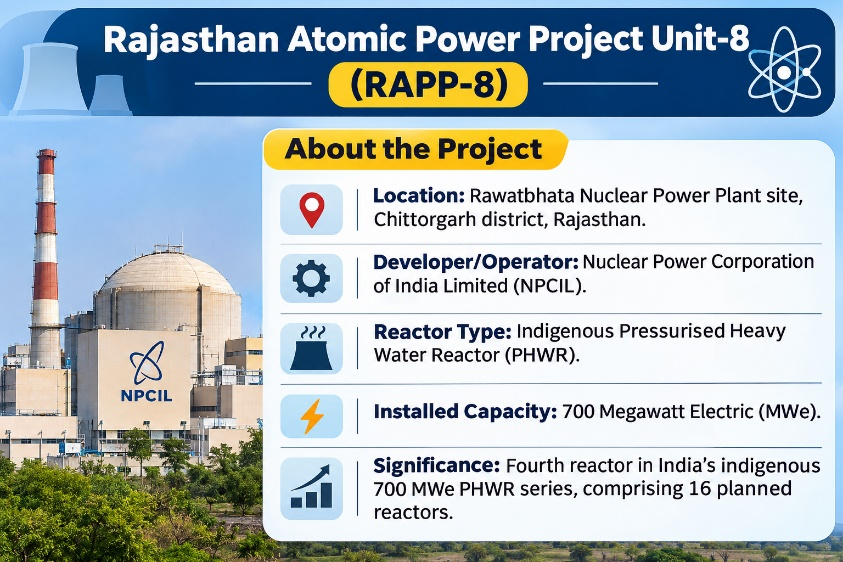
• Purpose: It establishes the reactor's ability to sustain a controlled nuclear chain reaction and enables subsequent commissioning activities.
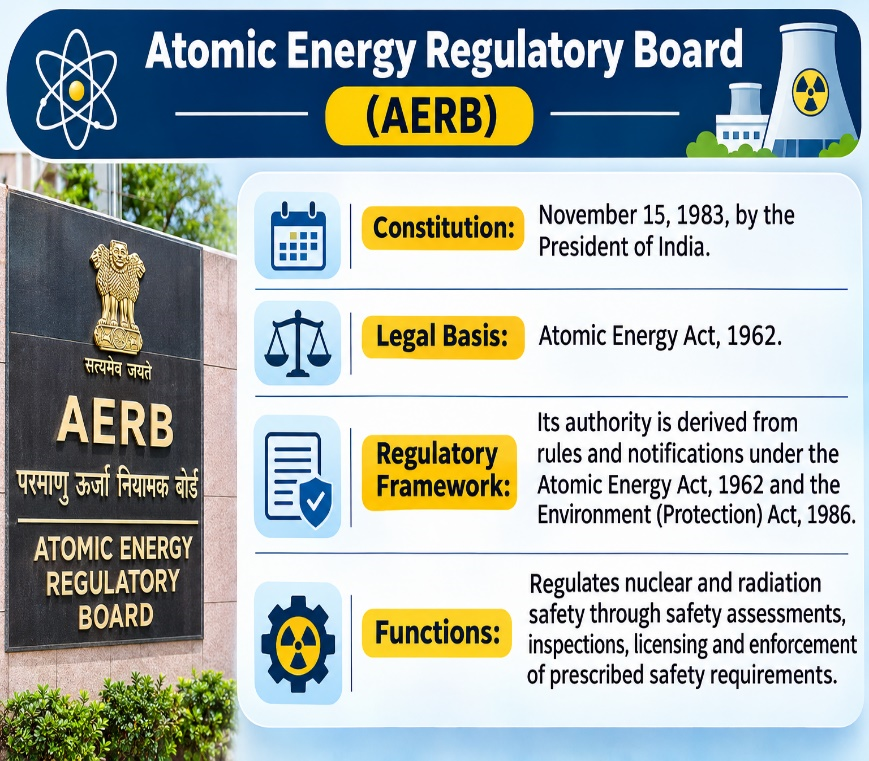
• Regulatory Approval: AERB grants permission for FAC after reviewing reactor safety, construction, commissioning test results and operational preparedness.
• Commercial Operation: FAC does not mean immediate electricity generation. Further testing, power escalation, grid synchronisation and regulatory approvals are required.
Stages of Nuclear Reactor Commissioning
• Initial Fuel Loading (IFL): Nuclear fuel is loaded into the reactor core after obtaining regulatory permission and completing prescribed safety requirements.
• Pre-Criticality Safety Checks: Reactor systems undergo integrity checks, safety evaluations and commissioning tests to establish operational readiness.
• First Approach to Criticality (FAC): The reactor is gradually brought to criticality, establishing a controlled, self-sustaining nuclear fission chain reaction.
• Low-Power Physics Experiments: Reactor behaviour, nuclear characteristics and safety systems are tested at low power.
• Power Ascension and Grid Synchronisation: Reactor power is gradually increased, followed by testing and synchronisation with the electricity grid.
• Commercial Operation: Commercial electricity generation begins after satisfactory completion of commissioning tests and requisite regulatory approvals.
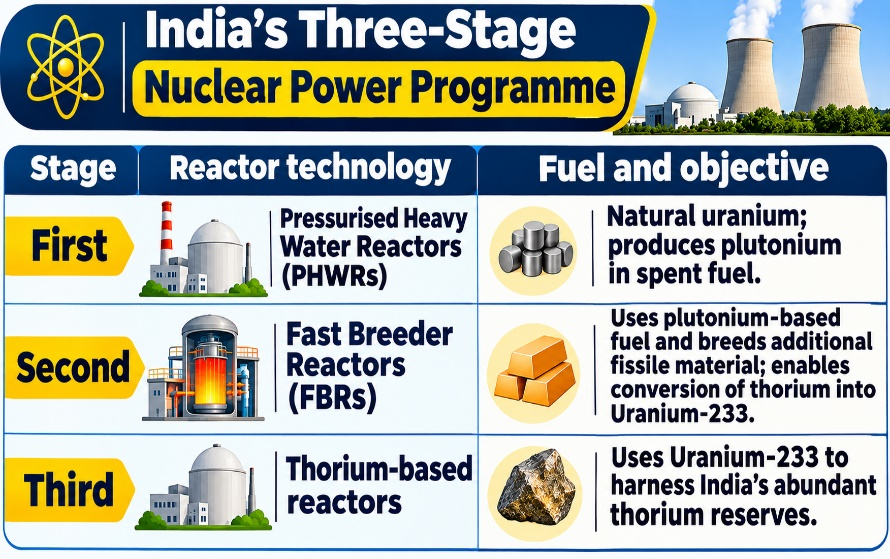
India's Three-Stage Nuclear Power Programme
• Conceived by Dr. Homi Jehangir Bhabha, India's three-stage nuclear power programme aims to utilise limited domestic uranium reserves and abundant thorium resources through a closed nuclear fuel cycle.
• On April 6, 2026, India's indigenously designed 500 MWe Prototype Fast Breeder Reactor (PFBR) at Kalpakkam, Tamil Nadu, attained first criticality.
About PHWR Technology
• PHWR uses heavy water (D₂O) as both moderator and coolant.
• It generally uses natural uranium as fuel, reducing dependence on enriched uranium.
• Heavy water slows down neutrons while absorbing relatively few of them, supporting an efficient nuclear chain reaction.
Government Initiatives for Nuclear Energy
• Nuclear Energy Mission: Announced in Union Budget 2025–26, it aims to achieve 100 GW of nuclear power capacity by 2047.
• Financial Outlay: ₹20,000 crore allocated for the development and deployment of Small Modular Reactors (SMRs).
• SMR Target: At least five indigenously designed SMRs to become operational by 2033.
• Indigenous Technology: BARC is developing BSMR-200 (200 MWe), SMR-55 (55 MWe) and a high-temperature gas-cooled reactor for hydrogen generation.
• SHANTI Act, 2025: Modernises India's nuclear legal framework and enables limited private-sector participation under regulatory oversight.
Khan Global Studies App
With our training programs, learning online can be a very exciting experience. Take the next step toward achieving your professional and personal objectives.



Course Related Query:
Ask Your DoubtsStore Related Query:[email protected]NEET | JEE | CUET
NCERT Books
Resources
We love learning. Through our innovative solutions, we encourage ourselves, our teams, and our Students to grow. We welcome and look for diverse perspectives and opinions because they enhance our decisions. We strive to understand the big picture and how we contribute to the company’s objectives. We approach challenges with optimism and harness the power of teamwork to accomplish our goals. These aren’t just pretty words to post on the office wall. This is who we are. It’s how we work. And it’s how we approach every interaction with each other and our Students.
Come with an open mind, hungry to learn, and you’ll experience unmatched personal and professional growth, a world of different backgrounds and perspectives, and the freedom to be you—every day. We strive to build and sustain diverse teams and foster a culture of belonging. Creating an inclusive environment where every students feels welcome, appreciated, and heard gives us something to feel (really) good about.