Explore All Exams at KGS


All Exams
Explore All Exams at KGS

Khan Sir Courses
Geography I Polity I History | World Map I Indian Map I Economics I Biology

UPSC & State PSC
UPSC I BPSC I UP-PSC I MP-PSC

State Exams
UP I Bihar I MP | Rajasthan

NEET | JEE | CUET
NEET | JEE | CUET

Defence Exams
NDA I CDS I CAPF I AFCAT I SSB I Agniveer

Police Exams
UP SI | Bihar SI | Delhi Police | UP Constable

SSC Exams
CGL I CPO I CHSL I MTS I SSC GD I Delhi Police

Foundation Courses
Physics I Chemistry I Biology I History I Geography I Polity I NCERT I Math I English | Map I Reasoning

Railway Exams
RRB | RPF

Teaching Exams
TET | Teaching | UGC

Banking Exams
SBI | RBI | IBPS

Engineering Exams
Civil | Electrical | Mechanical
UGC NET
UGC NET/JRF
Current Affairs provides you with the best compilation of the Daily Current Affairs taking place across the globe: National, International, Sports, Science and Technology, Banking, Economy, Agreement, Appointments, Ranks, and Report and General Studies

Current Affairs
SYLLABUS
GS-3: Indian Economy and issues relating to planning, mobilization of resources, growth, development and employment.
Context: The Department for Promotion of Industry and Internal Trade (DPIIT) has amended the Foreign Direct Investment (FDI) Policy to permit foreign-funded e-commerce entities to operate an inventory-based model exclusively for exports of goods manufactured and/or produced in India.
Key Highlights of the Decision
• DPIIT has reviewed the existing FDI Policy and relaxed FDI norms for the inventory-based model of e-commerce exclusively for exports.
• A new provision has been inserted in the FDI Policy stating: An e-commerce entity is permitted to engage in an inventory-based model of e-commerce exclusively for the export of goods/products manufactured and/or produced in India.
• The relaxation applies only to exports of domestically manufactured and/or produced goods and does not apply to domestic retail sales.
• Existing restrictions on Business-to-Consumer (B2C) and inventory-based e-commerce continue for the domestic market.
• Export operations must comply with the Foreign Trade Policy (FTP), 2023, Handbook of Procedures (HBP) and Foreign Exchange Management (Export of Goods & Services) Regulations, 2015, as amended from time to time.
• The decision will take effect from the date of notification under the Foreign Exchange Management Act (FEMA).
About FDI in E-commerce
• Existing FDI Policy: India permits 100% Foreign Direct Investment (FDI) under the automatic route in Business-to-Business (B2B) e-commerce and the marketplace model of e-commerce.
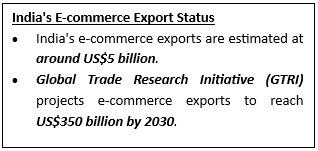
• Marketplace Model: In the marketplace model, the e-commerce entity provides a digital platform connecting buyers and sellers.
• Inventory-Based Model: The e-commerce entity owns the inventory of goods and services.
Why was this Change Needed?
• To Facilitate Greater Exports: The amendment enables easier access to global markets for Indian sellers, supporting the Government's target of US$1 trillion merchandise exports by 2030.
• To Reduce Compliance Burden on MSMEs: Large e-commerce companies can handle export documentation, paperwork, testing and labelling, helping MSMEs, of which only about 12,000 currently undertake e-commerce exports.
• To Meet Emerging Global Traceability Requirements: Large e-commerce companies can help MSMEs comply with new traceability regulations, including the European Union's Digital Product Passport (DPP).
• To Address US Tariff Challenges: The amendment comes ahead of the United States replacing the 10% global tariff and proposing a 12.5% tariff on certain goods imported from India, strengthening the need to boost export competitiveness.
• To Provide Policy Clarity: The amendment clarifies that inventory-based restrictions do not apply to export operations, reinforcing policy predictability while preserving domestic e-commerce safeguards.
Significance
• Boost to MSME Exports: Enables MSMEs to access global markets through large international e-commerce platforms while reducing the burden of paperwork, testing, labelling and export compliance.
• Supports Manufacturing and Export Targets: Supports the Government's objective of increasing manufacturing's share in GDP from around 17% to 25% by 2035 and achieving US$1 trillion merchandise exports by 2030.
• Improves Ease of Doing Business: Removes policy uncertainty and reinforces policy predictability for foreign investors.
• Supports Tier-II and Tier-III Manufacturers: Enables regional manufacturers and SMEs to reach global customers and strengthen Brand India.
• Better Integration with Global Supply Chains: Provides greater flexibility in sourcing, warehousing and shipping Indian-made products to overseas markets.
• Strengthens India's Export-led Growth Strategy: Expands the role of global e-commerce platforms in increasing exports of domestically manufactured goods.
Khan Global Studies App
With our training programs, learning online can be a very exciting experience. Take the next step toward achieving your professional and personal objectives.



Course Related Query:
Ask Your DoubtsStore Related Query:[email protected]NEET | JEE | CUET
NCERT Books
Resources
We love learning. Through our innovative solutions, we encourage ourselves, our teams, and our Students to grow. We welcome and look for diverse perspectives and opinions because they enhance our decisions. We strive to understand the big picture and how we contribute to the company’s objectives. We approach challenges with optimism and harness the power of teamwork to accomplish our goals. These aren’t just pretty words to post on the office wall. This is who we are. It’s how we work. And it’s how we approach every interaction with each other and our Students.
Come with an open mind, hungry to learn, and you’ll experience unmatched personal and professional growth, a world of different backgrounds and perspectives, and the freedom to be you—every day. We strive to build and sustain diverse teams and foster a culture of belonging. Creating an inclusive environment where every students feels welcome, appreciated, and heard gives us something to feel (really) good about.