Explore All Exams at KGS


All Exams
Explore All Exams at KGS

Khan Sir Courses
Geography I Polity I History | World Map I Indian Map I Economics I Biology

UPSC & State PSC
UPSC I BPSC I UP-PSC I MP-PSC

Judiciary
CLAT

State Exams
UP I Bihar I MP | Rajasthan

NEET | JEE | CUET
NEET | JEE | CUET

Defence Exams
NDA I CDS I CAPF I AFCAT I SSB I Agniveer

Police Exams
UP SI | Bihar SI | Delhi Police | UP Constable

SSC Exams
CGL I CPO I CHSL I MTS I SSC GD I Delhi Police

Foundation Courses
Physics I Chemistry I Biology I History I Geography I Polity I NCERT I Math I English | Map I Reasoning

Railway Exams
RRB | RPF

Teaching Exams
TET | Teaching | UGC

Banking Exams
SBI | RBI | IBPS

Engineering Exams
Civil | Electrical | Mechanical
UGC NET
UGC NET/JRF
Current Affairs provides you with the best compilation of the Daily Current Affairs taking place across the globe: National, International, Sports, Science and Technology, Banking, Economy, Agreement, Appointments, Ranks, and Report and General Studies
Current Affairs
SYLLABUS
GS-1: Salient Features of World's Physical Geography.
GS-3: Conservation, Environmental Pollution and Degradation, Environmental Impact Assessment.
Context: The first global assessment of coral reef ecosystems under the International Union for Conservation of Nature (IUCN) Red List of Ecosystems has warned that 96% of assessed shallow-water coral reef ecoregions face an extremely high risk of collapse by 2075 under projected climate conditions.
Key Findings of the Assessment
• Global Coverage: The assessment examined 127 tropical and subtropical ecoregions, encompassing approximately 188,362 sq. km of coral reefs across more than 80 countries and territories.
• Extent of Risk: With projected climate impacts included, 96% of assessed ecoregions were classified as Critically Endangered, indicating an extremely high risk of ecosystem collapse by 2075.
• Observed Decline versus Future Risk: Based on observed changes over the preceding 50 years alone, 24% of the assessed ecoregions were classified as Critically Endangered.
• Climate Change as the Dominant Threat: Human-induced ocean warming and marine heatwaves were identified as the most dominant and consistent threats.
• Other Major Pressures: Overexploitation of key fish groups, including parrotfish and groupers, threatens 63% of coral reef ecosystems. Pollution, coastal and industrial development, excessive tourism, aquaculture and other pressures further contribute to reef degradation.
Understanding Coral Reef Ecosystems
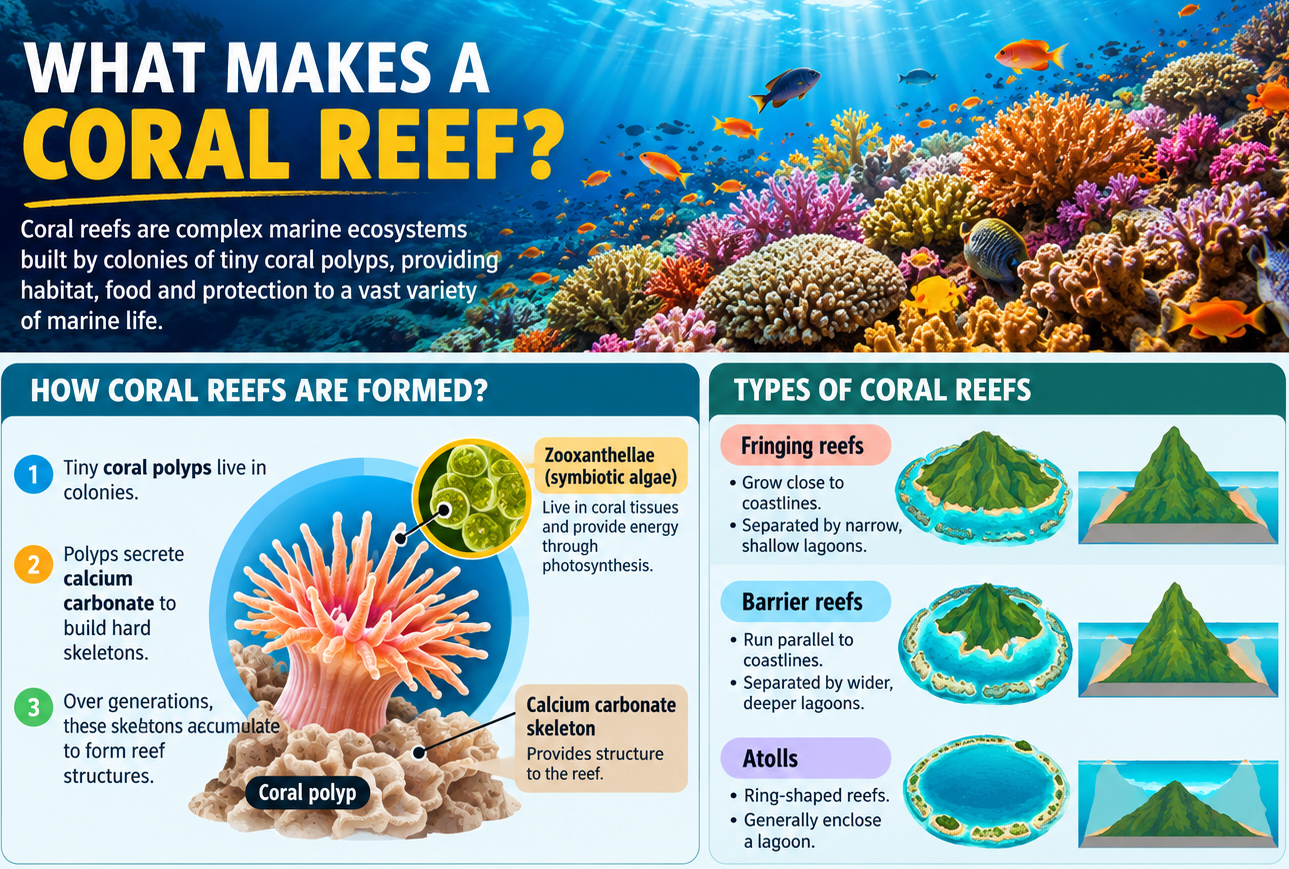
• What are Coral Reefs?
• Coral–Algae Symbiosis: Reef-building corals host microscopic algae called zooxanthellae, which provide much of their energy through photosynthesis. Heat stress can cause corals to expel these algae, resulting in coral bleaching; prolonged stress can lead to coral mortality.
• Conditions for Growth: Most shallow-water reef-building corals thrive in warm, clear, sunlit waters with suitable water quality. Excessive sedimentation and pollution can disrupt their growth and survival.
• Types of Coral Reefs:
Significance of Coral Reef Ecosystems
• Marine Biodiversity: Coral reefs cover less than 1% of the ocean floor but support at least 25% of marine species, making them among the most biodiverse ecosystems on Earth.
• Food Security and Livelihoods: Reef-associated fisheries provide food and income to coastal populations, while reef tourism supports employment and local economies. More than half a billion people depend on reefs for food, income and protection.
• Coastal Protection: Reef structures dissipate wave energy, helping protect coastlines from erosion, storm impacts and flooding, particularly in low-lying coastal and island regions.
• Economic and Medicinal Value: Coral reefs support fisheries, tourism, coastal protection and the discovery of medicinal compounds.
Major Threats to Coral Reef Ecosystems
• Climate Change: Rising ocean temperatures and increasingly intense marine heatwaves cause mass bleaching and coral mortality. Repeated bleaching events can occur before reefs recover, reducing coral cover and weakening their capacity to regenerate.
• Overfishing and Ecological Imbalance: Overexploitation of herbivorous fish, such as parrotfish, reduces the grazing that controls algal growth. Depletion of key fish populations disrupts marine food webs and weakens reef recovery.
• Pollution and Sedimentation: Sewage, agricultural runoff, plastics and other pollutants degrade water quality, while sediment from land clearing and construction can reduce sunlight and smother corals. Ocean acidification, driven by the absorption of atmospheric carbon dioxide, also threatens the formation of coral skeletons.
• Coastal Development and Other Pressures: Dredging, destructive fishing, poorly managed tourism, aquaculture and industrial development can damage reef habitats. Storms, disease outbreaks and crown-of-thorns starfish outbreaks can further compound the effects of climate stress.
Way Forward
• Climate Action: Rapidly reduce greenhouse gas emissions to limit ocean warming, the principal global driver of coral reef decline. Local conservation cannot fully compensate for continued global warming.
• Targeted Ecosystem Protection: Strengthen marine protected areas, sustainable fisheries management and controls on coastal pollution and destructive development. Protecting herbivorous fish populations can also help maintain ecological balance.
• Science-Led Conservation: Strengthen long-term reef monitoring, protect resilient coral populations, and support scientifically assessed restoration. Restoration must complement—not substitute for—emissions reductions and the control of local pressures.
• Community Participation: Involve coastal communities in reef management, sustainable fisheries and responsible tourism while safeguarding livelihoods dependent on healthy reefs.
Khan Global Studies App
With our training programs, learning online can be a very exciting experience. Take the next step toward achieving your professional and personal objectives.



Course Related Query:
Ask Your DoubtsStore Related Query:[email protected]NEET | JEE | CUET
NCERT Books
Resources
We love learning. Through our innovative solutions, we encourage ourselves, our teams, and our Students to grow. We welcome and look for diverse perspectives and opinions because they enhance our decisions. We strive to understand the big picture and how we contribute to the company’s objectives. We approach challenges with optimism and harness the power of teamwork to accomplish our goals. These aren’t just pretty words to post on the office wall. This is who we are. It’s how we work. And it’s how we approach every interaction with each other and our Students.
Come with an open mind, hungry to learn, and you’ll experience unmatched personal and professional growth, a world of different backgrounds and perspectives, and the freedom to be you—every day. We strive to build and sustain diverse teams and foster a culture of belonging. Creating an inclusive environment where every students feels welcome, appreciated, and heard gives us something to feel (really) good about.