Explore All Exams at KGS


All Exams
Explore All Exams at KGS

Khan Sir Courses
Geography I Polity I History | World Map I Indian Map I Economics I Biology

UPSC & State PSC
UPSC I BPSC I UP-PSC I MP-PSC

State Exams
UP I Bihar I MP | Rajasthan

NEET | JEE | CUET
NEET | JEE | CUET

Defence Exams
NDA I CDS I CAPF I AFCAT I SSB I Agniveer

Police Exams
UP SI | Bihar SI | Delhi Police | UP Constable

SSC Exams
CGL I CPO I CHSL I MTS I SSC GD I Delhi Police

Foundation Courses
Physics I Chemistry I Biology I History I Geography I Polity I NCERT I Math I English | Map I Reasoning

Railway Exams
RRB | RPF

Teaching Exams
TET | Teaching | UGC

Banking Exams
SBI | RBI | IBPS

Engineering Exams
Civil | Electrical | Mechanical
UGC NET
UGC NET/JRF
Current Affairs provides you with the best compilation of the Daily Current Affairs taking place across the globe: National, International, Sports, Science and Technology, Banking, Economy, Agreement, Appointments, Ranks, and Report and General Studies
Current Affairs
SYLLABUS
GS-2: Bilateral, Regional and Global Groupings and Agreements involving India and/or affecting India’s interests.
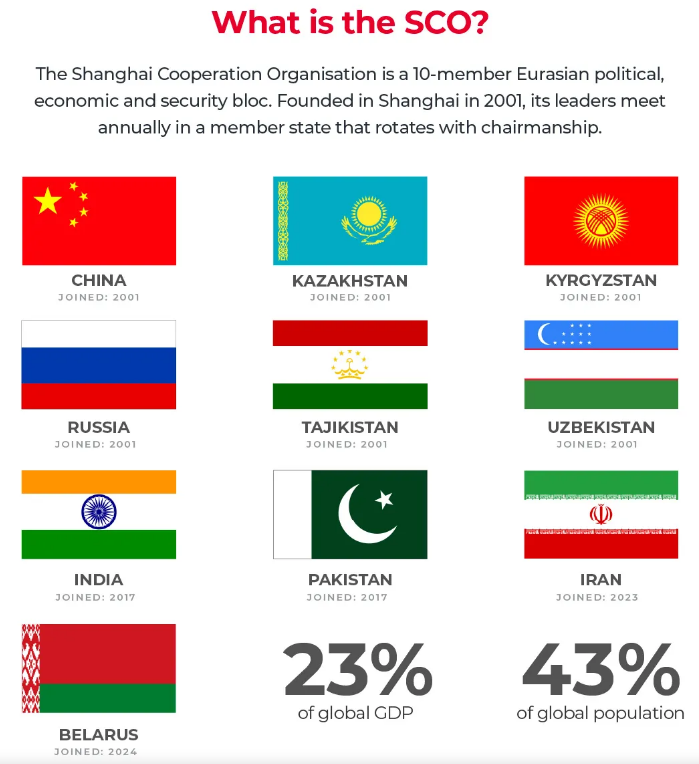
Context: The 26th Meeting of the Council of Heads of State (CHS) of the Shanghai Cooperation Organisation (SCO) was held on 1 September 2026 at the Yrys-Ordo Congress Hall in Bishkek, Kyrgyzstan, under the chairmanship of President Sadyr Japarov.
More on the News:
• Theme: The theme of this year’s SCO Summit is ‘25 Years of the SCO: Together Towards Sustainable Peace, Development and Prosperity’.
• 25th Anniversary of SCO: This year marks the 25th anniversary of the SCO, providing an opportunity for leaders to take stock of its progress and exchange views on further strengthening its role in promoting peace, security, stability and prosperity in the region.
• Transfer of Chairmanship: The summit marked the culmination of the Kyrgyz Republic’s SCO chairmanship for 2025–26, with the chairmanship for 2026–27 being handed over to Pakistan.
• Participation: The meeting was attended by leaders of the SCO member states, including Prime Minister Narendra Modi of India, along with the leaders of Belarus, Iran, Kazakhstan, Pakistan, Russia, Tajikistan and Uzbekistan.
Major Outcomes of SCO Summit 2026
• Approval of 28 Documents:A major outcome of the summit was the approval of 28 documents, including the Bishkek Declaration and the Protocol on Amendments and Additions to the SCO Charter.
• Strengthening Security Cooperation: The SCO approved provisions related to the Universal Centre for Countering Challenges and Threats to the Security of SCO Member States.
• Expanding International
Cooperation:The SCO also continued to strengthen its engagement with international and regional organisations.
• Transfer of SCO Chairmanship to Pakistan: The SCO chairmanship for 2026–27 was transferred from Kyrgyzstan to Pakistan.
• SCO Plus Meeting: The SCO Plus Meeting was held alongside the summit under the theme:“The UN as a Key Element of a Just World Order: The Contribution of the SCO Plus States to the Formation of a Multipolar World.”
India at SCO Summit 2026
• India’s Vision for the SCO: India’s vision for the SCO focuses on three key pillars: S – Security, C – Connectivity and O – Opportunity. The need to work towards achieving concrete outcomes under these three pillars was emphasised.
• Dialogue, Diplomacy and Terrorism: India reiterated that conflicts cannot be resolved on the battlefield and that dialogue and diplomacy are the only way forward.
• Connectivity and Sovereignty: India advocated strong and trusted connectivity initiatives linking regional markets.However, it emphasised that connectivity projects must respect the sovereignty and territorial integrity of nations.
• SCO Civilisation Dialogue Forum:India will host the first edition of the SCO Civilisation Dialogue Forum later in 2026.
Significance for India
• The SCO remains important for India as a platform for engagement with Central Asia and the wider Eurasian region.
• For India, the SCO continues to provide an important platform for advancing its interests in Central Asia, Eurasia, regional security and a multipolar international order.
• The inclusion of English in the SCO framework can facilitate India's institutional participation, while cooperation on counter-terrorism, narcotics, energy, climate change, disaster management and AI aligns with several of India's strategic priorities.
• The summit also reinforces India's emphasis on sovereignty-based connectivity, dialogue and diplomacy, and collective action against terrorism.
Challenges
• Despite these institutional and cooperative outcomes, the SCO continues to operate in a complex geopolitical environment marked by regional conflicts, security concerns and divergent interests among member states.
• Differences among members can make it difficult to translate declarations and programmes into effective implementation.
• Therefore, the effectiveness of the summit outcomes will depend largely on sustained coordination and implementation.
Way Forward
• India should focus on converting the SCO's decisions into concrete regional initiatives, particularly in counter-terrorism, narcotics control, energy security, climate cooperation, AI and disaster management.
• Greater engagement with Central Asian countries, stronger institutional participation and trusted connectivity respecting sovereignty and territorial integrity can further enhance India's role in the Eurasian region.
Conclusion
The 26th SCO Summit in Bishkek strengthened India’s engagement with Eurasia through cooperation on security, connectivity, energy, climate, AI and counter-terrorism. India’s priority now is to convert the SCO’s Security, Connectivity and Opportunity vision into tangible outcomes.
Khan Global Studies App
With our training programs, learning online can be a very exciting experience. Take the next step toward achieving your professional and personal objectives.


Course Related Query:
Ask Your DoubtsStore Related Query:[email protected]NEET | JEE | CUET
NCERT Books
Resources
We love learning. Through our innovative solutions, we encourage ourselves, our teams, and our Students to grow. We welcome and look for diverse perspectives and opinions because they enhance our decisions. We strive to understand the big picture and how we contribute to the company’s objectives. We approach challenges with optimism and harness the power of teamwork to accomplish our goals. These aren’t just pretty words to post on the office wall. This is who we are. It’s how we work. And it’s how we approach every interaction with each other and our Students.
Come with an open mind, hungry to learn, and you’ll experience unmatched personal and professional growth, a world of different backgrounds and perspectives, and the freedom to be you—every day. We strive to build and sustain diverse teams and foster a culture of belonging. Creating an inclusive environment where every students feels welcome, appreciated, and heard gives us something to feel (really) good about.