Explore All Exams at KGS


All Exams
Explore All Exams at KGS

Khan Sir Courses
Geography I Polity I History | World Map I Indian Map I Economics I Biology

UPSC & State PSC
UPSC I BPSC I UP-PSC I MP-PSC

Judiciary
CLAT

State Exams
UP I Bihar I MP | Rajasthan

NEET | JEE | CUET
NEET | JEE | CUET

Defence Exams
NDA I CDS I CAPF I AFCAT I SSB I Agniveer

Police Exams
UP SI | Bihar SI | Delhi Police | UP Constable

SSC Exams
CGL I CPO I CHSL I MTS I SSC GD I Delhi Police

Foundation Courses
Physics I Chemistry I Biology I History I Geography I Polity I NCERT I Math I English | Map I Reasoning

Railway Exams
RRB | RPF

Teaching Exams
TET | Teaching | UGC

Banking Exams
SBI | RBI | IBPS

Engineering Exams
Civil | Electrical | Mechanical
UGC NET
UGC NET/JRF
Current Affairs provides you with the best compilation of the Daily Current Affairs taking place across the globe: National, International, Sports, Science and Technology, Banking, Economy, Agreement, Appointments, Ranks, and Report and General Studies
Current Affairs
SYLLABUS
GS-3: Indian Economy and issues relating to planning, mobilization of resources, growth, development and employment.
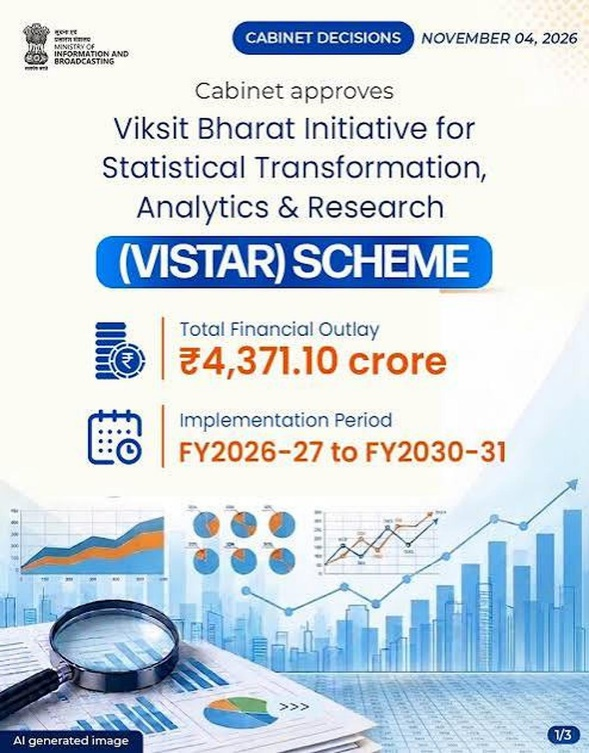
Context: The Union Cabinet has approved the Viksit Bharat Initiative for Statistical Transformation, Analytics & Research (VISTAR), a Central Sector Scheme with an outlay of ₹4,371.10 crore for FY 2026–27 to FY 2030–31, to modernise India's official statistical system in line with the vision of Viksit Bharat 2047.
About the Viksit Bharat Initiative for Statistical Transformation, Analytics & Research (VISTAR)
• Nodal Ministry: Ministry of Statistics and Programme Implementation (MoSPI).
• Duration: Five years (FY 2026–27 to FY 2030–31).
• Financial Outlay: ₹4,371.10 crore.
• Objective: To establish a dynamic, real-time and future-ready statistical architecture through improved data timeliness, granularity and interoperability, supported by harmonised and AI-ready datasets.
• Coverage: Encompasses all statistical and data management activities of MoSPI, including surveys, research, digital transformation and national data governance.
• The scheme has three major components:
1. Comprehensive Statistical Operations and Strengthening of Ecosystem:
2. Support for Statistical Strengthening (SSS):
3. Economic Census (EC):
Need and Significance of VISTAR
• Modernisation of Statistical Infrastructure: Establishes a dynamic, real-time and future-ready statistical architecture by improving data timeliness, granularity, accuracy and interoperability.
• Bridging Critical Data Gaps: Expansion from 43 to 59 proposed surveys during the 16th Finance Commission cycle will improve statistical coverage and enable timely, targeted policy interventions.
• Promoting Evidence-Based Policymaking: AI-driven analytics, harmonised datasets and alternative data sources will improve programme targeting, reduce duplication and respondent burden, and strengthen government decision-making.
• Strengthening Decentralised Statistical Capabilities: SSS 2.0 will improve district-level and million-plus-city estimates, strengthen indigenous data-processing capabilities and promote data-driven local policymaking.
• Improving Assessment of the Unorganised Sector: The 8th Economic Census and National Statistical Business Register will provide granular information on non-farm establishments and workers, helping estimate the unorganised sector's contribution to GDP.
Khan Global Studies App
With our training programs, learning online can be a very exciting experience. Take the next step toward achieving your professional and personal objectives.


Course Related Query:
Ask Your DoubtsStore Related Query:[email protected]NEET | JEE | CUET
NCERT Books
Resources
We love learning. Through our innovative solutions, we encourage ourselves, our teams, and our Students to grow. We welcome and look for diverse perspectives and opinions because they enhance our decisions. We strive to understand the big picture and how we contribute to the company’s objectives. We approach challenges with optimism and harness the power of teamwork to accomplish our goals. These aren’t just pretty words to post on the office wall. This is who we are. It’s how we work. And it’s how we approach every interaction with each other and our Students.
Come with an open mind, hungry to learn, and you’ll experience unmatched personal and professional growth, a world of different backgrounds and perspectives, and the freedom to be you—every day. We strive to build and sustain diverse teams and foster a culture of belonging. Creating an inclusive environment where every students feels welcome, appreciated, and heard gives us something to feel (really) good about.