Explore All Exams at KGS


All Exams
Explore All Exams at KGS

Khan Sir Courses
Geography I Polity I History | World Map I Indian Map I Economics I Biology

UPSC & State PSC
UPSC I BPSC I UP-PSC I MP-PSC

State Exams
UP I Bihar I MP | Rajasthan

NEET | JEE | CUET
NEET | JEE | CUET

Defence Exams
NDA I CDS I CAPF I AFCAT I SSB I Agniveer

Police Exams
UP SI | Bihar SI | Delhi Police | UP Constable

SSC Exams
CGL I CPO I CHSL I MTS I SSC GD I Delhi Police

Foundation Courses
Physics I Chemistry I Biology I History I Geography I Polity I NCERT I Math I English | Map I Reasoning

Railway Exams
RRB | RPF

Teaching Exams
TET | Teaching | UGC

Banking Exams
SBI | RBI | IBPS

Engineering Exams
Civil | Electrical | Mechanical
UGC NET
UGC NET/JRF
Current Affairs provides you with the best compilation of the Daily Current Affairs taking place across the globe: National, International, Sports, Science and Technology, Banking, Economy, Agreement, Appointments, Ranks, and Report and General Studies
Current Affairs
SYLLABUS
GS-2: Bilateral, regional and global groupings and agreements involving India and/or affecting India’s interests.
GS-3: Effects of liberalization on the economy, changes in industrial policy and their effects on industrial growth.
Context: India and New Zealand have ratified their Free Trade Agreement (FTA), signed in April 2026, which will enter into force on 20 October 2026.
More on the News
• New Zealand’s Parliament passed the implementing legislation on 16 September 2026, completing the key domestic process before the two countries announced the entry-into-force date.
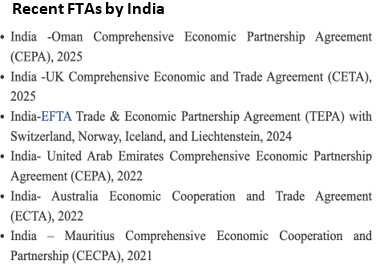
• The India–New Zealand FTA is the seventh FTA concluded by India in the last three and a half years, the latest being with Oman in December 2025.
• During Prime Minister Narendra Modi’s July 2026 visit to New Zealand, the two countries announced a Strategic Partnership and Roadmap to 2030, including an aspirational target of doubling bilateral trade in goods and services to NZ$7 billion (about ₹35,000 crore) by 2030.
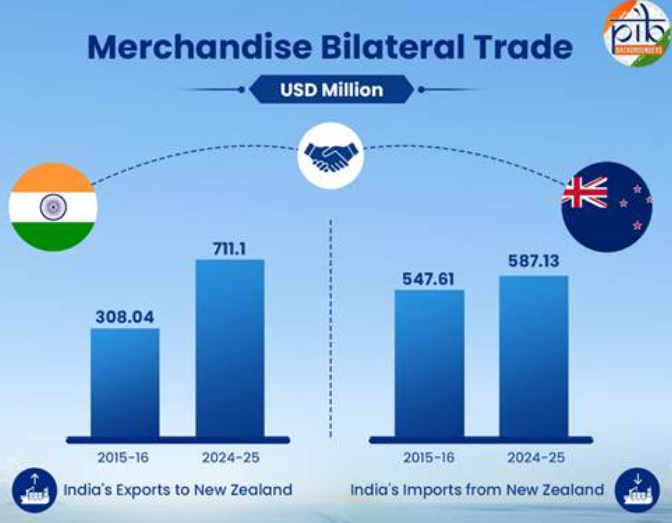
India–New Zealand Trade Relations
• Bilateral trade: In the year ending March 2026, two-way goods and services trade stood at US$2.24 billion, with Indian exports at US$1.03 billion and imports at US$1.21 billion.
• Merchandise trade: Merchandise trade was around US$1.16 billion in 2025–26.
• Services: India’s services exports to New Zealand reached US$634 million in 2024, growing 13%, with travel, IT and business services among the major components.
• People-to-people linkages: Nearly 300,000 people of Indian origin/NRIs live in New Zealand, providing an important economic and cultural bridge between the two countries.
Key Provisions of the FTA
A. Trade in Goods
• 100% duty-free access: New Zealand will eliminate duties on 100% of tariff lines covering Indian exports from the entry into force, benefiting textiles, apparel, leather, footwear, engineering goods, pharmaceuticals and processed foods.
• Calibrated Indian market access: India has offered concessions on 70.03% of tariff lines, covering about 95% of bilateral trade, while excluding sensitive sectors such as dairy, coffee, onions, sugar, spices, rubber and several other agricultural products.
• Selected products such as apples, kiwifruit and Mānuka honey receive calibrated access through tariff-rate quotas, minimum import prices and other safeguards.
B. Services and Mobility
• New Zealand has offered commitments across 118 service sectors, with MFN treatment in about 139 sub-sectors.
• The agreement provides a 5,000-visa TEE pathway for skilled Indians, 1,000 annual Working Holiday visas and expanded student mobility with post-study work opportunities.
C. Investment and Regulatory Cooperation
• New Zealand will facilitate US$20 billion of investment into India over 15 years, with focus areas including manufacturing, infrastructure, agriculture and emerging technologies.
• Acceptance of inspection approvals from comparable regulators in other advanced countries such as the US FDA is expected to facilitate market access for Indian pharmaceuticals and medical devices.
D. Agriculture and Economic Cooperation
• An Agriculture Productivity Partnership, supported by action plans and Centres of Excellence for apples, kiwifruit and honey, links market access with productivity and technology cooperation.
• The FTA also provides for cooperation in MSMEs, AYUSH/traditional medicine, technology, trade facilitation and other emerging areas.
• Rules of Origin: The FTA establishes a robust Rules of Origin framework to ensure that benefits accrue only to genuine exporters.
Significance for India
• Improves export competitiveness: Zero-duty access removes the tariff disadvantage faced by Indian products and creates greater opportunities for labour-intensive sectors such as textiles, footwear and leather.
• Expands services and talent mobility: Services commitments, professional visas and student pathways can strengthen India’s services exports and skilled human-capital linkages with New Zealand.
• Links trade with investment: The US$20-billion investment facilitation commitment can support manufacturing, infrastructure, agriculture and emerging technologies in India.
• Deepens Indo-Pacific economic engagement: The agreement combines market access with cooperation in agriculture, technology, traditional medicine and services, while strengthening India’s economic partnership with a developed Pacific economy.
Implementation Challenges
• FTA utilisation: Indian exporters, particularly MSMEs, will need to effectively use preferences while meeting rules of origin, standards and certification requirements.
• Non-tariff barriers: Regulatory and compliance requirements can continue to affect market access even after tariff barriers are removed.
• Domestic adjustment: Greater import access requires continued monitoring of sensitive agricultural sectors and effective use of safeguard provisions.
• Investment delivery: The impact of the investment commitment will depend on actual project mobilisation and implementation.
Way Forward
• Strengthen MSME export readiness, certification and standards compliance to maximise utilisation of the agreement.
• Develop sector-specific strategies to leverage opportunities in textiles, engineering, pharmaceuticals, processed food and services.
• Ensure effective monitoring of sensitive imports and safeguard mechanisms while maintaining predictable trade conditions.
• Integrate the FTA with wider cooperation in investment, agriculture, technology, skills and innovation to deepen long-term economic ties.
Khan Global Studies App
With our training programs, learning online can be a very exciting experience. Take the next step toward achieving your professional and personal objectives.



Course Related Query:
Ask Your DoubtsStore Related Query:[email protected]NEET | JEE | CUET
NCERT Books
Resources
We love learning. Through our innovative solutions, we encourage ourselves, our teams, and our Students to grow. We welcome and look for diverse perspectives and opinions because they enhance our decisions. We strive to understand the big picture and how we contribute to the company’s objectives. We approach challenges with optimism and harness the power of teamwork to accomplish our goals. These aren’t just pretty words to post on the office wall. This is who we are. It’s how we work. And it’s how we approach every interaction with each other and our Students.
Come with an open mind, hungry to learn, and you’ll experience unmatched personal and professional growth, a world of different backgrounds and perspectives, and the freedom to be you—every day. We strive to build and sustain diverse teams and foster a culture of belonging. Creating an inclusive environment where every students feels welcome, appreciated, and heard gives us something to feel (really) good about.