Explore All Exams at KGS


All Exams
Explore All Exams at KGS

Khan Sir Courses
Geography I Polity I History | World Map I Indian Map I Economics I Biology

UPSC & State PSC
UPSC I BPSC I UP-PSC I MP-PSC

State Exams
UP I Bihar I MP | Rajasthan

NEET | JEE | CUET
NEET | JEE | CUET

Defence Exams
NDA I CDS I CAPF I AFCAT I SSB I Agniveer

Police Exams
UP SI | Bihar SI | Delhi Police | UP Constable

SSC Exams
CGL I CPO I CHSL I MTS I SSC GD I Delhi Police

Foundation Courses
Physics I Chemistry I Biology I History I Geography I Polity I NCERT I Math I English | Map I Reasoning

Railway Exams
RRB | RPF

Teaching Exams
TET | Teaching | UGC

Banking Exams
SBI | RBI | IBPS

Engineering Exams
Civil | Electrical | Mechanical
UGC NET
UGC NET/JRF
Current Affairs provides you with the best compilation of the Daily Current Affairs taking place across the globe: National, International, Sports, Science and Technology, Banking, Economy, Agreement, Appointments, Ranks, and Report and General Studies
Current Affairs
SYLLABUS
GS-3: Science and Technology- developments and their applications and effects in everyday life; indigenization of technology and developing new technology; Awareness in the fields of IT, Space.
Context: The United States has publicly acknowledged deploying “on-orbit space control weapons”, bringing the growing issue of space weaponisation into renewed focus.
More on the News
• The US has not disclosed the type, number or operational details of these weapons, but described them as capabilities intended to defend the Joint Force against hostile action.
• The disclosure comes amid growing counter-space capabilities and raises concerns that action–reaction dynamics among space powers could contribute to a security dilemma and an arms race in outer space.
• With satellites supporting critical civilian and military functions, the development also highlights the need to examine the forms of space weaponisation, gaps in the existing legal framework and measures to prevent escalation.
Militarisation vs Weaponisation of Space
• Militarisation of Space: Use of space-based assets and technologies to support military activities on Earth, such as communication, navigation, surveillance, reconnaissance and missile warning.
• Weaponisation of Space: Development or deployment of capabilities intended to destroy, damage, disrupt, degrade or deny an adversary’s space or space-enabled capabilities.
• Thus, the militarisation of space does not necessarily mean that weapons are deployed in space; weaponisation represents a further step towards using space or counter-space capabilities for offensive or defensive military purposes.
Understanding Space Weaponisation & its Forms
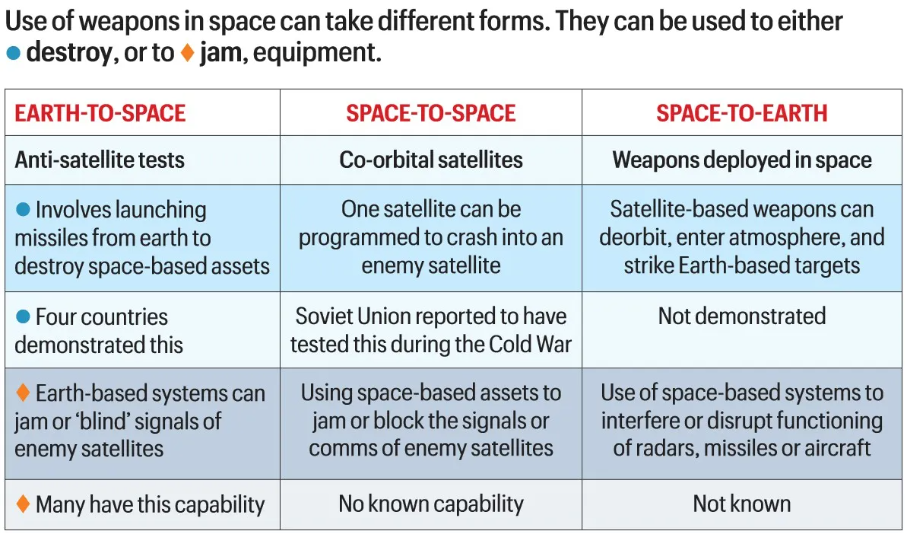
• Space weaponisation involves both kinetic and non-kinetic means. Kinetic systems physically damage, destroy or alter the orbit of a space object, while non-kinetic methods disrupt its functioning without necessarily causing physical destruction.
• Anti-Satellite (ASAT) weapons are the most publicly demonstrated kinetic counter-space capability. The US, Russia, China and India have demonstrated direct-ascent ASAT capabilities.
• Non-kinetic capabilities include jamming and cyber operations that can interfere with communications, signals or supporting ground infrastructure without physically destroying a satellite. The US Space Force describes space control as involving both kinetic and non-kinetic means.
• The challenge is further complicated by dual-use space systems, as the same satellite or supporting infrastructure may serve civilian as well as military functions.
• Therefore, space weaponisation extends beyond physically destroying satellites to the broader ability to deny, disrupt or degrade space-enabled capabilities.
International Legal Framework and Regulatory Gap
• Outer Space Treaty, 1967: The Outer Space Treaty (OST) prohibits placing nuclear weapons or other WMDs in Earth orbit and prohibits military bases, weapons testing and military manoeuvres on the Moon and other celestial bodies; however, it does not expressly prohibit conventional weapons in outer space.
• Earth-based Counter-Space Weapons: The Treaty also does not comprehensively prohibit Earth-based conventional systems such as direct-ascent ASAT weapons, creating a regulatory distinction between weapons placed in space and weapons used from Earth against space assets.
• Prevention of an Arms Race in Outer Space (PAROS): PAROS seeks to prevent an arms race in outer space through international rules and agreements; the issue is considered within the Conference on Disarmament, and India supports negotiations towards a legally binding instrument.
• Draft PPWT: Russia and China proposed the Draft Treaty on the Prevention of the Placement of Weapons in Outer Space and of the Threat or Use of Force Against Outer Space Objects (PPWT) in 2008, but the proposal has not resulted in a binding treaty and has faced concerns regarding its scope and verification.
• Artemis Accords: The Artemis Accords establish voluntary principles for peaceful, safe and sustainable civil space exploration and reinforce the OST, but they do not constitute a comprehensive arms-control framework for space weapons; India became a signatory in 2023.
• Regulatory Gap: Consequently, while the OST provides the foundational legal framework for outer space, conventional space weapons, Earth-based ASAT systems and several non-kinetic counter-space capabilities remain insufficiently regulated, underscoring the need for more comprehensive international norms.
Implications for Global Security and India
• Emergence of space as a warfighting domain: Growing counter-space capabilities could make satellites and associated ground infrastructure potential targets, extending military competition into outer space.
• Risk of cascading disruption and debris: Attacks or interference involving space assets can disrupt critical services and, in the case of destructive ASAT actions, generate debris that can threaten other spacecraft and long-term space operations.
• Strategic vulnerability of India: India increasingly depends on space-based systems for communication, navigation, Earth observation and national security, making the protection and resilience of its space assets an important security requirement.
• Need for enhanced Indian space-security preparedness: India has demonstrated a kinetic ASAT capability through Mission Shakti (2019) and is strengthening Space Situational Awareness (SSA), space-object tracking and space sustainability through initiatives such as IS4OM, NETRA and the Debris Free Space Mission.
Way Forward
• Pursue a legally binding PAROS framework: Advance negotiations in the Conference on Disarmament for a universal, verifiable and legally binding instrument to prevent an arms race in outer space.
• Close regulatory gaps: Future rules should address both weapons placed in space and Earth-based kinetic and non-kinetic capabilities capable of disrupting space assets.
• Strengthen responsible behaviour and confidence-building: Promote transparency, information-sharing, advance notifications and communication mechanisms to reduce miscalculation and unintended escalation.
• Build resilience and minimise debris: Strengthen Space Situational Awareness, cyber resilience, redundancy and protection of critical space infrastructure, alongside stronger international norms against debris-generating activities such as destructive ASAT testing.
Khan Global Studies App
With our training programs, learning online can be a very exciting experience. Take the next step toward achieving your professional and personal objectives.



Course Related Query:
Ask Your DoubtsStore Related Query:[email protected]NEET | JEE | CUET
NCERT Books
Resources
We love learning. Through our innovative solutions, we encourage ourselves, our teams, and our Students to grow. We welcome and look for diverse perspectives and opinions because they enhance our decisions. We strive to understand the big picture and how we contribute to the company’s objectives. We approach challenges with optimism and harness the power of teamwork to accomplish our goals. These aren’t just pretty words to post on the office wall. This is who we are. It’s how we work. And it’s how we approach every interaction with each other and our Students.
Come with an open mind, hungry to learn, and you’ll experience unmatched personal and professional growth, a world of different backgrounds and perspectives, and the freedom to be you—every day. We strive to build and sustain diverse teams and foster a culture of belonging. Creating an inclusive environment where every students feels welcome, appreciated, and heard gives us something to feel (really) good about.