Explore All Exams at KGS


All Exams
Explore All Exams at KGS

Khan Sir Courses
Geography I Polity I History | World Map I Indian Map I Economics I Biology

UPSC & State PSC
UPSC I BPSC I UP-PSC I MP-PSC

State Exams
UP I Bihar I MP | Rajasthan

NEET | JEE | CUET
NEET | JEE | CUET

Defence Exams
NDA I CDS I CAPF I AFCAT I SSB I Agniveer

Police Exams
UP SI | Bihar SI | Delhi Police | UP Constable

SSC Exams
CGL I CPO I CHSL I MTS I SSC GD I Delhi Police

Foundation Courses
Physics I Chemistry I Biology I History I Geography I Polity I NCERT I Math I English | Map I Reasoning

Railway Exams
RRB | RPF

Teaching Exams
TET | Teaching | UGC

Banking Exams
SBI | RBI | IBPS

Engineering Exams
Civil | Electrical | Mechanical
UGC NET
UGC NET/JRF
Current Affairs provides you with the best compilation of the Daily Current Affairs taking place across the globe: National, International, Sports, Science and Technology, Banking, Economy, Agreement, Appointments, Ranks, and Report and General Studies
Current Affairs
SYLLABUS
GS-2: Structure, organization and functioning of the Executive and the Judiciary Ministries and Departments of the Government.
Context: The e-Courts Mission Mode Project is transforming India’s paper-based judiciary into a digitally enabled, transparent, accessible and citizen-centric justice delivery system through digitisation of court records, e-filing, virtual hearings and emerging technologies.
About the e-Courts Mission Mode Project
• It was launched in 2007 to modernise India’s paper-based judicial system by digitising court proceedings and documents and making the judicial process more affordable, accessible and transparent.
• The project is being implemented in phases and is currently in its third phase (2023–2027).
• Phase I (2011–2015): Building the Digital Foundation: Phase I laid the foundation of the Mission by computerising over 14,000 courts and building the basic network infrastructure needed to support technology-enabled judicial services.
• Phase II (2015–2023): Expanding Citizen-Centric Services: Phase II built on this foundation through a range of citizen-centric services, including the National Judicial Data Grid (NJDG), e-Filing and e-Sewa Kendras.
• Phase III (2023–2027): Digital, Paperless and Intelligent Courts: The ongoing Phase III aims to create digital, paperless and intelligent courts through digitisation, virtual hearings, institutional interoperability and Artificial Intelligence, Machine Learning, analytics and Optical Character Recognition.
Major Benefits of Court Digitisation in India
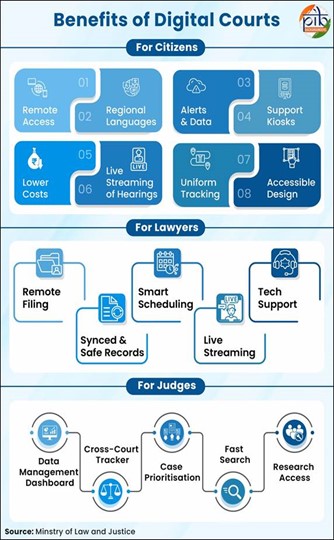
• Transparency through the National Judicial Data Grid: NJDG provides real-time public access to case data, pending/disposed cases, case stages and reasons for delays across the Supreme Court, High Courts and District Courts.
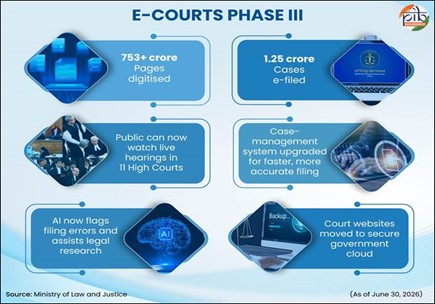
• Faster Filing and Digitisation of Court Records: e-Filing enables online filing, payments, e-signing and case tracking, with 1.25 crore+ cases filed, ₹1,404 crore court fees, ₹75 crore fines processed and 753 crore+ pages digitised.
• Affordable Access through Virtual Courts and Video Conferencing: Over 4.18 crore remote hearings have been conducted across 7,553 establishments, livestreaming operates in 11 High Courts, and 31 Virtual Courts have received 11.33 crore challans worth ₹1,135.79 crore,
• Integrated Digital Criminal Justice System: ICJS digitally connects police, courts, prisons, forensic laboratories and prosecution agencies through platforms.
• Inclusive Access through e-Sewa Kendras and Digital Platforms: 2,584 e-Sewa Kendras provide case-status, certified-copy, e-filing, payment, legal-aid and virtual-hearing assistance,
• AI-Enabled and Multilingual Judicial Services: AI and Machine Learning tools such as LegRAA, Digital Courts 2.1, ASR-SHRUTI and PANINI support legal research, case management, transcription and translation, with 83,000+ judgments translated into 18 Indian languages.
Khan Global Studies App
With our training programs, learning online can be a very exciting experience. Take the next step toward achieving your professional and personal objectives.



Course Related Query:
Ask Your DoubtsStore Related Query:[email protected]NEET | JEE | CUET
NCERT Books
Resources
We love learning. Through our innovative solutions, we encourage ourselves, our teams, and our Students to grow. We welcome and look for diverse perspectives and opinions because they enhance our decisions. We strive to understand the big picture and how we contribute to the company’s objectives. We approach challenges with optimism and harness the power of teamwork to accomplish our goals. These aren’t just pretty words to post on the office wall. This is who we are. It’s how we work. And it’s how we approach every interaction with each other and our Students.
Come with an open mind, hungry to learn, and you’ll experience unmatched personal and professional growth, a world of different backgrounds and perspectives, and the freedom to be you—every day. We strive to build and sustain diverse teams and foster a culture of belonging. Creating an inclusive environment where every students feels welcome, appreciated, and heard gives us something to feel (really) good about.