KGS

All Exams

Explore All Exams at KGS

All Exams
Home>Current Affairs>National Handloom Day 2026
Current Affairs made simple.

Current Affairs provides you with the best compilation of the Daily Current Affairs taking place across the globe: National, International, Sports, Science and Technology, Banking, Economy, Agreement, Appointments, Ranks, and Report and General Studies

banner-image

Current Affairs

National Handloom Day 2026

SYLLABUS

GS-3: Indian Economy and issues relating to planning, mobilization of resources, growth, development and employment.

Context: The 12th National Handloom Day is being celebrated on 7 August 2026 to commemorate the Swadeshi Movement (1905), honour India's rich handloom heritage and recognise the contribution of over 35.22 lakh handloom weavers and allied workers.

About National Handloom Day
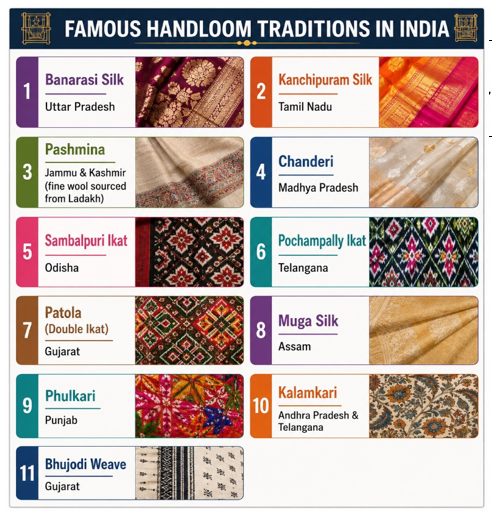
  • National Handloom Day is celebrated annually on 7 August.
  • It was instituted by the Government of India in 2015, and the first National Handloom Day was celebrated on 7 August 2015.
  • It commemorates the Swadeshi Movement, launched on 7 August 1905 to promote indigenous industries, domestic products and self-reliance.
  • It aims to generate awareness about the importance of the handloom industry in the socio-economic development of the country.
  • The day honours the handloom weaving community, preserves India's handloom heritage and promotes greater opportunities for handloom weavers and workers.

Status of India's Handloom Sector

  • According to the Fourth All India Handloom Census (2019-20), India has 31.45 lakh handloom households, 35.22 lakh handloom weavers and allied workers, including 8.48 lakh allied workers engaged in pre-loom and post-loom activities.
  • Women account for 25.46 lakh workers (over 72%), making the handloom sector one of India's largest women-led livelihood sectors.
  • India has 28.20 lakh handlooms, of which 25.30 lakh are located in rural areas, highlighting the sector's importance for sustainable rural employment and traditional household enterprises.
  • India's handloom exports stood at ₹1,330.96 crore in 2025-26, with the UAE, United States, France, United Kingdom and Spain emerging as the leading export destinations.

Significance of the Handloom Sector

  • Employment and Rural Livelihoods: The handloom sector is one of India's largest cottage industries, supporting the livelihoods of more than 35 lakh persons through weaving and allied activities.
  • Women-led Development: Women constitute over 72% of the handloom workforce, making the sector an important driver of women's economic empowerment and financial inclusion.
  • Preserving India's Cultural Heritage: India's handloom tradition dates back to the Indus Valley Civilisation, with references in the Rigveda, Ramayana and Mahabharata, preserving region-specific weaving traditions across generations.
  • Sustainable and Eco-friendly Production: Handloom production is labour-intensive, eco-friendly and based on manual craftsmanship, requiring minimal capital and power.
  • Economic Growth and Global Recognition: Growing demand, exports, digital platforms, branding, GI protection and global market linkages are improving weavers' incomes and strengthening India's position in global textile markets.

Government Support to the Handloom Sector

  • National Handloom Development Programme (NHDP): Flagship programme for integrated development through Cluster Development, Handloom Marketing Assistance, Weaver MUDRA, Social Security, Mega Cluster Development and Need-based Infrastructure Projects.
  • Financial Assistance and Social Security: Support through Weaver MUDRA, PMJJBY, PMSBY, scholarships for weavers' children and e-Pehchan registration.
  • Recognition and Skill Promotion: Sant Kabir Handloom Award and National Handloom Award recognise excellence in craftsmanship, while Handloom Hackathon 2026 promotes innovation, sustainability and entrepreneurship.
  • Quality Assurance and Legal Protection: Handloom Mark, India Handloom Brand, GI registration and the Handlooms (Reservation of Articles for Production) Act, 1985 protect authentic handloom products and weaving traditions.
  • Recent Policy Push (Union Budget 2026–27): National Fibre Scheme, National Handloom and Handicraft Programme, Textile Expansion and Employment Scheme and Mahatma Gandhi Gram Swaraj Initiative aim to modernise clusters, improve raw material, market linkages, skilling, technology and production quality.

Khan Global Studies App

The most trusted learning platform on your phone

With our training programs, learning online can be a very exciting experience. Take the next step toward achieving your professional and personal objectives.


Download on the App StoreGet it on Google Play
Khan Global Studies mobile app screens
logo
Khan Global Studies Pvt. Ltd. 5th Floor,
A13A, Graphix 1 Tower B, Sector 62,
Noida, Uttar Pradesh 201309

Course Related Query:

Ask Your DoubtsStore Related Query:[email protected]

Get Free Academic Counseling & Course Details

KGS best learning platform

About Khan Global Studies

We love learning. Through our innovative solutions, we encourage ourselves, our teams, and our Students to grow. We welcome and look for diverse perspectives and opinions because they enhance our decisions. We strive to understand the big picture and how we contribute to the company’s objectives. We approach challenges with optimism and harness the power of teamwork to accomplish our goals. These aren’t just pretty words to post on the office wall. This is who we are. It’s how we work. And it’s how we approach every interaction with each other and our Students.


What Makes Us Different

Come with an open mind, hungry to learn, and you’ll experience unmatched personal and professional growth, a world of different backgrounds and perspectives, and the freedom to be you—every day. We strive to build and sustain diverse teams and foster a culture of belonging. Creating an inclusive environment where every students feels welcome, appreciated, and heard gives us something to feel (really) good about.


©Copyright 2026 KhanGlobalStudies