Explore All Exams at KGS


All Exams
Explore All Exams at KGS

Khan Sir Courses
Geography I Polity I History | World Map I Indian Map I Economics I Biology

UPSC & State PSC
UPSC I BPSC I UP-PSC I MP-PSC

State Exams
UP I Bihar I MP | Rajasthan

NEET | JEE | CUET
NEET | JEE | CUET

Defence Exams
NDA I CDS I CAPF I AFCAT I SSB I Agniveer

Police Exams
UP SI | Bihar SI | Delhi Police | UP Constable

SSC Exams
CGL I CPO I CHSL I MTS I SSC GD I Delhi Police

Foundation Courses
Physics I Chemistry I Biology I History I Geography I Polity I NCERT I Math I English | Map I Reasoning

Railway Exams
RRB | RPF

Teaching Exams
TET | Teaching | UGC

Banking Exams
SBI | RBI | IBPS

Engineering Exams
Civil | Electrical | Mechanical
UGC NET
UGC NET/JRF
Current Affairs provides you with the best compilation of the Daily Current Affairs taking place across the globe: National, International, Sports, Science and Technology, Banking, Economy, Agreement, Appointments, Ranks, and Report and General Studies

Current Affairs
SYLLABUS
GS-1: Indian culture will cover the salient aspects of Art Forms, Literature and Architecture from ancient to modern times.
Context: Archaeological excavations at Karivalamvanthanallur (Malayadipatti) on the banks of the Vaippar River in Tenkasi district, Tamil Nadu, are uncovering evidence of a settlement that appears to have survived and evolved from the Microlithic Period to the Sangam Age.
Key Findings
• Continuous Human Occupation: Evidence points to continuous occupation from the Microlithic Period through the Iron Age to the Early Historic and Historic periods, bypassing the Neolithic and Chalcolithic phases.
• Organised Industrial Settlement: The discoveries suggest that the site was not merely a habitation site but an organised industrial settlement.
• Large Brick Structure: One of the excavation's most significant discoveries is a large brick structure measuring about 8.7 m × 4.2 m, constructed using bricks measuring 40 × 20 × 7 cm.
• Burial Evidence: Archaeologists unearthed a red-slipped burial pot decorated with painted peacocks.
Significance of the Findings
• Historically Significant Site: The site's importance was first recognised after Roman coins were reported from the region, leading L. A. Cammiade to survey it, while the Madras Museum's 1932–33 Annual Report documented glass beads and burial urns.
• Evidence of a Specialised Production Centre: The discoveries suggest the settlement functioned as a specialised production centre, with evidence of iron production, bead manufacturing, shell bangle production and weaving.
• Habitation, Manufacturing and Commerce: Located along an ancient east-west trade route, the settlement appears to have combined habitation, manufacturing and commerce, indicating its integration into wider trade networks.
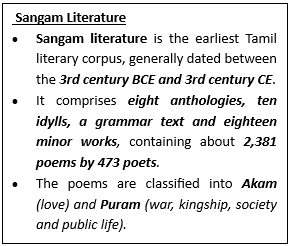
• Bridges Archaeology and Sangam Literature: The peacock-decorated burial urn and references in Akananuru strengthen the link between archaeological evidence and Sangam literature.
• Distinct Cultural Sequence: The excavation suggests southern Tamil Nadu followed a Microlithic–Iron Age–Early Historic sequence, unlike the Microlithic–Neolithic–Iron Age sequence of northern Tamil Nadu.
• Strengthens Tamil Nadu's Archaeological Record: Together with Keeladi, Sivagalai, Mangudi and Adichanallur, the findings strengthen Tamil Nadu's archaeological record and may reveal Karivalamvanthanallur's continuous evolution from the Stone Age to the Sangam Age.
Khan Global Studies App
With our training programs, learning online can be a very exciting experience. Take the next step toward achieving your professional and personal objectives.


Course Related Query:
Ask Your DoubtsStore Related Query:[email protected]NEET | JEE | CUET
NCERT Books
Resources
We love learning. Through our innovative solutions, we encourage ourselves, our teams, and our Students to grow. We welcome and look for diverse perspectives and opinions because they enhance our decisions. We strive to understand the big picture and how we contribute to the company’s objectives. We approach challenges with optimism and harness the power of teamwork to accomplish our goals. These aren’t just pretty words to post on the office wall. This is who we are. It’s how we work. And it’s how we approach every interaction with each other and our Students.
Come with an open mind, hungry to learn, and you’ll experience unmatched personal and professional growth, a world of different backgrounds and perspectives, and the freedom to be you—every day. We strive to build and sustain diverse teams and foster a culture of belonging. Creating an inclusive environment where every students feels welcome, appreciated, and heard gives us something to feel (really) good about.