Explore All Exams at KGS


All Exams
Explore All Exams at KGS

Khan Sir Courses
Geography I Polity I History | World Map I Indian Map I Economics I Biology

UPSC & State PSC
UPSC I BPSC I UP-PSC I MP-PSC

State Exams
UP I Bihar I MP | Rajasthan

NEET | JEE | CUET
NEET | JEE | CUET

Defence Exams
NDA I CDS I CAPF I AFCAT I SSB I Agniveer

Police Exams
UP SI | Bihar SI | Delhi Police | UP Constable

SSC Exams
CGL I CPO I CHSL I MTS I SSC GD I Delhi Police

Foundation Courses
Physics I Chemistry I Biology I History I Geography I Polity I NCERT I Math I English | Map I Reasoning

Railway Exams
RRB | RPF

Teaching Exams
TET | Teaching | UGC

Banking Exams
SBI | RBI | IBPS

Engineering Exams
Civil | Electrical | Mechanical
UGC NET
UGC NET/JRF
Current Affairs provides you with the best compilation of the Daily Current Affairs taking place across the globe: National, International, Sports, Science and Technology, Banking, Economy, Agreement, Appointments, Ranks, and Report and General Studies

Current Affairs
SYLLABUS
GS-3: Conservation, environmental pollution and degradation; Infrastructure: Energy.
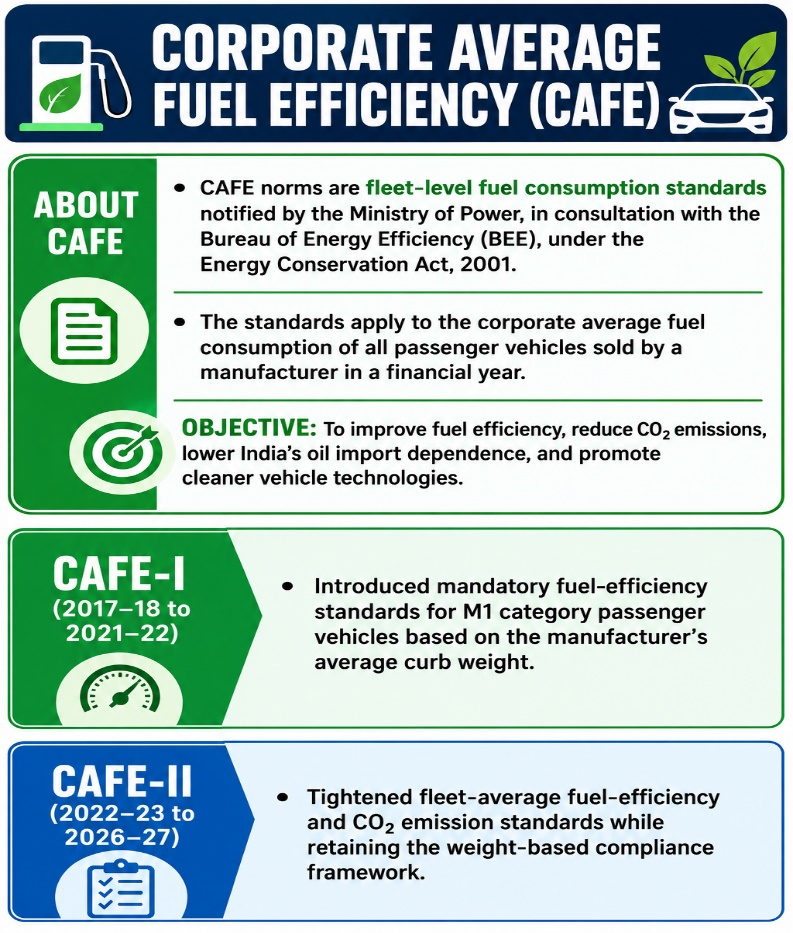
Context: The Ministry of Power has released the Draft Corporate Average Fuel Economy (CAFE)-III Norms, 2027 for stakeholder consultation to tighten fuel-efficiency and carbon dioxide (CO₂) emission standards for passenger vehicles from 1 April 2027.
Key Provisions and Major New Features of CAFE-III
• Applicability: The norms will apply to M1 category passenger vehicles (having not more than eight seats in addition to the driver's seat) manufactured or imported for sale in India during 2027-28 to 2031-32.
• Implementation Period: The proposed norms will come into force from 1 April 2027 and will remain applicable for five years, replacing the existing CAFE-II regime.
• Compliance Assessment: Compliance will be assessed over two blocks: First Block (Three years) and Second Block (Two years).
• Progressively Stricter Fuel-Efficiency Targets: The draft proposes progressively tighter fleet-average fuel consumption targets:
• Carbon Neutrality Factors (CNFs): For the first time, the draft recognises the carbon-neutrality of ethanol, biofuel and Compressed Bio-Gas (CBG) by permitting specified reductions in declared tailpipe CO₂ emissions before compliance assessment.
• Technology Incentives: Manufacturers will be eligible to claim compliance benefits of up to 9 gCO₂/km for approved fuel-saving technologies, subject to a maximum benefit of 1 gCO₂/km per technology.
• Super Credits: Volume-based super credits will continue for:
• Credit-Debit Mechanism: Manufacturers exceeding prescribed targets will earn compliance credits, which may be carried forward within a compliance block. Those falling short may meet their obligations through:
• Compliance Credits: Compliance credits will be denominated in units of 1 gCO₂/km, with an initial buy-out price of ₹2,500 per credit, increasing by ₹500 annually.
• Penalty and Exemption: Manufacturers failing to comply will be liable for penalties under the Energy Conservation Act, while passenger vehicle manufacturers with annual sales of fewer than 1,000 units will remain exempt.
Significance
• Supports India's Net Zero Vision: Accelerates decarbonisation of the transport sector, contributing to India's commitments under the Paris Agreement and the target of achieving Net Zero emissions by 2070.
• Strengthens Energy Security: Lower fuel consumption in the passenger vehicle sector will reduce dependence on imported crude oil, improving India's long-term energy security and reducing vulnerability to global oil price volatility.
• Enhances Global Competitiveness: Encourages the Indian automobile industry to align with evolving global fuel-efficiency and emission standards, improving its competitiveness in international markets.
• Drives Technological Innovation: Promotes investment in advanced automotive technologies, lightweight materials and energy-efficient powertrains, strengthening domestic manufacturing capabilities.
• Improves Environmental and Public Health: Lower vehicular emissions will improve urban air quality, reduce pollution-related health risks and support sustainable urban development
Khan Global Studies App
With our training programs, learning online can be a very exciting experience. Take the next step toward achieving your professional and personal objectives.




Course Related Query:
Ask Your DoubtsStore Related Query:[email protected]NEET | JEE | CUET
NCERT Books
Resources
We love learning. Through our innovative solutions, we encourage ourselves, our teams, and our Students to grow. We welcome and look for diverse perspectives and opinions because they enhance our decisions. We strive to understand the big picture and how we contribute to the company’s objectives. We approach challenges with optimism and harness the power of teamwork to accomplish our goals. These aren’t just pretty words to post on the office wall. This is who we are. It’s how we work. And it’s how we approach every interaction with each other and our Students.
Come with an open mind, hungry to learn, and you’ll experience unmatched personal and professional growth, a world of different backgrounds and perspectives, and the freedom to be you—every day. We strive to build and sustain diverse teams and foster a culture of belonging. Creating an inclusive environment where every students feels welcome, appreciated, and heard gives us something to feel (really) good about.