Explore All Exams at KGS


All Exams
Explore All Exams at KGS

Khan Sir Courses
Geography I Polity I History | World Map I Indian Map I Economics I Biology

UPSC & State PSC
UPSC I BPSC I UP-PSC I MP-PSC

State Exams
UP I Bihar I MP | Rajasthan

NEET | JEE | CUET
NEET | JEE | CUET

Defence Exams
NDA I CDS I CAPF I AFCAT I SSB I Agniveer

Police Exams
UP SI | Bihar SI | Delhi Police | UP Constable

SSC Exams
CGL I CPO I CHSL I MTS I SSC GD I Delhi Police

Foundation Courses
Physics I Chemistry I Biology I History I Geography I Polity I NCERT I Math I English | Map I Reasoning

Railway Exams
RRB | RPF

Teaching Exams
TET | Teaching | UGC

Banking Exams
SBI | RBI | IBPS

Engineering Exams
Civil | Electrical | Mechanical
UGC NET
UGC NET/JRF
Current Affairs provides you with the best compilation of the Daily Current Affairs taking place across the globe: National, International, Sports, Science and Technology, Banking, Economy, Agreement, Appointments, Ranks, and Report and General Studies

Current Affairs
SYLLABUS
GS-3: Science and Technology—Developments and their Applications and Effects in Everyday Life; Awareness in the fields of IT, Computers, and Biotech; Basics of Cyber Security.
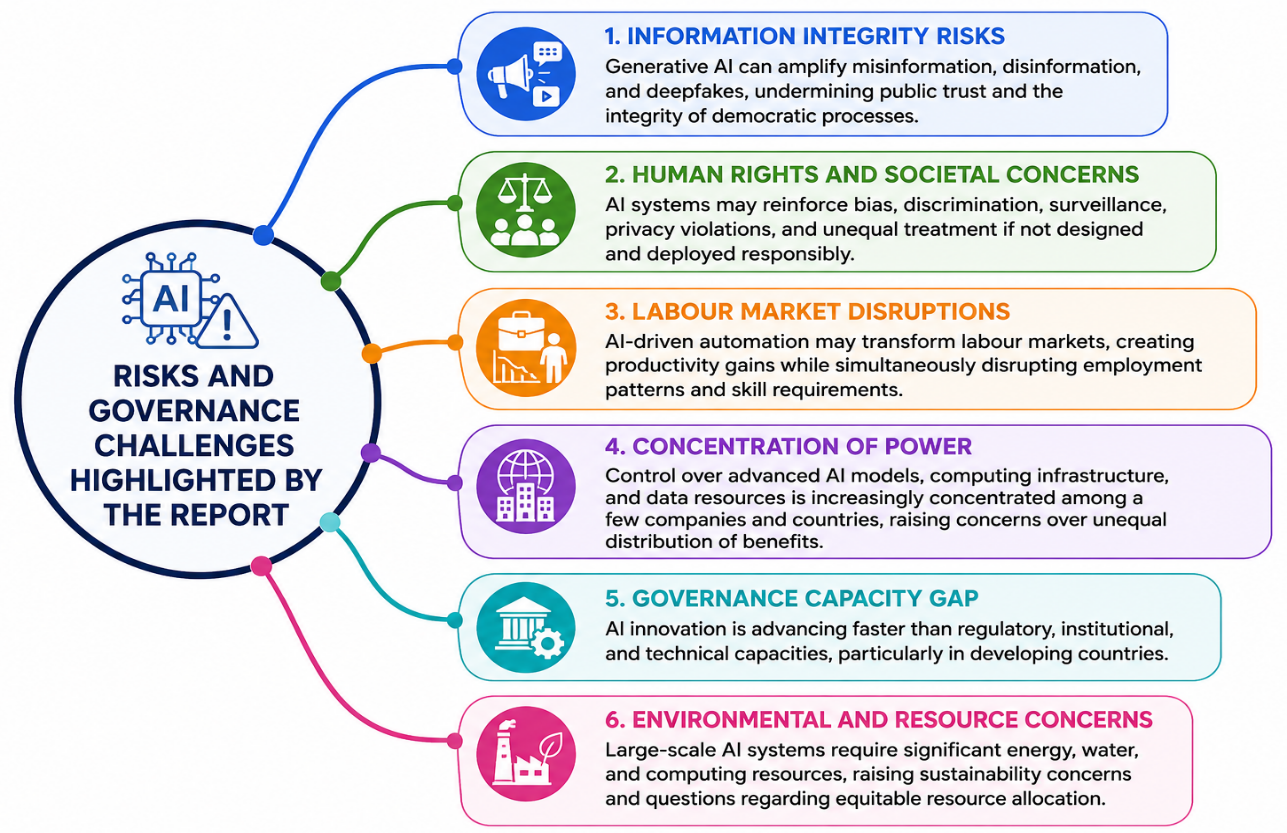
Context: The United Nations' Independent International Scientific Panel on Artificial Intelligence (AI) released its first scientific report on AI, providing a global scientific assessment of AI's capabilities, opportunities, risks, and governance challenges.
More on the News
• The report was prepared by the 40-member Independent International Scientific Panel on AI, co-chaired by Yoshua Bengio and Maria Ressa, to provide an independent scientific assessment of AI.
• It served as the scientific foundation for the inaugural Global Dialogue on AI Governance held in Geneva on 6–7 July 2026.
• The report covers seven thematic dimensions of AI and marks the first in a series of periodic UN assessments, with a comprehensive report expected in 2027.
Key Findings of the UN Scientific Report on AI
• Rapid Advancement in AI Capabilities: AI capabilities in reasoning, coding, content generation, and scientific research are improving at an unprecedented pace.
• AI as a General-Purpose Technology: AI is emerging as a transformative technology with applications across health, education, agriculture, governance, and scientific research.
• Concentration of AI Development: Frontier AI development remains concentrated in a few countries and firms; the US accounts for about 75% of leading AI compute capacity, while China accounts for 15%.
• AI Is Creating a New Development Divide: Countries lacking compute infrastructure, talent, data, and governance capacity risk being left behind in the AI economy.
• Emergence of Agentic AI Systems: AI systems are increasingly capable of autonomous planning and task execution, creating new governance challenges.
• AI Can Accelerate Sustainable Development: Responsible deployment of AI can support the achievement of SDGs in sectors such as health, education, food systems, and climate action.
Relevance of Report Findings for India
• Building AI Compute and Innovation Capacity: The report's emphasis on compute infrastructure and research ecosystems underscores the importance of initiatives such as the IndiaAI Mission, indigenous AI models, and domestic GPU capacity.
• Bridging the AI Capacity Gap: India must strengthen access to high-performance computing, quality datasets, AI talent, and governance capabilities to ensure broad-based participation in the AI economy.
• Leveraging AI for Development: The report's findings align with India's efforts to deploy AI in healthcare, agriculture, education, language technologies, and Digital Public Infrastructure (DPI).
• Voice of the Global South: India's experience with digital public goods and inclusive technology governance positions it to advocate for equitable, development-oriented, and inclusive global AI governance frameworks.
Way Forward
• Bridge the Global AI Capacity Gap: Expand access to compute infrastructure, datasets, technical expertise, and governance capacity, particularly in developing countries.
• Develop Better AI Evaluation Mechanisms: Build independent testing, auditing, benchmarking, and post-deployment monitoring systems for frontier AI models.
• Prepare for Agentic AI Systems: Strengthen oversight mechanisms for increasingly autonomous AI systems capable of independent planning and action.
• Promote Shared Global Evidence Standards: Develop common scientific frameworks and measurement standards to support informed AI governance.
• Deepen International Cooperation: Strengthen multilateral collaboration through UN-led processes to ensure that AI benefits are distributed more equitably across countries.
Khan Global Studies App
With our training programs, learning online can be a very exciting experience. Take the next step toward achieving your professional and personal objectives.


Course Related Query:
Ask Your DoubtsStore Related Query:[email protected]NEET | JEE | CUET
NCERT Books
Resources
We love learning. Through our innovative solutions, we encourage ourselves, our teams, and our Students to grow. We welcome and look for diverse perspectives and opinions because they enhance our decisions. We strive to understand the big picture and how we contribute to the company’s objectives. We approach challenges with optimism and harness the power of teamwork to accomplish our goals. These aren’t just pretty words to post on the office wall. This is who we are. It’s how we work. And it’s how we approach every interaction with each other and our Students.
Come with an open mind, hungry to learn, and you’ll experience unmatched personal and professional growth, a world of different backgrounds and perspectives, and the freedom to be you—every day. We strive to build and sustain diverse teams and foster a culture of belonging. Creating an inclusive environment where every students feels welcome, appreciated, and heard gives us something to feel (really) good about.