Explore All Exams at KGS


All Exams
Explore All Exams at KGS

Khan Sir Courses
Geography I Polity I History | World Map I Indian Map I Economics I Biology

UPSC & State PSC
UPSC I BPSC I UP-PSC I MP-PSC

State Exams
UP I Bihar I MP | Rajasthan

NEET | JEE | CUET
NEET | JEE | CUET

Defence Exams
NDA I CDS I CAPF I AFCAT I SSB I Agniveer

Police Exams
UP SI | Bihar SI | Delhi Police | UP Constable

SSC Exams
CGL I CPO I CHSL I MTS I SSC GD I Delhi Police

Foundation Courses
Physics I Chemistry I Biology I History I Geography I Polity I NCERT I Math I English | Map I Reasoning

Railway Exams
RRB | RPF

Teaching Exams
TET | Teaching | UGC

Banking Exams
SBI | RBI | IBPS

Engineering Exams
Civil | Electrical | Mechanical
UGC NET
UGC NET/JRF
Current Affairs provides you with the best compilation of the Daily Current Affairs taking place across the globe: National, International, Sports, Science and Technology, Banking, Economy, Agreement, Appointments, Ranks, and Report and General Studies

Current Affairs
SYLLABUS
GS-3: Issues of Buffer Stocks and Food Security; Infrastructure: Energy.
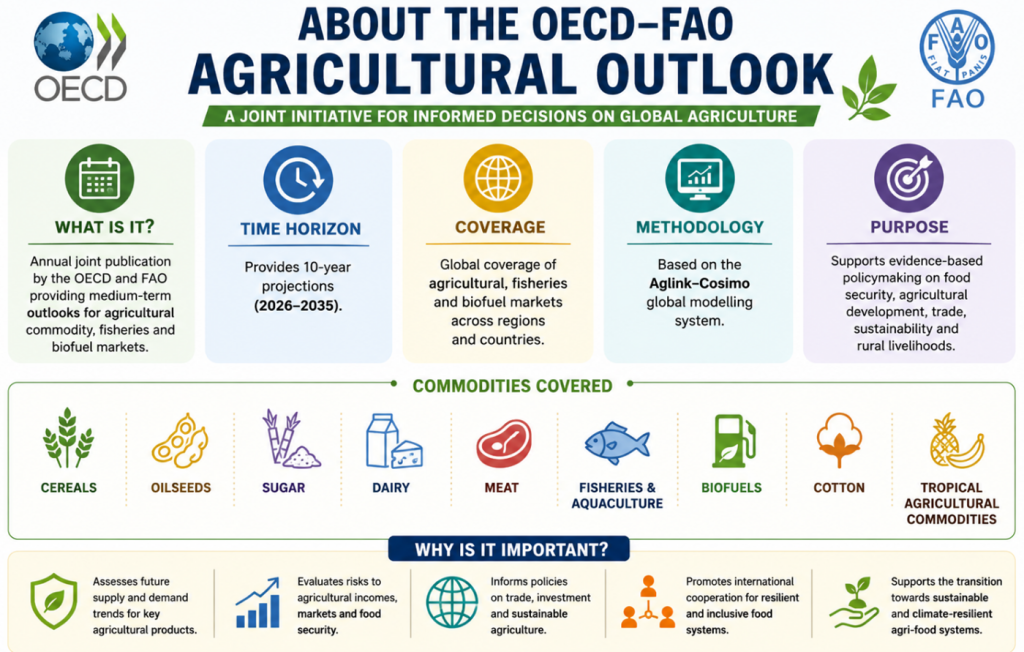
Context: The recently released OECD–FAO Agricultural Outlook 2026–2035 projects sustained growth in global agriculture through productivity gains, while highlighting risks from climate change, income volatility and geopolitical disruptions.
More on the News
• The 22nd edition of the OECD–FAO Agricultural Outlook provides a ten-year assessment of global agricultural commodity, fisheries and biofuel markets from 2026 to 2035.
• The report places special emphasis on Agricultural Labour Productivity and Income Variability, highlighting the need for resilient and inclusive agricultural growth.
• Global agricultural and fish production is projected to increase by around 13% by 2035, while the global population is expected to reach 8.8 billion.
• The Outlook also analyses the potential impact of the 2026 Middle East conflict, warning that higher energy and fertiliser prices could adversely affect agricultural production and food security, particularly in low-income countries.
Key Findings of the OECD–FAO Agricultural Outlook 2026–2035
• Agricultural Production to Grow Through Productivity Gains
• Agricultural Incomes Likely to Improve, but Risks Persist
• Biofuels and Energy Transition to Shape Agricultural Demand
• Evolving Global Food Systems
Challenges and Risks Highlighted by the Report
• Income Volatility and Farmer Vulnerability: Despite projected income growth, farmers—especially in low-income countries—remain highly vulnerable to climate shocks, market fluctuations and input-cost volatility.
• Climate Change and Environmental Sustainability: Direct agricultural emissions are projected to rise by 6.5% by 2035, highlighting the challenge of increasing production while reducing environmental impacts.
• Geopolitical and Input-Cost Risks: Geopolitical disruptions can raise energy and fertiliser prices, increasing production costs and reducing agricultural output, particularly in vulnerable economies.
• Food Security Concerns: Supply-chain disruptions, price volatility and unequal access to resources continue to threaten global food security, especially for low-income populations.
Recommendations
• Promote Productivity-Led Agricultural Growth: Increase investments in agricultural research, innovation, digital technologies and improved farming practices to sustainably raise productivity.
• Strengthen Farmer Resilience: Expand climate-risk insurance, social protection measures and risk-management tools to reduce the impact of income volatility on farmers.
• Advance Sustainable Agriculture: Encourage climate-smart agriculture, efficient resource use and low-emission technologies to decouple production growth from environmental degradation.
• Balance Food and Fuel Objectives: Design biofuel policies that support energy-transition goals while minimizing pressure on food systems, land resources and commodity prices.
Sources :
Down to Earth
Oecd
Khan Global Studies App
With our training programs, learning online can be a very exciting experience. Take the next step toward achieving your professional and personal objectives.



Course Related Query:
Ask Your DoubtsStore Related Query:[email protected]NEET | JEE | CUET
NCERT Books
Resources
We love learning. Through our innovative solutions, we encourage ourselves, our teams, and our Students to grow. We welcome and look for diverse perspectives and opinions because they enhance our decisions. We strive to understand the big picture and how we contribute to the company’s objectives. We approach challenges with optimism and harness the power of teamwork to accomplish our goals. These aren’t just pretty words to post on the office wall. This is who we are. It’s how we work. And it’s how we approach every interaction with each other and our Students.
Come with an open mind, hungry to learn, and you’ll experience unmatched personal and professional growth, a world of different backgrounds and perspectives, and the freedom to be you—every day. We strive to build and sustain diverse teams and foster a culture of belonging. Creating an inclusive environment where every students feels welcome, appreciated, and heard gives us something to feel (really) good about.