Explore All Exams at KGS


All Exams
Explore All Exams at KGS

Khan Sir Courses
Geography I Polity I History | World Map I Indian Map I Economics I Biology

UPSC & State PSC
UPSC I BPSC I UP-PSC I MP-PSC

Judiciary
CLAT

State Exams
UP I Bihar I MP | Rajasthan

NEET | JEE | CUET
NEET | JEE | CUET

Defence Exams
NDA I CDS I CAPF I AFCAT I SSB I Agniveer

Police Exams
UP SI | Bihar SI | Delhi Police | UP Constable

SSC Exams
CGL I CPO I CHSL I MTS I SSC GD I Delhi Police

Foundation Courses
Physics I Chemistry I Biology I History I Geography I Polity I NCERT I Math I English | Map I Reasoning

Railway Exams
RRB | RPF

Teaching Exams
TET | Teaching | UGC

Banking Exams
SBI | RBI | IBPS

Engineering Exams
Civil | Electrical | Mechanical
UGC NET
UGC NET/JRF
Current Affairs provides you with the best compilation of the Daily Current Affairs taking place across the globe: National, International, Sports, Science and Technology, Banking, Economy, Agreement, Appointments, Ranks, and Report and General Studies
Current Affairs
SYLLABUS
GS-1: Important Geophysical Phenomena such as earthquakes, Tsunami, Volcanic activity, cyclones, etc.
GS-3: Disaster and disaster management.
Context: Cyclone Arnab, the first cyclone of 2026 over the North Indian Ocean, made landfall along the Andhra Pradesh–Yanam coast on 28 October 2026 as a very severe cyclonic storm before weakening.
More on the News
• Cyclone Arnab made landfall on 28 October between Bapatla and Visakhapatnam, with sustained winds of 125–135 kmph and gusts up to 150 kmph.
• Originating on 23 October, it intensified into a very severe cyclonic storm by 27 October.
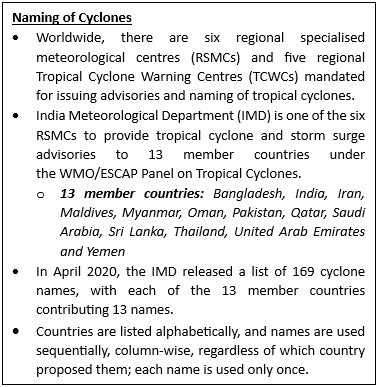
• Bangladesh proposed the name “Arnab”, meaning “ocean” or “sea” in Bengali, under the WMO–UNESCAP regional naming system.
Reasons Behind Cyclone Arnab’s Intensification
• Warm Ocean Waters: Sea surface temperatures of around 26°C or higher, with sufficient heat extending to depths of 50–100 metres, provide energy for tropical cyclone formation and intensification.
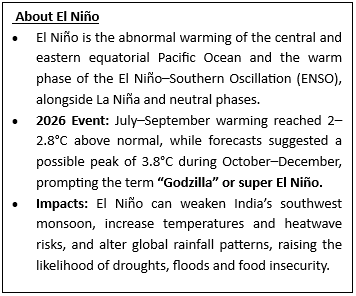
• Influence of El Niño: El Niño alters atmospheric circulation and wind patterns; IMD Director-General Mrutyunjay Mohapatra noted that cyclones during El Niño tend to form closer to the equator and may move towards Andhra Pradesh and Tamil Nadu.
• Favourable Atmospheric and Oceanic Conditions: Wind shear, atmospheric boundary layers, convection, upper-ocean circulation and air–sea interactions collectively influence cyclone intensification, so El Niño alone cannot explain Arnab’s rapid strengthening.
• Rapid Intensification and Precedent: Arnab intensified from a low-pressure system on 23 October to a very severe cyclonic storm by 27 October, while Cyclone Hudhud (2014), which struck Andhra Pradesh during an El Niño year, provides a relevant precedent.
About Tropical Cyclones
• Tropical cyclones are intense low-pressure systems that form over warm ocean waters in tropical regions.
• They are characterised by:
• They form under specific conditions, including:
• These systems are known by different names across regions, such as cyclones in the Indian Ocean, hurricanes in the Atlantic, and typhoons in the Pacific.
• Climate change is influencing cyclone behaviour, leading to greater intensity, rapid intensification, and changing spatial distribution.
• On the basis of wind speed and the degree of potential destruction, Cyclones can be categorized as:
Khan Global Studies App
With our training programs, learning online can be a very exciting experience. Take the next step toward achieving your professional and personal objectives.



Course Related Query:
Ask Your DoubtsStore Related Query:[email protected]NEET | JEE | CUET
NCERT Books
Resources
We love learning. Through our innovative solutions, we encourage ourselves, our teams, and our Students to grow. We welcome and look for diverse perspectives and opinions because they enhance our decisions. We strive to understand the big picture and how we contribute to the company’s objectives. We approach challenges with optimism and harness the power of teamwork to accomplish our goals. These aren’t just pretty words to post on the office wall. This is who we are. It’s how we work. And it’s how we approach every interaction with each other and our Students.
Come with an open mind, hungry to learn, and you’ll experience unmatched personal and professional growth, a world of different backgrounds and perspectives, and the freedom to be you—every day. We strive to build and sustain diverse teams and foster a culture of belonging. Creating an inclusive environment where every students feels welcome, appreciated, and heard gives us something to feel (really) good about.