KGS

All Exams

Explore All Exams at KGS

All Exams
Current Affairs made simple.

Current Affairs provides you with the best compilation of the Daily Current Affairs taking place across the globe: National, International, Sports, Science and Technology, Banking, Economy, Agreement, Appointments, Ranks, and Report and General Studies

Current Affairs

News in Short

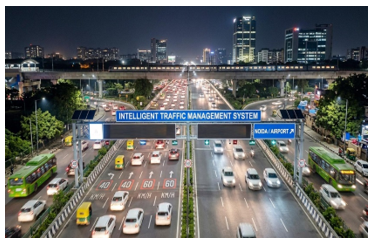
Intelligent Traffic Management System (ITMS) for Delhi

Context: The Cabinet Committee on Economic Affairs (CCEA) has approved implementation of the Intelligent Traffic Management System (ITMS) Project by Delhi Police at an estimated cost of Rs.1,789.52 crore.

About the Intelligent Traffic Management System (ITMS)

  • The ITMS is a technology-led initiative that uses real-time data, artificial intelligence and automated enforcement to manage Delhi's existing road network more intelligently.

Key features:

  • Coverage: 42 identified traffic corridors, with 1,092 Adaptive Traffic Control System (ATCS) locations and 1,029 enforcement locations.
  • Adaptive signals: Signal timings adjust to prevailing traffic and are coordinated along corridors.
  • Emergency priority: Green corridors and priority passage for ambulances and other emergency vehicles.
  • Commuter information: Variable Message Sign boards and digital platforms share updates on congestion, diversions and parking; data may also go to navigation providers.
  • Automated enforcement: Detection of red-light, speeding, wrong-way, helmet, seat belt, illegal parking and mobile phone violations. AI analytics also help identify stolen or blacklisted vehicles, repeat violators and hit-and-run vehicles.
  • Command centres: Traffic Command and Control Centres, backed by Data Centre and Disaster Recovery infrastructure, using open standards and APIs for future expansion.
  • Implementation: Three phases over 24 months, followed by five years of operation and maintenance. Each phase proceeds only after performance evaluation.
    A Master System Integrator, selected through competitive bidding, will execute the project, with C-DAC as Project Management Consultant.

Need and Significance

  • Delhi has about 71 lakh active registered vehicles, and vehicular growth has substantially outpaced road expansion.
  • Traffic regulation still relies heavily on fixed signal timings and manual intervention.
  • ITMS improves use of existing road capacity by responding dynamically to actual road conditions.
  • It is expected to mean smoother traffic, safer roads, faster incident response, consistent enforcement and more predictable travel for commuters.

Times Higher Education (THE) World University Rankings 2027

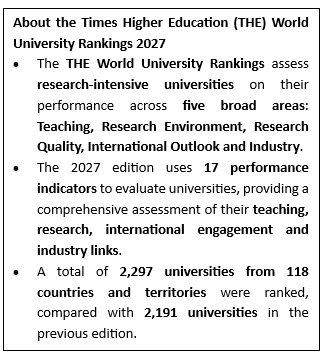
Context: The Times Higher Education (THE) World University Rankings 2027, ranked 2,297 universities across 118 countries and territories, making it the largest edition so far.

Key findings
Global:

  • University of Oxford retained the No. 1 position for the 11th consecutive year, followed by MIT, with only a 0.1-point gap between them.
  • Tsinghua University rose to 11th, becoming Asia’s highest-ranked institution, while Peking University ranked 13th and NUS 15th. Thus, Asia secured three universities in the global top 15 for the first time.
  • Asia recorded 40 universities in the global top 200, five more than last year, while Malaysia entered the top 200 for the first time.
  • China increased its top-200 representation from 13 to 17 universities, reflecting the growing presence of Asian institutions in global higher education.

India’s findings:

  • India had 143 universities in the rankings, 15 more than last year, making it the most represented country in Asia for the second consecutive year.
  • IISc Bengaluru was India’s highest-ranked institution at 254th globally, with an overall score of 57.0.
  • Its strongest indicator was Research Environment (98.0), followed by Teaching (62.1) and Research Quality (58.6).
  • Other leading Indian institutions were Saveetha (326–350), Shoolini (451–500), Jamia Millia Islamia and KIIT (501–550).
  • SRM University-A.P. debuted in the 1001–1200 band in its first participation.

India–Japan UNICORN Agreement

Context: Japan has urged India to fast-track its internal processing of the UNICORN (Unified Complex Radio Antenna) agreement, highlighting its importance for advancing bilateral defence technology cooperation.

About the UNICORN (Unified Complex Radio Antenna) Naval Radar System
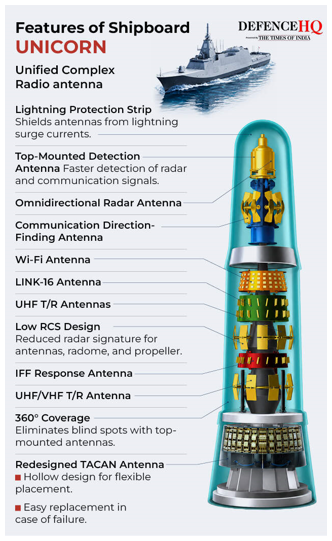
  • UNICORN is an advanced integrated naval antenna mast, also known as the NORA-50 integrated mast.
  • It was developed by Japanese companies including NEC Corporation, Sampa Kogyo K.K. and Yokohama Rubber Co. Ltd.
  • The system is designed to integrate multiple communication, surveillance and electronic systems into a single enclosed mast.

Key Features

  • It consolidates multiple antennas into one structure, reducing the radar cross-section and electromagnetic signature of warships.
  • The mast integrates systems for tactical data links, communications, Tactical Air Navigation System (TACAN), Identification Friend or Foe (IFF) and Electronic Support Measures (ESM).
  • Its integrated design improves space efficiency, electromagnetic compatibility and system maintainability.
  • The mast uses a Fibre Reinforced Plastic (FRP) radome and includes a lightning-diverter arrangement to improve protection and reliability at sea.
  • UNICORN is currently associated with Japan’s Mogami-class frigates.

Strategic Significance:

  • The system can enhance the stealth and survivability of naval platforms by making them harder to detect and track.
  • It represents access to advanced Japanese naval technology and supports India’s efforts towards indigenous naval modernisation.

India–Japan Agreement on UNICORN

  • India and Japan signed a Memorandum of Implementation (MoI) on 15 November 2024 for the co-development of UNICORN masts for Indian Navy ships.
  • It represents the first defence equipment co-development/co-production project between India and Japan.
  • Japan will provide design expertise and technology, while Bharat Electronics Limited (BEL) will undertake manufacturing and system integration in India.
  • The project supports Make in India by promoting domestic manufacturing, technology absorption and strengthening India’s defence-industrial capabilities.

Khan Global Studies App

The most trusted learning platform on your phone

With our training programs, learning online can be a very exciting experience. Take the next step toward achieving your professional and personal objectives.


Download on the App StoreGet it on Google Play
KGS learning dashboard and mobile application
logo
Khan Global Studies Pvt. Ltd. 5th Floor,
A13A, Graphix 1 Tower B, Sector 62,
Noida, Uttar Pradesh 201309

Course Related Query:

Ask Your DoubtsStore Related Query:[email protected]

Get Free Academic Counseling & Course Details

KGS best learning platform

About Khan Global Studies

We love learning. Through our innovative solutions, we encourage ourselves, our teams, and our Students to grow. We welcome and look for diverse perspectives and opinions because they enhance our decisions. We strive to understand the big picture and how we contribute to the company’s objectives. We approach challenges with optimism and harness the power of teamwork to accomplish our goals. These aren’t just pretty words to post on the office wall. This is who we are. It’s how we work. And it’s how we approach every interaction with each other and our Students.


What Makes Us Different

Come with an open mind, hungry to learn, and you’ll experience unmatched personal and professional growth, a world of different backgrounds and perspectives, and the freedom to be you—every day. We strive to build and sustain diverse teams and foster a culture of belonging. Creating an inclusive environment where every students feels welcome, appreciated, and heard gives us something to feel (really) good about.

©Copyright 2026 KhanGlobalStudies