Explore All Exams at KGS


All Exams
Explore All Exams at KGS

Khan Sir Courses
Geography I Polity I History | World Map I Indian Map I Economics I Biology

UPSC & State PSC
UPSC I BPSC I UP-PSC I MP-PSC

State Exams
UP I Bihar I MP | Rajasthan

NEET | JEE | CUET
NEET | JEE | CUET

Defence Exams
NDA I CDS I CAPF I AFCAT I SSB I Agniveer

Police Exams
UP SI | Bihar SI | Delhi Police | UP Constable

SSC Exams
CGL I CPO I CHSL I MTS I SSC GD I Delhi Police

Foundation Courses
Physics I Chemistry I Biology I History I Geography I Polity I NCERT I Math I English | Map I Reasoning

Railway Exams
RRB | RPF

Teaching Exams
TET | Teaching | UGC

Banking Exams
SBI | RBI | IBPS

Engineering Exams
Civil | Electrical | Mechanical
UGC NET
UGC NET/JRF
Current Affairs provides you with the best compilation of the Daily Current Affairs taking place across the globe: National, International, Sports, Science and Technology, Banking, Economy, Agreement, Appointments, Ranks, and Report and General Studies
Current Affairs
SYLLABUS
GS-2: Issues relating to development and management of Social Sector/Services relating to Health, Education, Human Resources.
GS-2: Government policies and interventions for development in various sectors and issues arising out of their design and implementation.
Context: Launched on 2 October 2014, the Swachh Bharat Mission (SBM) marks 12 years of India’s sanitation transformation, from achieving ODF status to sustainable sanitation, waste management and behavioural change.
About the Swachh Bharat Mission (SBM)
• The SBM was launched on 2 October 2014 to achieve universal sanitation and make India Open Defecation Free (ODF) by 2019.
• It operates through two components: SBM-Grameen (SBM-G) for rural areas and SBM-Urban (SBM-U) for urban areas.
• SBM-G Phase I (2014–2019) focused on expanding toilet access and usage.
• SBM-G Phase II (2020–21 to 2026–27) shifted the focus from achieving ODF status to sustaining ODF behaviour and achieving ODF Plus through solid and liquid waste management (SLWM), visual cleanliness and community participation.
• SBM-U 2.0, launched on 1 October 2021, seeks to make cities Garbage Free through source segregation, door-to-door collection, scientific processing of waste, safe disposal and remediation of legacy dumpsites, while continuing efforts on safe sanitation.
• It places Social and Behaviour Change Communication (SBCC) at its centre, using Swachhagrahis, community mobilisation, digital platforms and citizen feedback to make sanitation an everyday practice.
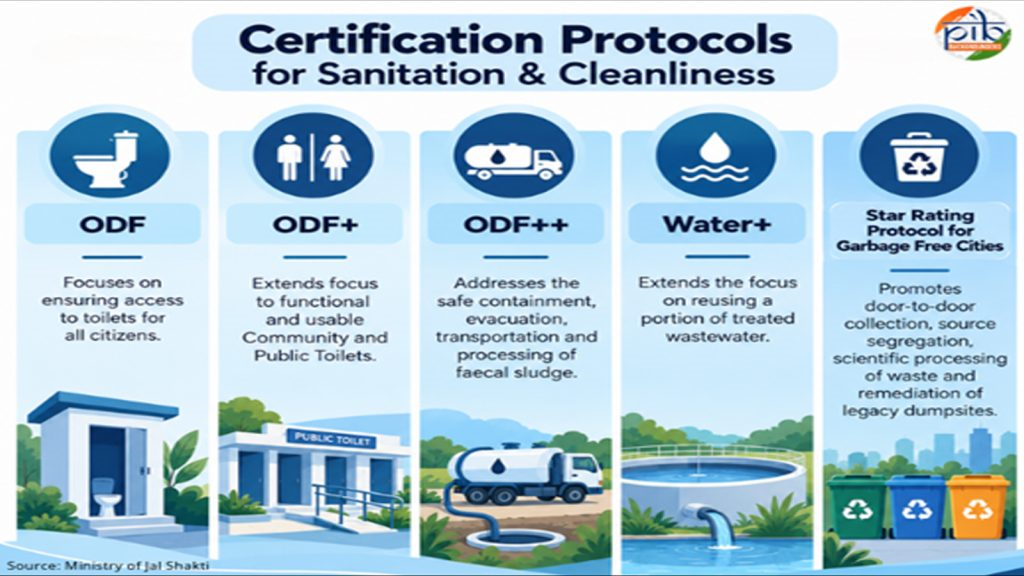
• It also uses outcome-based standards such as ODF, ODF+, ODF++, Water+ and the Star Rating Protocol for Garbage-Free Cities to assess and sustain results.
Key Achievements
• Rural ODF Plus: By September 2026, over 5.69 lakh villages achieved ODF Plus, including 5.25 lakh+ ODF Plus Model villages, with 5.38 lakh+ having solid and 5.65 lakh+ liquid waste management.
• Sanitation infrastructure: Over 12.22 crore household toilets and 98,273 biogas plants were built, including 1,314 GOBARdhan plants across 585 districts.
• Urban sanitation: SBM-U built 63.83 lakh household latrines and 6.36 lakh community/public toilet seats, exceeding mission targets.
• Urban waste management: Waste processing rose from 16% in 2014 to 81–82% in 2026, while door-to-door collection reached 97–98%.
• Health and dignity: WHO estimated nearly 3 lakh fewer diarrhoeal deaths in 2019 than in 2014, while 93% of women felt safer, 91% saved up to an hour, and 93% stopped restricting food or water intake.
Need and Significance of SBM
• Public health: Safe sanitation reduces exposure to diarrhoeal diseases, groundwater contamination and unsafe waste.
• Women’s safety and dignity: Access to toilets improves Suraksha, Suvidha and Swabhimaan by reducing risks, inconvenience and restrictions faced by women.
• Environmental sustainability: SBM has expanded from toilet construction to source segregation, solid and liquid waste management, sewage treatment, plastic-waste management and resource recovery.
• Behavioural change: SBCC, Swachhagrahis, Nigrani Samitis, Gram Sabhas and campaigns such as Swachhata Hi Seva have helped shift sanitation from an individual concern to collective responsibility.
• Inclusive and dignified sanitation: Modern public facilities increasingly incorporate women’s, children’s and persons with disabilities’ needs, while attention to SafaiMitras links sanitation with occupational safety and dignity.
Gaps or Challenges in SBM
• Sustaining ODF outcomes: ODF status needs continued toilet use, maintenance, community engagement and monitoring to prevent slippage.
• Waste segregation and collection gaps: Only 39.9% of surveyed households segregated waste, while 45% of villages had waste-collection vehicles and 29.4% had storage and segregation sheds.
• Uneven infrastructure functionality: Only 61.4% of Plastic Waste Management Units and 58.5% of GOBARdhan/biogas plants surveyed in 2023–24 were functional.
• Legacy waste management: By January 2026, 2,488 dumpsites held nearly 25 crore tonnes of legacy waste; although 62% was remediated, completing remediation and preventing new dumpsites remain challenges.
• Wastewater and faecal-sludge management: Sanitation must ensure the safe containment, transport, treatment and disposal/reuse of sewage, greywater and faecal sludge, especially in smaller urban areas.
Khan Global Studies App
With our training programs, learning online can be a very exciting experience. Take the next step toward achieving your professional and personal objectives.


Course Related Query:
Ask Your DoubtsStore Related Query:[email protected]NEET | JEE | CUET
NCERT Books
Resources
We love learning. Through our innovative solutions, we encourage ourselves, our teams, and our Students to grow. We welcome and look for diverse perspectives and opinions because they enhance our decisions. We strive to understand the big picture and how we contribute to the company’s objectives. We approach challenges with optimism and harness the power of teamwork to accomplish our goals. These aren’t just pretty words to post on the office wall. This is who we are. It’s how we work. And it’s how we approach every interaction with each other and our Students.
Come with an open mind, hungry to learn, and you’ll experience unmatched personal and professional growth, a world of different backgrounds and perspectives, and the freedom to be you—every day. We strive to build and sustain diverse teams and foster a culture of belonging. Creating an inclusive environment where every students feels welcome, appreciated, and heard gives us something to feel (really) good about.