Explore All Exams at KGS


All Exams
Explore All Exams at KGS

Khan Sir Courses
Geography I Polity I History | World Map I Indian Map I Economics I Biology

UPSC & State PSC
UPSC I BPSC I UP-PSC I MP-PSC

Judiciary
CLAT

State Exams
UP I Bihar I MP | Rajasthan

NEET | JEE | CUET
NEET | JEE | CUET

Defence Exams
NDA I CDS I CAPF I AFCAT I SSB I Agniveer

Police Exams
UP SI | Bihar SI | Delhi Police | UP Constable

SSC Exams
CGL I CPO I CHSL I MTS I SSC GD I Delhi Police

Foundation Courses
Physics I Chemistry I Biology I History I Geography I Polity I NCERT I Math I English | Map I Reasoning

Railway Exams
RRB | RPF

Teaching Exams
TET | Teaching | UGC

Banking Exams
SBI | RBI | IBPS

Engineering Exams
Civil | Electrical | Mechanical
UGC NET
UGC NET/JRF
Current Affairs provides you with the best compilation of the Daily Current Affairs taking place across the globe: National, International, Sports, Science and Technology, Banking, Economy, Agreement, Appointments, Ranks, and Report and General Studies
Current Affairs
SYLLABUS
GS-2: Issues relating to poverty and hunger.
GS-3: Inclusive growth and issues arising from it.
Context: According to the World Bank’s October 2026 Poverty and Equity Brief, India’s poverty rate declined from 57.7% in 2011 to 16.1% in 2023, lifting an estimated 49.6 crore people above the lower-middle-income poverty threshold.
About the World Bank’s Poverty and Equity Brief
• The Poverty and Equity Brief (PEB) is published by the World Bank twice a year, during its Spring and Annual Meetings with the International Monetary Fund (IMF).
• It provides a country-wise overview of poverty, shared prosperity and inequality trends across more than 100 developing countries.
• It presents key indicators covering monetary poverty, multidimensional poverty, poverty levels and income inequality.
• It uses internationally comparable poverty thresholds based on Purchasing Power Parity (PPP):
• It also uses the Multidimensional Poverty Measure (MPM) and Gini Index to assess non-monetary deprivation and income inequality.
Key Findings of the World Bank’s Poverty and Equity Brief
• Decline in Poverty:
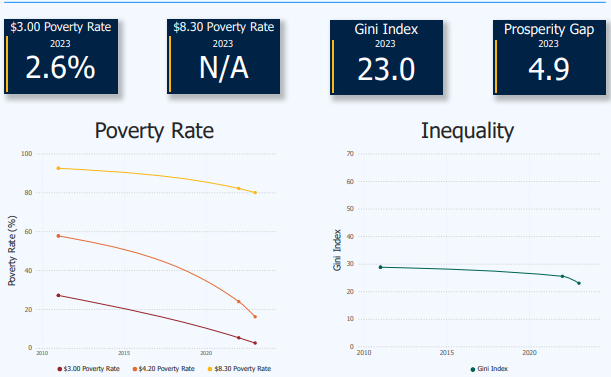
• Reduction in Multidimensional Poverty: OPHI's MPI-based poverty declined from 53.8% (2005–06) to 16.4% (2019–21).
• Major Drivers of Poverty Reduction: Rising consumption, household incomes and employment, particularly among rural women.
• Employment and Labour Market Trends: Employment increased by 13.4 crore (2017–2023), nearly twice the growth of the working-age population.
• Wage Inequality and Vulnerable Households: Median earnings of the top 10% of workers were 13 times those of the bottom 10% in 2023.
• Regional and Social Distribution of Poverty:
• Future Poverty Projections: Poverty at the $4.20/day threshold is projected to decline:
Khan Global Studies App
With our training programs, learning online can be a very exciting experience. Take the next step toward achieving your professional and personal objectives.


Course Related Query:
Ask Your DoubtsStore Related Query:[email protected]NEET | JEE | CUET
NCERT Books
Resources
We love learning. Through our innovative solutions, we encourage ourselves, our teams, and our Students to grow. We welcome and look for diverse perspectives and opinions because they enhance our decisions. We strive to understand the big picture and how we contribute to the company’s objectives. We approach challenges with optimism and harness the power of teamwork to accomplish our goals. These aren’t just pretty words to post on the office wall. This is who we are. It’s how we work. And it’s how we approach every interaction with each other and our Students.
Come with an open mind, hungry to learn, and you’ll experience unmatched personal and professional growth, a world of different backgrounds and perspectives, and the freedom to be you—every day. We strive to build and sustain diverse teams and foster a culture of belonging. Creating an inclusive environment where every students feels welcome, appreciated, and heard gives us something to feel (really) good about.