Explore All Exams at KGS


All Exams
Explore All Exams at KGS

Khan Sir Courses
Geography I Polity I History | World Map I Indian Map I Economics I Biology

UPSC & State PSC
UPSC I BPSC I UP-PSC I MP-PSC

State Exams
UP I Bihar I MP | Rajasthan

NEET | JEE | CUET
NEET | JEE | CUET

Defence Exams
NDA I CDS I CAPF I AFCAT I SSB I Agniveer

Police Exams
UP SI | Bihar SI | Delhi Police | UP Constable

SSC Exams
CGL I CPO I CHSL I MTS I SSC GD I Delhi Police

Foundation Courses
Physics I Chemistry I Biology I History I Geography I Polity I NCERT I Math I English | Map I Reasoning

Railway Exams
RRB | RPF

Teaching Exams
TET | Teaching | UGC

Banking Exams
SBI | RBI | IBPS

Engineering Exams
Civil | Electrical | Mechanical
UGC NET
UGC NET/JRF
Current Affairs provides you with the best compilation of the Daily Current Affairs taking place across the globe: National, International, Sports, Science and Technology, Banking, Economy, Agreement, Appointments, Ranks, and Report and General Studies

Current Affairs
SYLLABUS
GS-2: Indian Constitution—Amendments, Significant Provisions and Basic Structure; Structure, Organization and Functioning of the Judiciary; Appointment to various Constitutional Posts, Powers, Functions and Responsibilities of various Constitutional Bodies.
Context: The Lok Sabha has passed the Supreme Court (Number of Judges) Amendment Bill, 2026, increasing the sanctioned strength of the Supreme Court from 34 to 38 judges, including the Chief Justice of India.
More on the News
• The Bill replaces the Supreme Court (Number of Judges) Amendment Ordinance, 2026, promulgated by the President in May 2026, after the Union Cabinet approved the proposal on 5 May 2026.
• It amends the Supreme Court (Number of Judges) Act, 1956 by increasing the number of judges from 33 to 37 (excluding the Chief Justice of India), thereby raising the total sanctioned strength to 38 judges.
• The Government stated that the increase in judicial strength is aimed at addressing the growing backlog of cases, improving docket management, and enabling faster disposal of matters, particularly Constitution Bench cases.
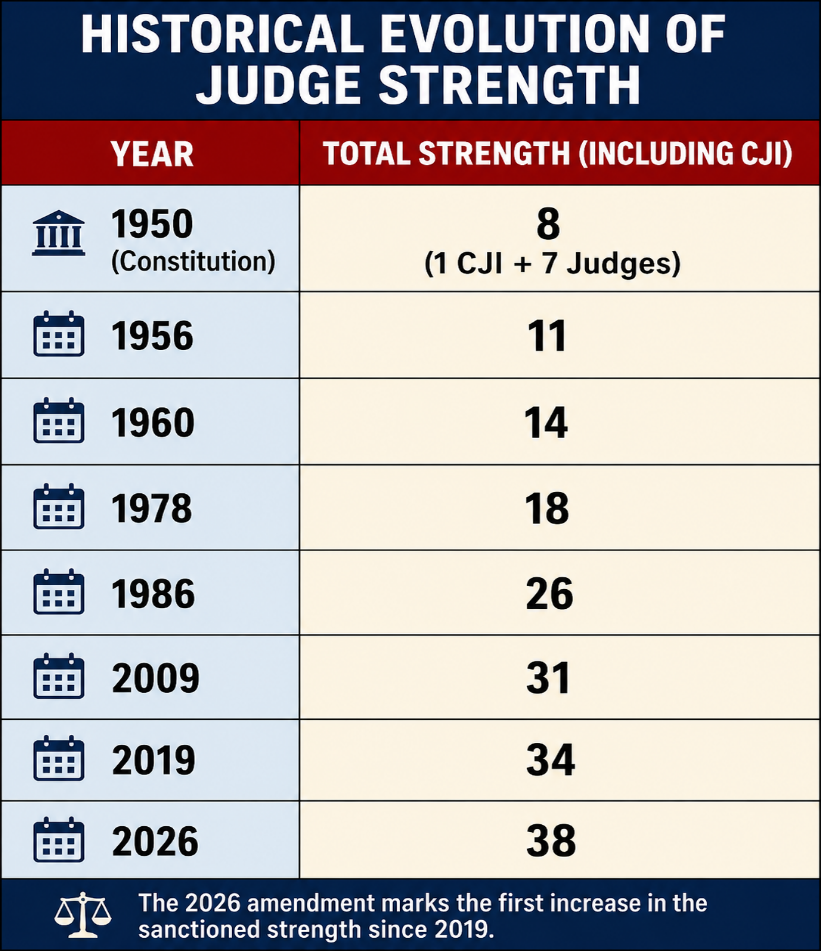
Constitutional and Legal Framework
• Article 124 of the Constitution establishes the Supreme Court of India.
• Parliament enacted the Supreme Court (Number of Judges) Act, 1956 to prescribe the maximum sanctioned strength of the Supreme Court.
Rationale Behind the Increase
• Rising Pendency of Cases: 92,101 cases were pending before the Supreme Court. The Court has experienced a persistent gap between the institution of new cases and their disposal.
• Growing Litigation: During 2025, the Supreme Court received 75,410 fresh cases but disposed of only 65,615 cases, resulting in a continued increase in pending matters.
• Improving Docket Management: A larger judicial strength is expected to improve the Court's ability to manage its growing docket, particularly long-pending matters.
• Constitution Bench Requirements: Many constitutional and nationally significant cases require Benches of five or more judges. Increasing the number of judges would facilitate the constitution of more Constitution Benches without affecting regular judicial work.
• Strengthening Judicial Capacity: The Government considers increasing the sanctioned strength as one of the most immediate and practical measures to enhance judicial efficiency and ensure timely justice.
Significance / Implications of the Move
• Reduction in Case Backlog: Additional judges are expected to accelerate the disposal of pending cases and reduce delays in the justice delivery system.
• Timely Access to Justice: Faster adjudication will strengthen citizens' access to speedy justice, an essential component of the rule of law.
• More Effective Constitution Benches: The enhanced strength will enable the Supreme Court to constitute more Constitution Benches while maintaining the disposal of routine cases.
• Improved Judicial Efficiency: Greater judicial capacity is likely to improve overall docket management and reduce the gap between new filings and case disposal.
• Strengthening the Justice Delivery System: The amendment reinforces institutional capacity without requiring constitutional changes and supports a more responsive and efficient judiciary.
Khan Global Studies App
With our training programs, learning online can be a very exciting experience. Take the next step toward achieving your professional and personal objectives.




Course Related Query:
Ask Your DoubtsStore Related Query:[email protected]NEET | JEE | CUET
NCERT Books
Resources
We love learning. Through our innovative solutions, we encourage ourselves, our teams, and our Students to grow. We welcome and look for diverse perspectives and opinions because they enhance our decisions. We strive to understand the big picture and how we contribute to the company’s objectives. We approach challenges with optimism and harness the power of teamwork to accomplish our goals. These aren’t just pretty words to post on the office wall. This is who we are. It’s how we work. And it’s how we approach every interaction with each other and our Students.
Come with an open mind, hungry to learn, and you’ll experience unmatched personal and professional growth, a world of different backgrounds and perspectives, and the freedom to be you—every day. We strive to build and sustain diverse teams and foster a culture of belonging. Creating an inclusive environment where every students feels welcome, appreciated, and heard gives us something to feel (really) good about.