KGS

All Exams

Explore All Exams at KGS

All Exams
Current Affairs made simple.

Current Affairs provides you with the best compilation of the Daily Current Affairs taking place across the globe: National, International, Sports, Science and Technology, Banking, Economy, Agreement, Appointments, Ranks, and Report and General Studies

Current Affairs

News in Short

Govt notifies grievance redressal rules under VB-G RAM G

Context: The Ministry of Rural Development has notified the Grievance Redressal Rules, 2026, under the Viksit Bharat Guarantee for Rozgar and Ajeevika Mission (Gramin) (VB-G RAM G), establishing a time-bound mechanism to address complaints related to the scheme.

Key Provisions

  • Multi-tier Mechanism: State Governments will establish grievance redressal mechanisms at Gram Panchayat, Block and District levels, with designated Grievance Redressal Officers.
  • Multiple Channels: Complaints can be submitted in person, through Speed Post, digital platforms, telephone helplines and other State-approved modes.
  • Mandatory Registration: No grievance can be rejected due to its format, language, submission method or procedural deficiencies.Physical complaints must be digitally registered on the same day or by the next working day.
  • Time-bound Resolution: Enquiries must be completed within 7 working days, and grievances resolved within 15 days of receipt.
  • Accountability: Acknowledgements, findings and action taken must be recorded and communicated to complainants.Unresolved grievances will be escalated to higher authorities and digitally monitored.
  • Appeals: Provision for appeals is governed by Schedule I of the VB-G RAM G Act, 2025. ‘
  • Changes from Draft Rules: The final rules dropped provisions mandating FIR registration in cases of prima facie financial irregularities and placing action-taken reports before Panchayat meetings.

About the VB-G RAM G Scheme

  • Legal Framework: The VB-G RAM G Act, 2025, replaces MGNREGA and aligns rural employment with the vision of Viksit Bharat @2047.
  • Employment Guarantee: Increases guaranteed employment from 100 to 125 days per rural household annually, with a 60-day no-work period during peak agricultural seasons.
  • Four Priority Areas: Water security, core rural infrastructure, livelihood-related infrastructure and extreme weather mitigation.
  • Decentralised Planning: Works are planned through Viksit Gram Panchayat Plans and integrated into the Viksit Bharat National Rural Infrastructure Stack.
  • Implementation: Effective nationwide from 1 July 2026.

Exposition of the Sacred Relics of Shakyamuni Buddha

Context: The sacred relics of Shakyamuni Buddha are being exhibited at Thubchog Gatsel Ling (TGL) Monastery (Lower Gompa), Bomdila, Arunachal Pradesh, where 11,969 devotees visited during the first two days of the exposition (November 8–9, 2026).

Shakyamuni Buddha

  • Original Name: Siddhartha Gautama, also known as Shakyamuni, meaning the Sage of the Shakya clan. He was born around 2,500 years ago at Lumbini (present-day Nepal) to King Suddhodana and Queen Maya.
  • Renunciation: Born into a royal family, he became deeply concerned about human suffering after witnessing four realities: birth, old age, sickness and death.At the age of 29, he renounced worldly life in search of liberation from suffering.
  • Enlightenment: After practising severe asceticism for several years, he rejected self-mortification and meditated under a Peepal tree at Bodh Gaya, Bihar, where he attained enlightenment.Thereafter, he became known as the Buddha, meaning the Awakened One.
  • Teachings: He delivered his first sermon at Sarnath and spent around 45 years spreading his teachings across the Indian subcontinent, emphasising wisdom, compassion and liberation from suffering.
  • Mahaparinirvana: He attained Mahaparinirvana at Kushinagar, Uttar Pradesh, at approximately 80 years of age.His disciples preserved his teachings in Buddhist scriptures known as Sutras.

India–Myanmar Joint Tri-Services HADR Exercise ‘RAHAT MITRA’

Context: India and Myanmar concluded their first bilateral Tri-Services Humanitarian Assistance and Disaster Relief (HADR) Exercise, ‘RAHAT MITRA’, in Chennai on November 6, 2026, to strengthen joint disaster response capabilities and operational interoperability.

About the Exercise ‘RAHAT MITRA’

  • Participants: Personnel from the Indian Army, Navy and Air Force, along with a delegation from the Myanmar Defence Forces.
  • Centred on the theme ‘Together for Humanity, Stronger through Partnership’, the exercise aims to strengthen bilateral cooperation, foster mutual trust and enhance coordination between the Defence Forces of both nations.
  • Duration: Two-day exercise conducted on November 5–6, 2026.
  • Day 1: A Table-Top Exercise (TTX) based on a severe cyclone scenario focused on joint planning and disaster management protocols.Demonstrations included obstacle clearance and bridge-laying by the Indian Army, along with a visit to INS Sukanya to understand shipborne HADR capabilities.
  • Day 2: Demonstrations covered multi-domain disaster response across land, maritime and air domains, including:
  • Shore-based response and communication infrastructure at INS Adyar and Communication Network Centre, Chennai.
  • Field medical triage and disaster relief camps at Military Hospital, Chennai.
  • Flood relief capabilities of Navy's Flood Relief Teams.
  • Maritime Search and Rescue involving a Chetak helicopter and INS Bitra.
  • Casualty evacuation by the Indian Air Force using an Advanced Light Helicopter (ALH).

National Entrepreneurship Day

Context: National Entrepreneurship Day is observed annually on 9 November to recognise the role of entrepreneurship in promoting innovation, employment generation and India's journey towards Viksit Bharat @2047.

About the National Entrepreneurship Day
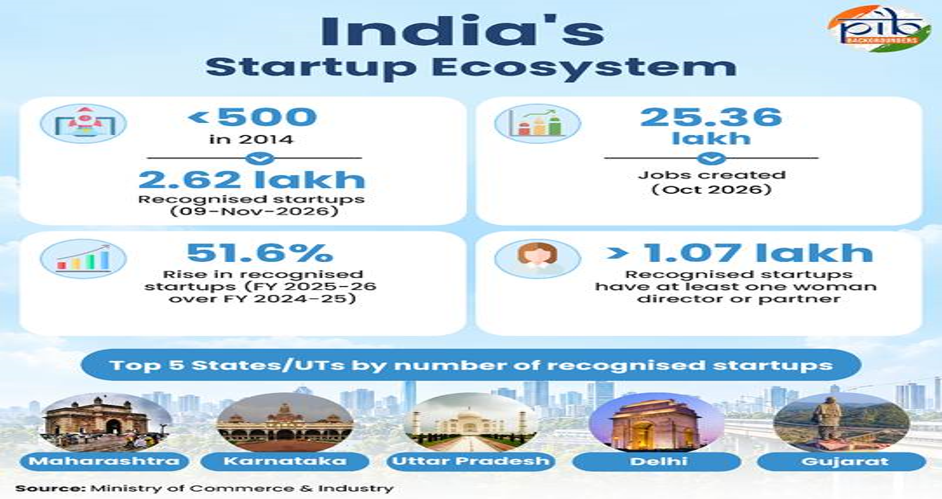
  • The Ministry of Skill Development and Entrepreneurship was established on 9 November 2014, and the day highlights the importance of entrepreneurship in India's development.
  • Startup Ecosystem: India has emerged as the world's third-largest startup ecosystem, with over 2.62 lakh DPIIT-recognised startups as of November 2026, compared to fewer than 500 in 2014.
  • Employment Generation: Startups have created over 25 lakh jobs up to October 2026. More than 55,200 startups were recognised in FY 2025–26, the highest in a single year since 2016.
  • Women Entrepreneurship: Over 1.07 lakh recognised startups (approximately 48%) have at least one woman director or partner.
  • Geographical Expansion: Nearly 52% of recognised startups originate from Tier-II and Tier-III cities, reflecting the expansion of entrepreneurship beyond metropolitan areas.Rural entrepreneurship is also growing through initiatives such as the Start-up Village Entrepreneurship Programme (SVEP), which supported 4.32 lakh rural enterprises by June 2026.
  • Major Government Initiatives: Startup India, Fund of Funds for Startups (FFS), Credit Guarantee Scheme for Startups (CGSS), Startup India Seed Fund Scheme (SISFS), Atal Innovation Mission, Pradhan Mantri Mudra Yojana (PMMY), PMEGP, MeitY Startup Hub and Swavalambini Scheme.

Khan Global Studies App

The most trusted learning platform on your phone

With our training programs, learning online can be a very exciting experience. Take the next step toward achieving your professional and personal objectives.


Download on the App StoreGet it on Google Play
KGS learning dashboard and mobile application
logo
Khan Global Studies Pvt. Ltd. 5th Floor,
A13A, Graphix 1 Tower B, Sector 62,
Noida, Uttar Pradesh 201309

Course Related Query:

Ask Your DoubtsStore Related Query:[email protected]

Get Free Academic Counseling & Course Details

KGS best learning platform

About Khan Global Studies

We love learning. Through our innovative solutions, we encourage ourselves, our teams, and our Students to grow. We welcome and look for diverse perspectives and opinions because they enhance our decisions. We strive to understand the big picture and how we contribute to the company’s objectives. We approach challenges with optimism and harness the power of teamwork to accomplish our goals. These aren’t just pretty words to post on the office wall. This is who we are. It’s how we work. And it’s how we approach every interaction with each other and our Students.


What Makes Us Different

Come with an open mind, hungry to learn, and you’ll experience unmatched personal and professional growth, a world of different backgrounds and perspectives, and the freedom to be you—every day. We strive to build and sustain diverse teams and foster a culture of belonging. Creating an inclusive environment where every students feels welcome, appreciated, and heard gives us something to feel (really) good about.

©Copyright 2026 KhanGlobalStudies